
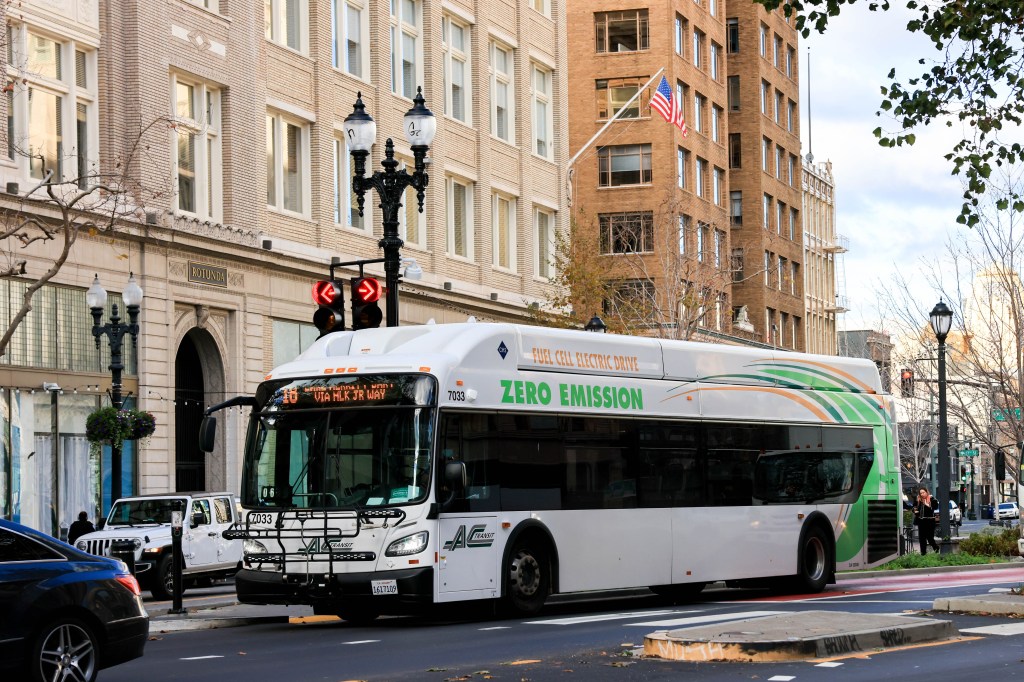
As rising gas prices cause more pain at the pump, thousands of East Bay commuters who ride AC Transit may face significant reductions next year after the Board of Directors approved developing contingency plans to address an expected $50 million deficit in 2027.
While cuts have not yet been officially decided, a worst-case scenario would reduce bus service by as much as 16.4%, lay off 300 employees and reduce supplemental services for East Bay Paratransit riders and 4,200 East Bay students who use the bus to get to and from school each day.
“We are all working together as one Bay Area, each and every transit agency, to try to become more efficient and effective and be able to have people rely on us,” said Diane Shaw, president of the agency’s Board of Directors. “It’s next fiscal year where we’ll have to do something if we don’t find sustainable funding going forward.”
AC Transit’s budget deficit is a combination of declining revenues, rising operating costs, and the expiration of pandemic-era financial support, Shaw said. Ridership has been lower since the pandemic and is only 85% of 2019 pre-pandemic levels, according to agency reports.
In addition, long-term structural deficits at AC Transit – including the rising costs of employees, bus maintenance, and fuel – have pushed the transit agency toward a fiscal cliff, according to budget documents.
“These are the unavoidable costs of keeping the buses on the road,” Shaw, who represents Ward 5, said.
Next year, AC Transit’s budget deficit will be $50 million.
The state of California threw a temporary lifeline to the agency this February when the legislature authorized a $590 million emergency loan to the Metropolitan Transportation Commission to support the Bay Area’s four major transit agencies in fiscal year 2026-27. While loan funding was primarily focused on BART, AC Transit received $55 million.
But it’s only a short-term fix for AC Transit. The Board of Directors last week approved the development of two contingency plans.
The first option would reduce service by 11.4% and lay off approximately 200 employees. The second would reduce service by 16.4% and terminate 300 employees, according to AC Transit documents.
The cuts could have effects beyond just the East Bay’s bus system, according to Metropolitan Transportation Commission spokesperson John Goodwin. The region’s transit systems are an ecosystem of transit hubs and connections, stitched together by buses and commuter rail to move hundreds of thousands of passengers a day.
“BART is made stronger by AC Transit feeding its passengers. And AC Transit is made stronger in turn by BART feeding its passengers,” Goodwin said.
When a transit agency breaks down, others can step up in its place; like a house of cards that lean on each other for support. If too many load-bearing cards are taken away, the tower crumbles and the overall transportation quality tanks, Goodwin said.
“There are certain transportation corridors where the impact will be obvious, and we have proof of that. Most notably, the Bay Bridge corridor and its approaches between the inner East Bay and San Francisco,” said Goodwin. “When there were BART outages last year, the proof was in the pudding, immediately.”
Proposed cuts would be specifically devastating for the disabled community. Shaw said the East Bay Paratransit program, which is responsible for assisting disabled residents within three-quarters of a mile from transit routes, receives 69% of its operational budget from AC Transit and 31% from BART.
“If we were to change and take different routes out, (disabled residents) would no longer have paratransit service, as well. And we carry 1,800 weekday trips one way,” Shaw said.
Shaw said the board would work to mitigate reductions in service to the promising, newly established Realign route, which restructured the bus network to improve frequency and reliability across the East Bay. The initiative has increased overall ridership 5-6% since its implementation last August, and Shaw believes it is key to maintaining services for students, low-income and disabled residents.
The Board of Directors will reconvene in June to review detailed plans of potential cuts, Shaw said. She hopes that residents will see the value of AC Transit buses across the region before it’s too late.
“Not only will their gas prices spike because they’re going to be sitting in traffic, but they’re going to lose so much more of their quality of life time,” Shaw said. “The government (needs to step) up and (recognize) that providing transportation for people that need it is really what they need to do.”