
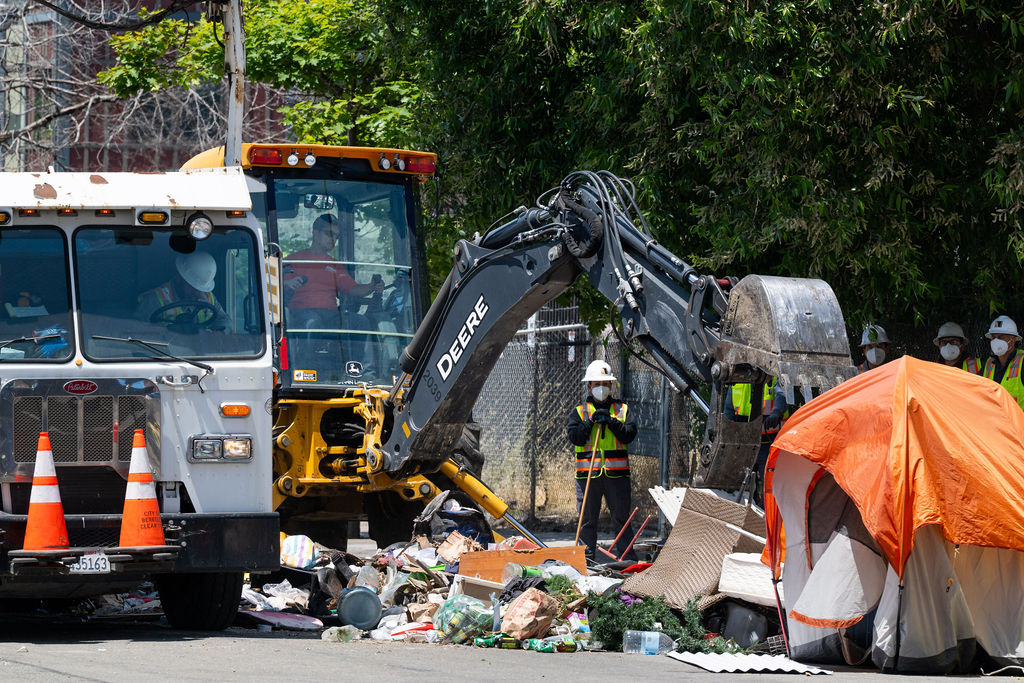
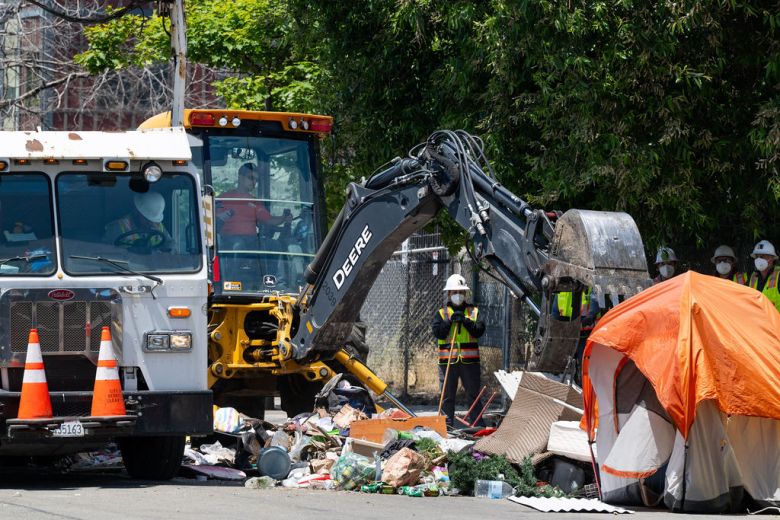
 City workers remove peoples’ tents, tarps, belongings and trash during a partial clearing of the homeless encampment at 8th and Harrison streets in June 2025. The city hasn’t specified any timeline for a potential clearing of the encampment after a judge’s ruling last week. Credit: Adahlia Cole for Berkeleyside
The city of Berkeley can clear a troubled homeless encampment at Eighth and Harrison streets but must provide accommodations to disabled residents, a federal judge ruled Friday.
The city will have to help disabled campers move and store their belongings, and grant them exceptions to a city rule limiting personal property on a sidewalk to a 3-by-3-foot square, U.S. District Judge Edward Chen outlined in three separate orders.
For all residents of the encampment, Chen ruled that city employees cannot seize or destroy their RVs unless they first prove that an individual vehicle is blocking traffic or endangering public health, give the owner an opportunity to correct the problem, and consider less drastic measures.
The orders are the latest step in a suit filed by the Berkeley Homeless Union in January 2025 when the city first announced it would clear the Eighth and Harrison encampment. The case gained new urgency after a leptospirosis outbreak was reported there earlier this year.
“It really means a lot that the city doesn’t get to take away our homes,” said Yesica Prado, president of the Berkeley Homeless Union and a plaintiff in the suit. “Right now they are just being seen as vehicles and tents, but to us it is our livelihood.”
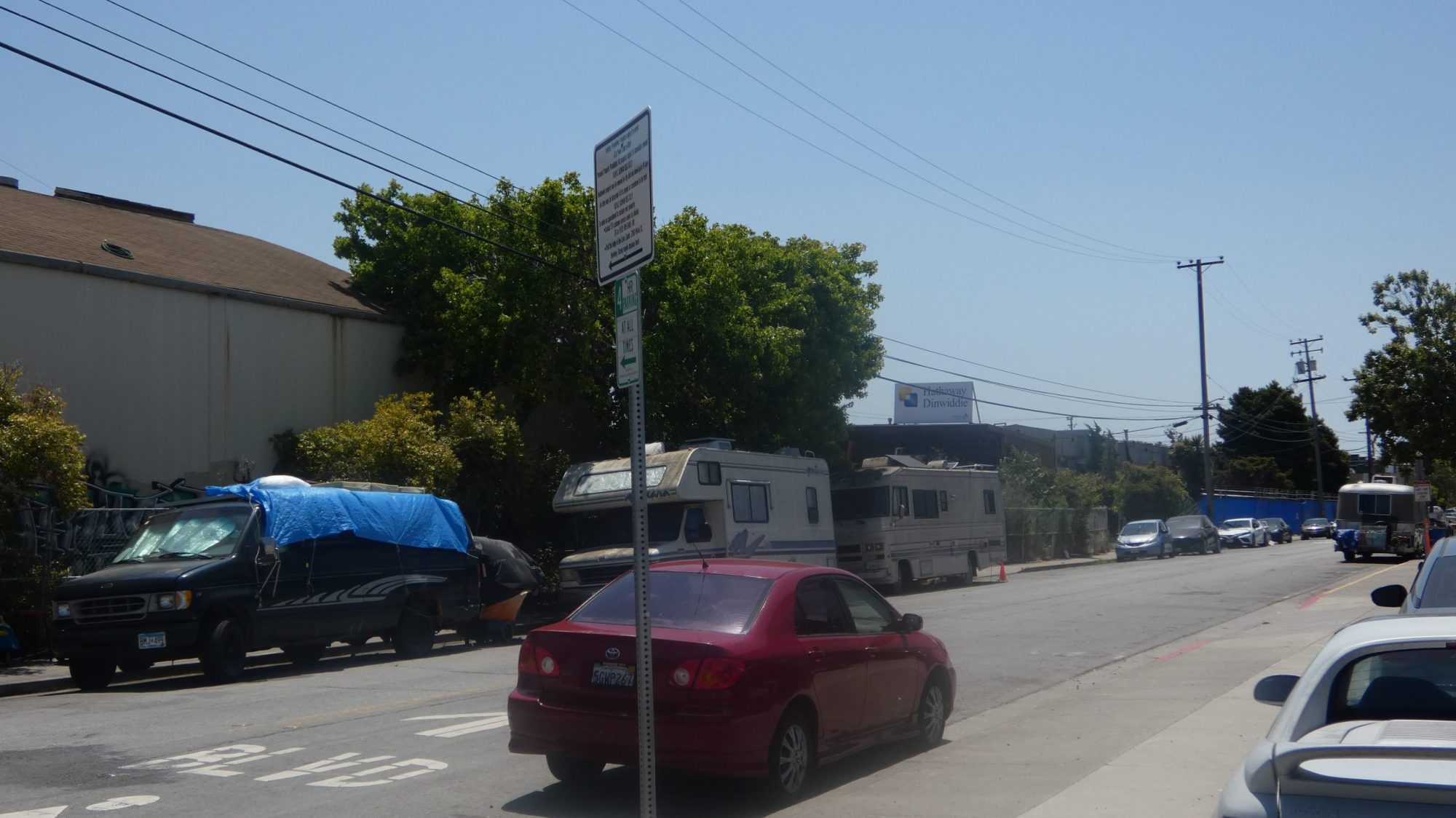 RVs and other vehicles parked on Eighth Street in June 2025. Credit: Daniel Ekonde/Berkeleyside
Berkeley City Attorney Farimah Brown said in a statement that the city was still reviewing the orders and assessing their impacts. “The City will ensure that any future actions it takes comply with the court’s directives while also endeavoring to address the health and safety needs of the community to the maximum possible extent,” Brown wrote.
The city did not specify any timeline for a potential clearing of the encampment.
Court documents describe a litany of complaints by Berkeley residents about the longstanding collection of tents and RVs surrounding the northwest Berkeley intersection, including reports of fights, fires, gunshots, hazardous waste and debris.
The city has said a complete eviction of the camp’s residents is necessary to combat the outbreak of leptospirosis, a disease carried by rats and usually found in low-income tropical countries but that can also plague homeless encampments in the U.S. Public health workers found the bacterium in rats at the encampment in January.
But unhoused residents say they have found community and protection in the longstanding encampment, and that the city has not provided adequate alternatives for those forced to leave. They also say the disease outbreak may have occurred because the city removed a dumpster residents had used for disposing of refuse.
After the city moved to clear the camp last June, the court issued a preliminary injunction requiring city officials to consult with disabled plaintiffs over requests they had filed for accommodations under the Americans with Disabilities Act (ADA).
The disabled residents had asked the city for a range of accommodations, including exemption from parking enforcement, a map identifying other locations where they could legally camp, transfers to ADA-accessible and permanent housing, physical assistance moving their belongings, and the ability to have larger sidewalk tents. The city denied most of those requests, according to the court orders.
In a nearly 100-page set of orders analyzing the residents’ claims under both the ADA and the U.S. Constitution, Chen found that many of those requests were unreasonable. But he sided with the plaintiffs in their request for exceptions to the city regulations on tent sizes, writing that “it is virtually impossible for a person to sleep within a 3×3 foot square.”
 Ross Patten sits with his remaining belongings and other displaced residents after a partial clearing of the 8th and Harrison encampment on June 4, 2025. Credit: Adahlia Cole for Berkeleyside
Effectively depriving residents of sleeping in tents because of the 3-by-3 rule, or impounding their RVs without due process, would also leave them in more danger than they were before the city’s action, a constitutional violation, the judge wrote.
He also said the city must replace any “essential survival equipment,” such as tents, that is thrown away because it is contaminated.
“We’re pleased that Judge Chen recognized that these are absolutely necessary survival situations,” said Anthony Prince, the attorney representing the Berkeley Homeless Union. “People need to stay in their RVs until such time as they’re housed more permanently and durably.”
The city can move ahead with displacing residents from the camp even if they have not yet found other housing options for them, the judge ruled. But he left open the door for future legal challenges under the Constitution or the ADA if the city engages in a pattern of serial displacement of residents that “effectively denies them any lawful location to seek shelter.”
While the ruling resolves issues raised in Chen’s preliminary injunction, the Berkeley Homeless Union says it still plans to pursue its original complaint that the sweep overall violates residents’ civil rights; a jury trial is scheduled for October.
Berkeley has also appealed one of the judge’s earlier orders in the case to the Ninth Circuit Court of Appeals. It’s unclear whether the city plans to drop that appeal, but a ruling on it could have implications for homeless encampments throughout the region in the wake of a 2024 U.S. Supreme Court decision making it easier for cities to enforce anti-camping laws, attorneys for the homeless union said.
“*” indicates required fields