
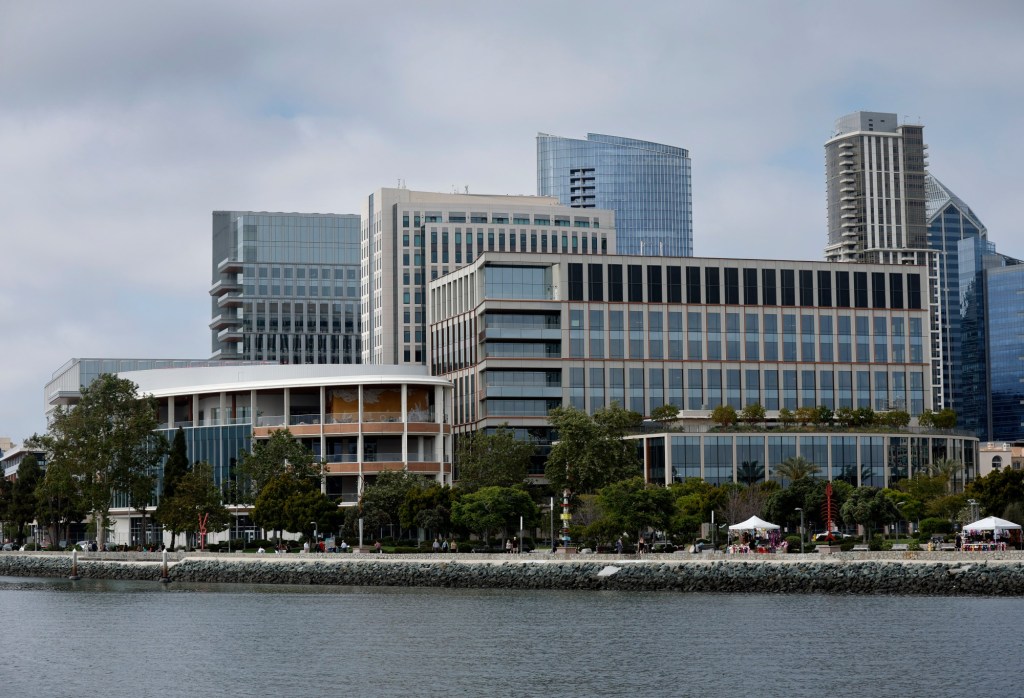
The developer behind San Diego’s ambitious waterfront research campus is being sued for fraud by one of its earliest investors.
An entity affiliated with multifamily housing developer Aimco filed a civil complaint last month with the Delaware Court of Chancery that accuses San Diego-based life science real estate investment firm IQHQ of making false promises to secure an equity investment that is now worth nothing.
The complaint, which is heavily redacted, accuses IQHQ of fraud, breach of contract and corporate mismanagement as spelled out in eight counts. Aimco is asking for its money back and requesting a court-ordered audit of IQHQ’s books.
“Defendants engaged in a scheme to induce Aimco’s investment and then trap that capital while they pursued their own interests to the detriment of Aimco,” the lawsuit states. “Defendants’ post-investment lies and omissions kept Aimco invested while its position was diluted and eroded to near worthlessness.”
IQHQ denied wrongdoing.
“The company believes the allegations in the complaint to be baseless and wholly without merit and intends to defend itself vigorously,” Chris Brewer, general counsel for IQHQ, said in an emailed statement.
The suit provides a public glimpse into the private dealings of IQHQ, which started as Creative Science Properties in 2019 and is headquartered in Solana Beach. The firm quickly raked in billions to develop millions of square feet of life science space in key biotech hubs, including San Diego, where it built the 1.7 million-square-foot Research and Development District, or RaDD, overlooking San Diego Bay that remains mostly vacant.
Based in Denver, Aimco, which is short for Apartment Investment and Management Company, is a publicly traded real estate investment trust that is in the process of selling all of its assets and winding down operations.
The company invested $50 million in IQHQ in August 2020. In 2022, IQHQ bought back 22% of Aimco’s stake for $16.5 million, according to regulatory filings. The value of Aimco’s remaining investment was adjusted, at the same rate, to $59.7 million, the filings state. However, in June 2024, Aimco reduced the value of its equity ownership to $12.7 million, citing increased real estate development costs and “IQHQ’s financial condition.”
In the complaint, filed March 12, Aimco alleges that it was deceptively persuaded to invest in IQHQ with the promise that it would be IQHQ’s partner on projects with residential components. The firm says it was deceived again in June 2022, when IQHQ restructured and moved investor interests into a Delaware limited partnership structure. According to the lawsuit, Aimco wanted to completely cash out at the time, but IQHQ pressured the company to roll over its shares into the new entity with the same false promises.
“Defendants have failed to present Aimco with a single qualifying multifamily opportunity, and have even excluded Aimco from at least one multifamily development transaction of the very type promised,” the lawsuit states.
The suit is likely referencing IQHQ’s Elco Yards lab and office project in Redwood City, where it is partnered with Greystar on the project’s 540 residential units. IQHQ also had housing in mind when it purchased, between 2021 and 2022, the entirety of the 12-acre Aventine La Jolla complex in San Diego, although it has yet to advance a project for that property.
Aimco maintains that IQHQ purposefully withheld information on its relationships with other housing developers, refused to disclose important financial information despite repeated requests, and inflated the market value of company shares during the 2022 restructuring. What’s more, the suit alleges that management and company affiliates enriched themselves — through operating fees, development fees, property-management and leasing fees, reimbursements and insider-favoring transactions — while diluting investor equity.
“Throughout their investment relationship, defendants consistently sidelined Aimco, dissipated investor capital through excessive management expenses, engaged in undisclosed and conflicted transactions, and provided incomplete and delayed reporting,” the complaint states. “Had Aimco known the truth and been provided all material facts and timely, accurate financial information, Aimco would have exited when it had the chance.”
The lawsuit also paints a picture of IQHQ as a company in dire straits.
In the years after Aimco’s reinvestment, IQHQ continued to raise funding, communicating with its investors, “the need to raise hundreds of millions of dollars to remain in compliance with debt covenants.” And in 2025, Aimco said it was provided with information that indicated IQHQ was in “severe financial distress.”
In early 2025, IQHQ told the Union-Tribune that it had raised nearly $5 billion in equity and corporate financing, not including loans for specific projects. Since then, the company received debt and equity funding from cannabis-focused real estate investment trust Innovative Industrial Properties, totaling up to $270 million.
The privately held life science developer’s financial health can be assessed, in part, through its stock and debt, which are owned by funds, regulated by the Securities and Exchange Commission, that disclose their ownership position over time, said Ryan Alfred, who is CEO of the AI-powered platform Atrium. The platform uses county records, bank filings and real estate lending data to provide insights to investors and bankers.
For instance, the Bluerock Private Real Estate Fund started publicly trading on the New York Stock Exchange in December. The fund’s holding report identifies a significant concentration in IQHQ, with an ownership position valued at $562.5 million across common and preferred stock. The report also shows that the fund has loaned an additional $255.4 million to IQHQ.
“Bluerock, on the first day of trading, traded 40% below what they had marked their book at in the quarter prior to them listing. And so this is investors basically saying, ‘We don’t believe your marks,’” Alfred said. “Some market participants interpret that as a signal around the fund’s large, relatively illiquid position, where there may be a gap between reported marks and where public investors are willing to price the exposure.”
Taken together, the Aimco lawsuit and market indicators suggest that IQHQ might be on tenuous footing.
“Based on the available data, this looks like a company scrambling to raise additional capital with the hope that market conditions and leasing somehow improve before loan maturity,” Alfred said. “Taken together, the data points and market signals suggest that storm clouds are growing. … In similar situations, access to capital tends to become more constrained over time, not less, which can make recovery far more challenging.”
To date, IQHQ has announced just one research tenant for its RaDD project, the J. Craig Venter Institute, which last year leased 50,000 square feet of space. The company also previously announced that half of the project’s 200,000 square feet of retail is leased to tenants, including the recently opened Equinox. The balance of the project remains vacant.
Bank OZK, which is the project’s largest lender, told its investors in a January earnings call that it remains confident in the project, despite limited leasing activity.