
Over a decade ago, when I came to interview for a faculty position in Asian Religious Traditions at Fresno State, on my way to the library, I nearly ran into Gandhi’s monument. I looked up, and I saw the large bust of Gandhi. I was intrigued, as I had just published my first book on Gandhi. Later, my colleague gave me a tour of the Peace Garden, and I still remember that he spent the most time at the César Chávez monument, telling the story of farmworkers’ struggles in the San Joaquin Valley.

By Veena Howard
Opinion
In recent days, as our campus has grappled with the painful revelations surrounding César Chávez and the removal of his monument, I have found myself returning to that moment and reflecting more deeply on the purpose of the Peace Garden.
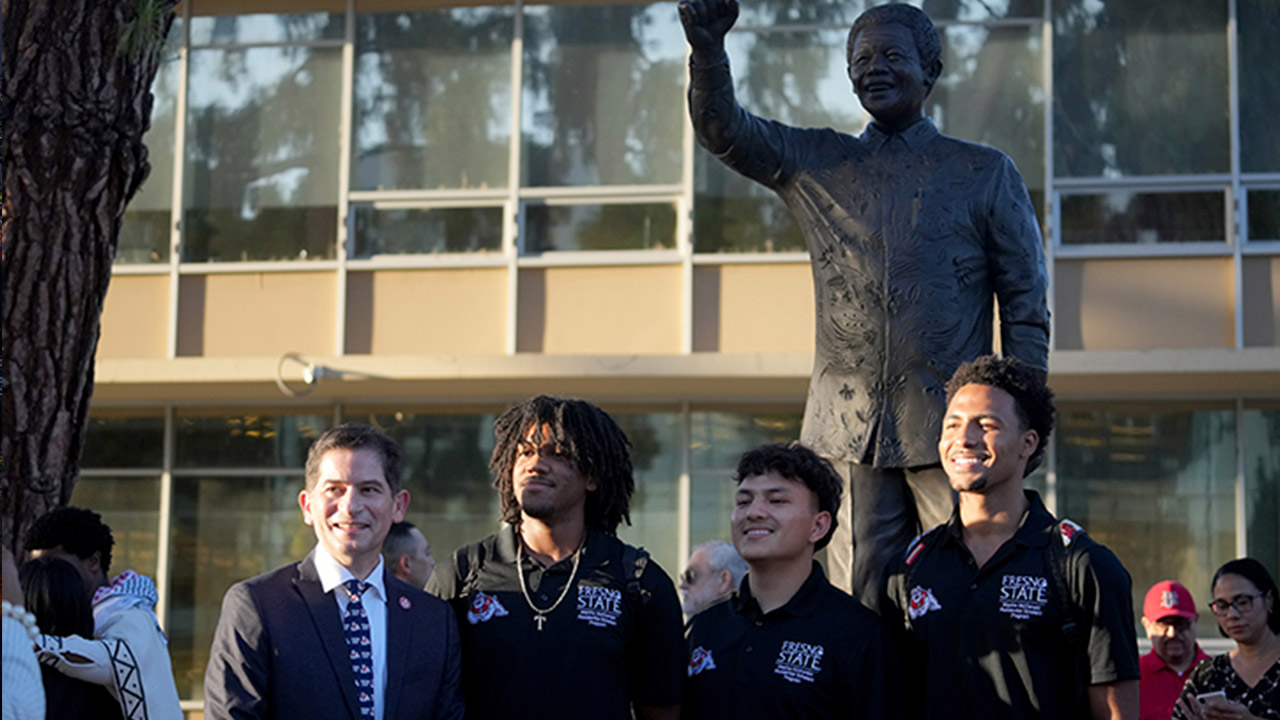
As a scholar of Gandhi and nonviolence methods, I have long reflected on the choice of the figures represented in the Peace Garden: Mohandas K. Gandhi (popularly known as Mahatma Gandhi), Dr. Martin Luther King Jr., Jane Addams, and César Chávez. (Nelson Mandela’s monument was added in 2024.)

In my mind, I saw laser beams connecting these figures. Although embodied in human form, they represent a shared idea — an idea that the structures of oppression must be confronted with alternative means; that nonviolence is more powerful than violence; that a clear vision and direct action can enable ordinary people to defy powerful regimes; and that the moral force must remain in the center of struggles for justice, equality, and human dignity.
Cross-Cultural Solidarity
Fresno State’s Peace Garden also represents “cross-cultural solidarity”—the alliances forged through a shared goal of improving the condition of our fellow human beings. Cross-cultural currents of connections span continents and movements. In his formative years, Gandhi drew inspiration from Booker T. Washington in his efforts in community-building and self-reliance. Martin Luther King Jr. traveled to India in 1959 and returned strengthened in his commitment to nonviolence. And Jane Addams corresponded with Gandhi about their shared work. Leaders of the United Farm Workers, including Dolores Huerta, drew from these same traditions in their fight for dignity and justice in the fields of California.
Special Event
What We Can Still Learn from Gandhi’s Philosophies in These Violent Times
Wednesday, April 8, 5:30 p.m. to 7 p.m.
Peters Business Building (UBC 191)
Registration at this link
The United Farm Workers movement’s leaders in California found inspiration in the tradition of nonviolence that had proven its success in India, the United States, and across the globe. The Farmworkers’ mobilizations brought tangible changes and involved many notable figures. The Reverend James M. Lawson Jr., who was called by Dr. King, “the greatest teacher of nonviolence in America became a strong ally in the struggle against the practices that subjected farmers and labor workers in California to inhumane treatment.
Nelson Mandela, whose monument was later added to our peace garden, learned deep lessons in nonviolence and forgiveness after going through a phase of anger — which resulted in violence against the apartheid regime in South Africa. He thus became an example of restorative justice. Many later movements, including antiwar demonstrations, women’s rights movements, Black Lives Matter, and others, carried this idea of fighting against oppression into a new era.
Peace Garden Honors Leaders and Their Ideas
The figures in the Peace Garden are not just individual leaders; they are representations of the enduring ideas that support the fight against inequality, injustice, and violence. The human figures represented in the Peace Garden invite us, as teachers, students, activists, and intellectuals, to focus on the larger vision — a vision that is woven through many sacrifices of millions of women and men who forged cross-cultural solidarity for upholding shared human dignity and humanity.
At the same time, this moment reminds us of a difficult truth of remaining steadfast to nonviolence: When we center an individual person as the symbol of a movement, we must reckon with the full complexity of their lives.
We must not forget, as we enjoy the rare privilege of free speech, that we are the beneficiaries of many who sacrificed their resources and even their lives. We must carry forward the vision of building peace through nonviolent action, recognizing our own human frailties, and always aspiring to do better.
In this moment of reflection, the Peace Garden remains what it has always been: a space for holding on to the truth of the power of nonviolence, learning, dialogue, and the ongoing work of aligning our values with our actions.
About the Author
Dr. Veena Howard is a professor and the chair of philosophy at Fresno State, the endowed chair in Jain and Hindu Dharma, and the director of the M.K. Gandhi Center for Inner Peace and Sarvodaya.