
There’s a particular kind of power in recognizing something that feels like home, especially when that home has been filtered through distance and history.
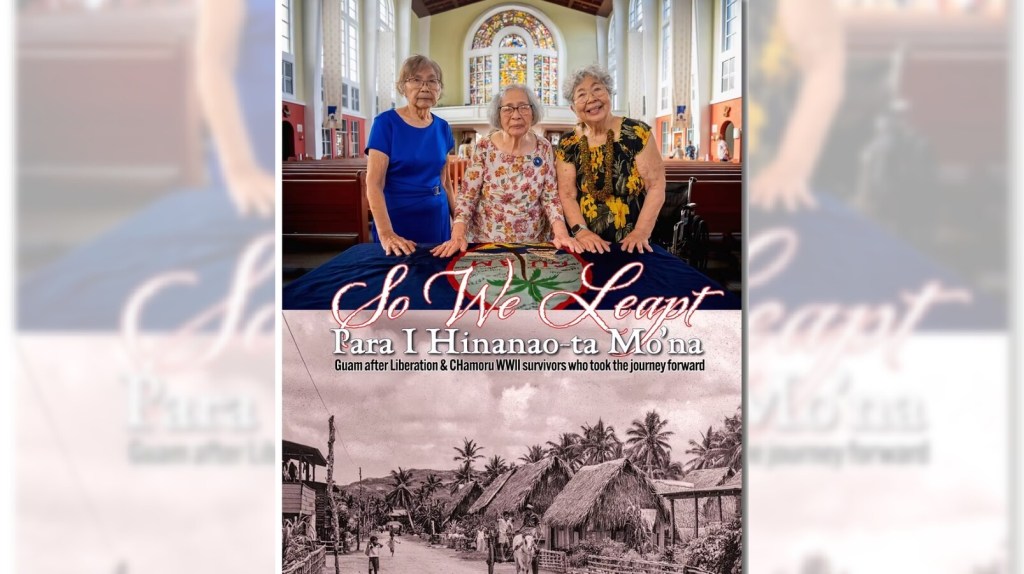
In its newest exhibition, “So We Leapt – Para I Hinanao-ta Mo’na,” the Pacific Island Ethnic Art Museum invites us into exactly that space where the familiar becomes newly visible, and where images captured decades ago still resonate.
Opening on Saturday, April 18, the exhibition centers on a remarkable archive of photographs captured by U.S. Army photographer Frank Buchman between 1944 and 1946 in Guam.
Far from formal wartime documentation, many of Buchman’s images depict everyday life, including moments of resilience, routine, and community among CHamorus — the Indigenous people of Guam and the Northern Mariana Islands — navigating the aftermath of conflict.
That capital “H” in “CHamoru,” by the way, is intentional and significant — it reflects a linguistic truth, recognizing “CH” as one distinct letter in this community’s language rather than a combination of two letters.
It’s a small but meaningful assertion of cultural identity that was formally adopted by Guam in 2019, an assertion that echoes throughout the upcoming exhibition.
The photographs in the exhibition have been meticulously restored and curated by Manny Crisostomo, the only Pacific Islander to receive a Pulitzer Prize.
Working from a collection of more than 500 prints, negatives, and transparencies, Crisostomo brings a deeply personal lens to the project. He has described his work as drawn to “people that look like me, places that are all too familiar and events that form and shape my cultural identity,” a perspective that transforms the exhibition from historical record into something more intimate and immediate.
This transformative perspective also shines through a companion series of contemporary portraits from “Hasso,” a project by Johnny Cepeda Gogo, also on view.
These images capture CHamoru World War II survivors — now in their 80s and 90s — whose faces and stories form a living bridge between Buchman’s mid-century photographs and today.
The past and present collapse into one another, asking audiences in Long Beach and the rest of Southern California to consider not just what has changed, but what endures.
A companion book, sharing the exhibition’s title, will be available in limited print at the museum, and the opening will feature a moving communal element: a Guam flag from Gogo’s project honoring World War II survivors and liberators, available for CHamoru survivors to sign.
Running through August 30, “So We Leapt – Para I Hinanao-ta Mo’na” is an act of historical recognition, as well as a reminder that sometimes the most powerful images are the ones that bring us back to places we already know, revealing just how much they’ve always meant.
Head to pieam.org/exhibits for more information.
Bob Cole Conservatory
Keyboard fireworks and Baroque brilliance take center stage this week at the Bob Cole Conservatory, with two concerts that showcase both the scale of collaborative performance and the intimacy of early music — one a fundraiser, the other a chance to hear masterworks completely free of charge.
The weekend kicks off with the Multi-Piano Extravaganza, directed by Shun-Lin Chou, on Saturday, April 11 at 4 p.m. in the Daniel Recital Hall at Cal State University Long Beach.
As the title suggests, this is no ordinary recital. The entire piano faculty is joined by standout alumni and students for a high-energy program of original works and inventive arrangements for up to four pianos — yes, 80 fingers in motion at once.
Expect familiar classics refracted through layered textures, all in support of the Keyboard Studies program.
A reception will follow, giving audiences a chance to mingle with performers after an afternoon of virtuosity. Tickets are tiered at $23.75, $13.75, and $8.75.
Then, on Tuesday, April 14 at 7:30 p.m., the focus shifts with the Collegium Musicum Ensemble’s “A Bach Family Concert,” directed by David Garrett.
Spanning generations of the Bach dynasty, this program offers a kind of musical family tree in sound.
It begins with Heinrich Bach’s “Sonata a 5 in F” and Johann Bernhard Bach’s “Suite in D,” before arriving at the towering figure of Johann Sebastian Bach, represented by the intricate “Ricercar a 6” from his “Musical Offering” and the ever-popular “Air” from his “Orchestral Suite No. 3.”
From there, the concert traces the evolution of the family style through the next generation, with works by Johann Christian Bach and Carl Philipp Emanuel Bach, whose compositions reveal the shift toward a more expressive, Classical sensibility.
Together, these two events, courtesy of Bob Cole Conservatory offer a compelling snapshot of the conservatory’s range from exuberant, large-scale collaboration to historically informed performance.
And with the Collegium concert at a great price (that is, free), there’s every reason to attend both shows.
For more information, check out shorturl.at/rZtUO.