
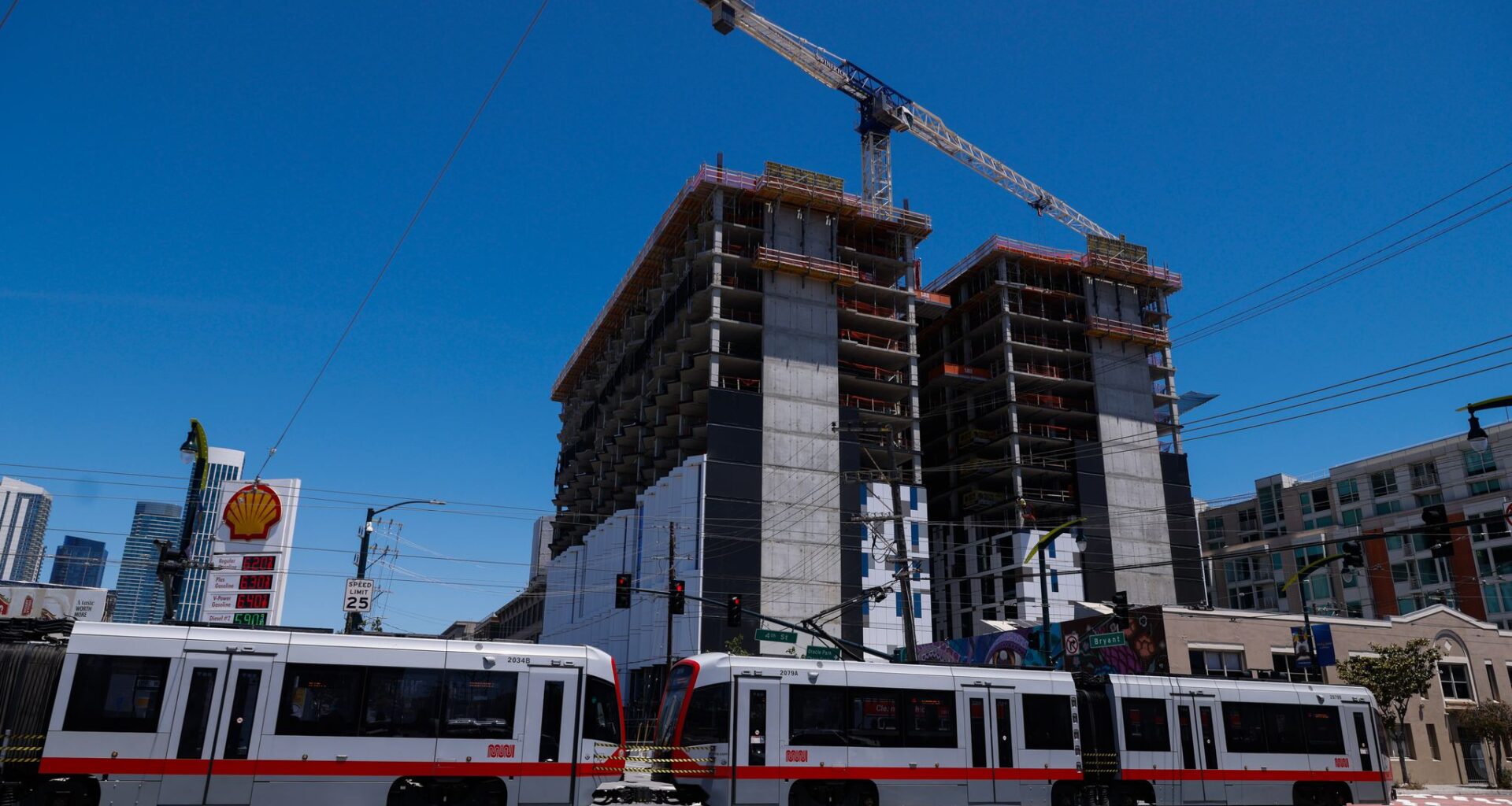
San Francisco could soon lower the affordable housing requirements for new developments.
Yalonda M. James/The Chronicle
Three years ago the San Francisco Board of Supervisors slashed the percentage of affordable units that developers must include within their market-rate housing projects, arguing that it would help revive a residential construction industry that has been moribund since the pandemic.
Major development plans that were frozen as funding dried up have yet to restart. Few new projects have been proposed or have materialized. Between 2020 and 2025 the city’s “inclusionary housing” program produced just 767 affordable homes, for which more than 34,000 people applied. Between 2015 and 2020, the program produced more than twice that amount.
Article continues below this ad
Meanwhile, purely affordable projects built in that same time period using public subsidies produced 4,559 units. Overall, the city issued building permits for the construction of just 1,031 new homes — market rate and affordable — in 2024 and 1,900 last year, compared with over 5,000 in 2019.
Now, with most housing construction still stalled, a key committee of developers and advocates advising City Hall on its inclusionary housing policies wants to chop the rate further — lowering it by more than half from the current rate for new projects, from 15% to just 5%. The recommendation, which the Board of Supervisors will need to vote to adopt, is especially dramatic considering that, without changes, the inclusionary rates were set to revert on Nov. 1 to 18% for new rental projects and 20% condo developments.
San Francisco Chronicle Logo
Make us a Preferred Source to get more of our news when you search.
Add Preferred Source
San Francisco’s inclusionary housing laws are meant to produce the highest amount of affordable units that the market can bear. Prior to the pandemic, the city’s rates were among the highest in the country — a stark contrast to today’s sharply reduced requirement as officials are forced to contend with a virtually frozen development landscape. The new rate would rank the city among the nation’s lowest according to a 2021 study by Inclusionary Housing.
The proposed rate cut by the Inclusionary Housing Technical Advisory Committee (TAC) — a group of developers and affordable housing proponents appointed to advise the city on the program — must still be approved by the Board of Supervisors.
Article continues below this ad
And it’s unclear if the proposed decrease will be enough to jump-start housing construction. A 2026 analysis by a consultant for the city, found that “the maximum economically feasible inclusionary level is 0%.” That analysis prompted the City Controller to conclude that “requirements significantly above 0% would further threaten” the feasibility of new housing construction would therefore “not create affordable housing.”
A proposal could lower the required percentage of affordable housing units in new developments from 15% to 5%.
Yalonda M. James/The Chronicle
But some members of the TAC rejected that approach, arguing that maintaining at least a modest inclusionary requirement is critical to ensuring the city continues to produce below-market-rate homes even amid a downturn.
“We are faced with a situation where 0% affordable is what is seen as economically viable. None of us wants to do that,” said Enrique Landa, a partner with the group developing the former Potrero Power Plant.
“To the degree that we don’t require inclusionary, the market is exclusionary,” said Shannon Way, executive director of Home SF.
Article continues below this ad
While the seven-person technical advisory committee ultimately agreed to the temporary rate cut, the committee was somewhat split over how to address the broader issue of how to best create alternative funding sources for affordable housing.
“I am willing to go to 5%, however I want to see a really strong plan around a dedicated source” for affordable housing, said Saki Bailey, executive director of the San Francisco Community Land Trust.
The three members of the committee appointed by the Board of Supervisors, who tend to be more progressive on housing issues than the four appointed by the mayor, said they would only support the reduction if there was a commitment to increasing the amount of money spent on affordable housing.
“It’s not part of the TAC’s charge to focus on other ways we fund affordable housing, but it feels fundamentally connected,” said Rebecca Foster, CEO of the San Francisco Housing Accelerator Fund. “How can we ensure that we are actually funding affordable housing at some fraction of the need in a more reliable way?”
Foster said a few options are currently on the table: Creating a citywide special tax district to fund affordable housing; removing an existing $50 million annual cap on the Housing Trust Fund, which is a voter-approved fund dedicated to creating and preserving below-market rate homes; and dedicating revenues from the city’s real estate transfer tax to the effort.
Article continues below this ad
Whether the mayor’s office supports these proposals is not clear. A spokesperson for Mayor Daniel Lurie declined to comment.
“We can’t trust in a pathway that … does not have political support yet,” Bailey said.
While the TAC’s decision serves only as a recommendation, it is consequential: San Francisco faces a state mandate to allow for the construction of 82,000 new homes over the next five years, of which roughly half must be income restricted. And the city is trailing on that goal.
Marc Babsin, a partner with Emerald Fund, one of San Francisco’s most prolific builders, said reducing the inclusionary percentage from 15% to 5% is worth about $100,000 per unit. Emerald Fund is trying to line up financing for 1 Oak St., a 541-unit tower near the intersection of Market Street and Van Ness Avenue.
“Other than construction costs, the inclusionary housing is the most significant lever the city can pull,” Babsin said. “As the market rate rents move, that benefit becomes more valuable.”
Article continues below this ad
Labor leader Rudy Gonzalez, of the San Francisco Building Trades, said further reducing the inclusionary fee is “smart and reasonable,” and added that the move, paired with identifying new sources for funding affordable housing, represents “something like a grand bargain.”
“We should be flexible about continuing to recalibrate as market conditions change,” Gonzalez said.