
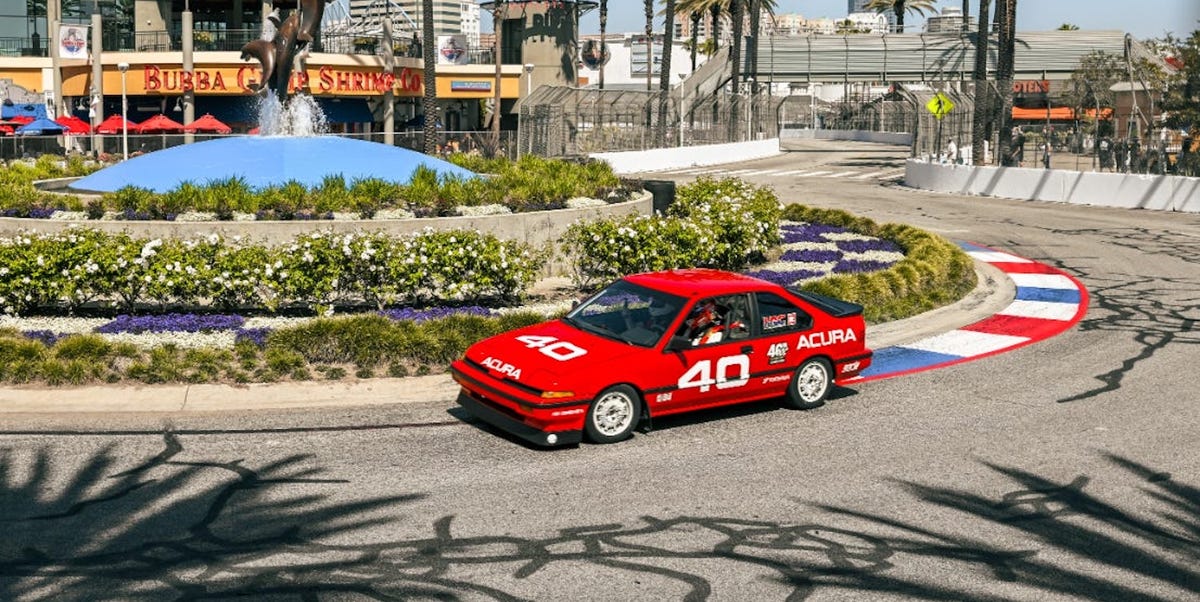
The glory days of Acura racing began almost as soon as the division spun off from the Honda mothership.
Acura launched in 1986 with the Integra and the Legend. It was the first Japanese luxury brand created, ahead of Lexus, Infiniti, and even Mazda’s failed Amati division, if anyone remembers that.
Related Story
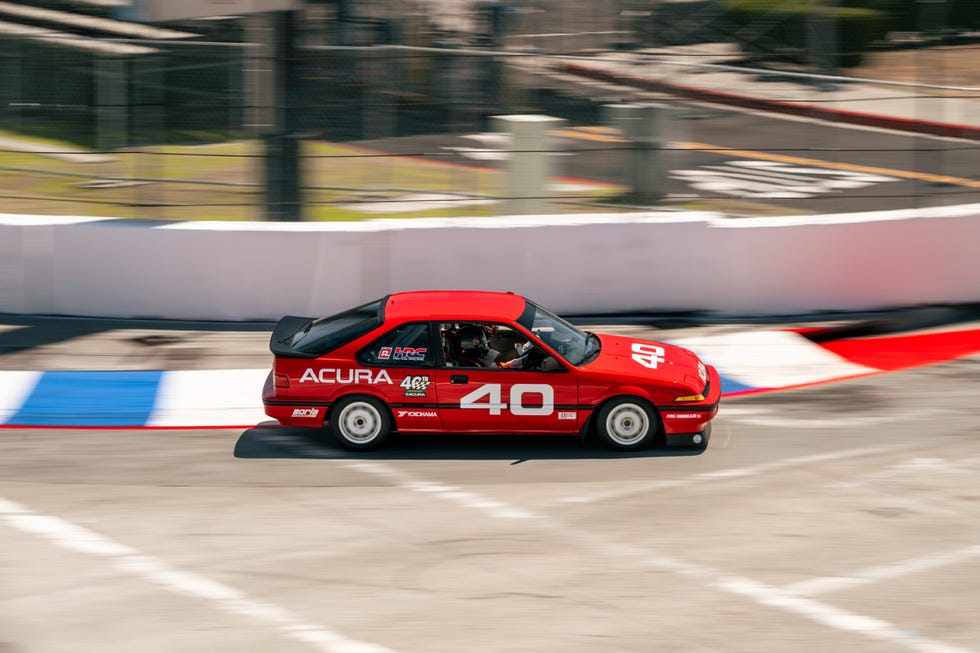
The brand had racing success right out of the box, starting with the original of this car, the Comptech Integra No. 48–which won consecutive IMSA International Sedan Series Manufacturers’ and Drivers’ Championships from 1987 to 1990. To celebrate its 40th anniversary, Acura recreated the race car here and put the number 40 on it to note 40 years of division excellence. It was built by Honda Racing Corporation US (HRC US), and it was giving hot laps on the Long Beach street circuit ahead of the Acura Grand Prix of Long Beach taking place in a week.
Acura
If you stand around long enough in the right place, good things happen. Thus, when the Acura rep asked if I wanted a lap in the car with none other than 2011 Formula Drift champion Dai Yoshihara, I said, as any sane person would, “Yes!”
The car was a faithful recreation of the original, with these modifications:
Rebuilt original D16A1 engine and five‑speed manualMonsoon ECUCoil‑on‑plug conversionStainless 4‑2‑1 long‑tube headerCustom Borla exhaustTorsen‑type limited‑slip differentialTein coiloversAdjustable panhard barManual steering rackManual brake conversionCarbotech performance brake padsStainless braided brake linesLightweight Mugen 14‑inch wheelsYokohama ADVAN – A050 semi-slick tires
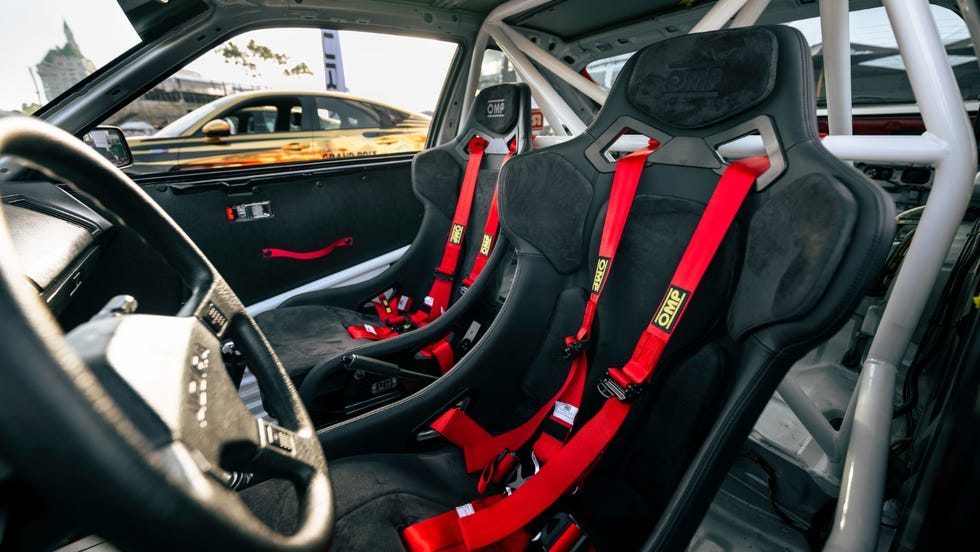
The interior was stripped down to the bare metal, with two carbon-fiber race buckets bolted firmly in place. I slithered into one and clicked all six buckles of the six-point harness. Acura was good enough to provide a full-face helmet and even a HANS device to keep my head attached to my body. Thank you, Acura.
Acura
Off we set down Long Beach’s long straightaway, Yoshihara winding it out to redline on each shift of the five-speed manual. The car had good pickup for a 1.6-liter four. In stock trim that engine made between 113 and 118, hp but here it was probably putting out 140.
No idea what speed we hit by the end of the straight, but I can tell you there’s no way they’re going to squeeze 27 Indy cars through that first left turn around the fountain next week. No way. I resisted the normal dog-in-a-car-wash reaction our monkey ancestors would have felt and was only briefly terrified approaching the first corner because it looks like it just ends in a bunch of white-painted k-rail. Yoshihara knew where it went, though, and we whipped around the dolphin fountain and down the narrow canyon of the course with ease.
Related Story
Then, just to keep things interesting, coming onto the back straight, the car died. Yoshihara twisted the ignition key a few times, saying casually, “This happened last time…” Like a good co-driver I raised my hand out the window because, well, who knows why? James Garner did it in Grand Prix, so I figured that was the protocol. Porsche Carrera Cup cars screamed past us, the loudest internal combustion engines in Southern California at that moment.
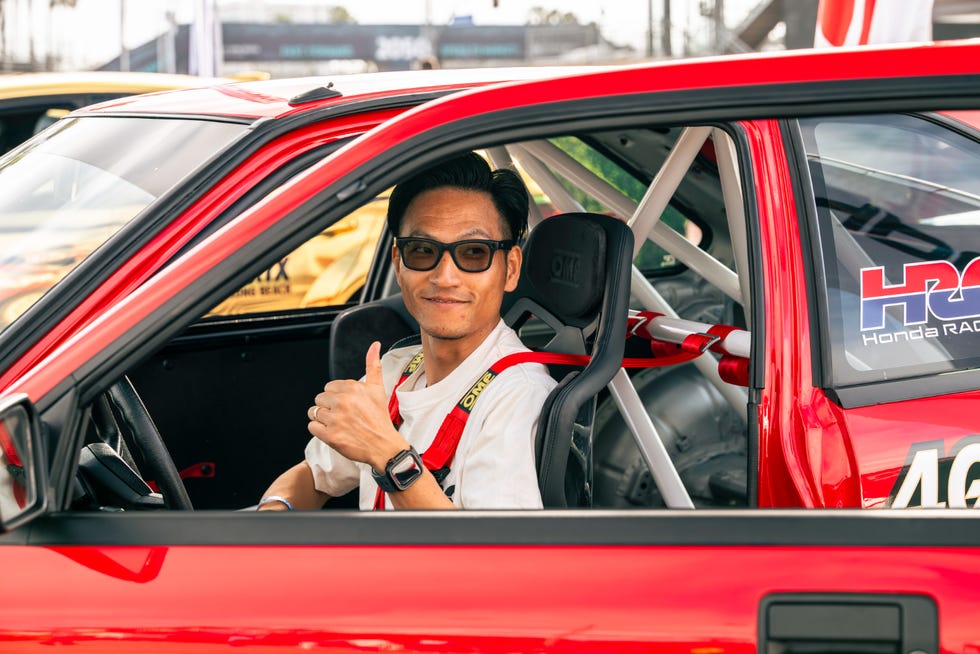
The D16A1 fired after a few more twists and we were off again, threading our way through the turns used by the Formula Drift teams, then around the hairpin and back into the pits.
The lesson learned? It’s better to drive a slow car fast than a fast car slow. Plus, Dai Yoshihara is a cool cat. And finally, happy birthday, Acura.
The Acura Grand Prix of Long Beach is April 17-19. Tickets still available!
Mark Vaughn grew up in a Ford family and spent many hours holding a trouble light over a straight-six miraculously fed by a single-barrel carburetor while his father cursed the Blue Oval, all its products and everyone who ever worked there. This was his introduction to objective automotive criticism. He started writing for City News Service in Los Angeles, then moved to Europe and became editor of a car magazine called, creatively, Auto. He decided Auto should cover Formula 1, sports prototypes and touring cars—no one stopped him! From there he interviewed with Autoweek at the 1989 Frankfurt motor show and has been with us ever since.