
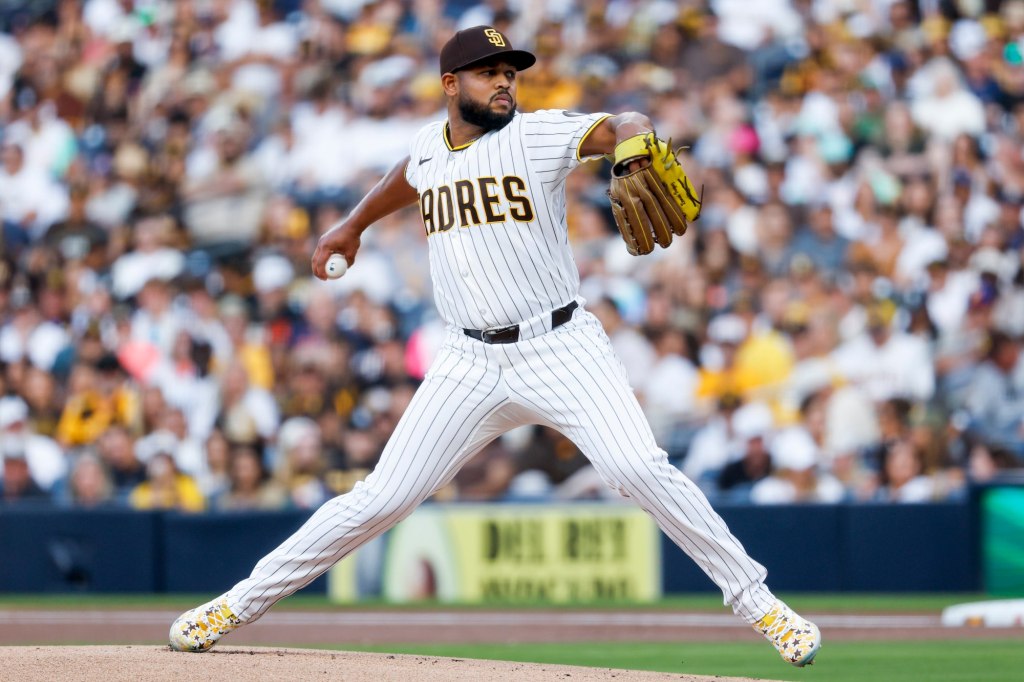
Randy Vásquez arrived in San Diego as a piece of the blockbuster Juan Soto trade and spent his first season with the Padres navigating between the majors and minors. Over 20 starts, the right-hander worked to refine his command and expand his pitch mix, setting the stage for a more stable role on the roster.
By 2025, the former New York Yankee earned a spot in the starting rotation but struggled with consistency and closing out hitters. He developed a reputation as a “traffic cop” for his ability to create — and escape — jams.
Vásquez demonstrated late-season gains in both velocity and confidence, a product of the work he put in with the Padres’ staff but also with veteran Yu Darvish, with whom he formed a close bond. He opens the 2026 season as a rising star in the Padres’ rotation.
Vásquez, 27, was born in Navarrete, Dominican Republic, where his love for the game took root. Growing up, he spent countless hours playing vitilla — a street version of stickball using a water jug cap and broomstick — which laid the groundwork for the style of pitching he maintains today.
This interview has been edited for length and clarity. It is translated by Padres interpreter Jorge Merlos.
What do you remember most about your childhood?
A: I enjoyed my childhood when I was little. My parents never forgot about me. They got me into baseball at 3 years old, and really, since then on, I will always love baseball for what it was. I had so much fun. And coming from that small town, Navarrete, it’s grown so much in baseball over the years and so many things have come out of there. So, I’ve really enjoyed it.
Baseball is so popular in the Dominican Republic. What is the culture like around the game?
A: I loved playing out on the streets. We would play vitilla, which is (played) with bottle caps and you’re swinging it with a stick. My friends and I would go out in the street and play that all the time. That was part of my childhood. I didn’t really understand or really know that there was an ability to do this professionally until I was 15 years old. And so, I mean, that’s where that love comes from — of what the sport is — is just playing that when I was young, and then playing it obviously now.
You were a catcher originally, correct?
A: Yeah, I was a catcher, but I just didn’t have any swing to me. I didn’t have any power batting. So my uncle, Fernando Hernandez, his nickname is El Cuchillo, which translates into “The Knife.” He’s in the Hall of Fame in the Dominican. He told me, ‘Hey, you’ve got a live arm. Let’s try it out, because it looks like we can get you somewhere with this arm.’ So from there on, I became a pitcher.
Did you do a tryout for scouts? How did you get seen?
A: Arturo Pena, he was a scout that saw me. I think of him as my father, really, just one of those guys that really helped me out. He saw me when I was a catcher. He told me, ‘If you can throw 92, 93 (mph), I’ll get you signed right there (as a pitcher).’ And so he gave me a month to prepare myself to do it physically and mentally, to try to get to that point where I could do it. So the next time that I did a tryout, I threw 92, 93 (mph). He saw that. He invited all the American guys down to come see me. And then once they saw me, that’s when I signed.
Does your experience as a catcher help you at all today?
A: Yeah. I think most of all, it’s really helped in just my arm ability and how much speed I’ve been able to accomplish over the years. Because it just seems like every year I’ve been able to increase that power and am able to throw at max velocity. So I think just learning all those intricate details of how to become a catcher, and just that physical work that I’ve been able to do down in the Dominican, has really helped me to become this pitcher that I am today.
How did you learn how to throw?
A: From the vitilla, I was able to have a good curveball, because I threw a lot of that. Obviously, that’s my first really true (pitch) that I threw. So using the command from what I did in vitilla, I was able to have a lot of breaking balls, and that’s why I had such a great breaking ball at the time with the Yankees. Using that, I kind of learned how to throw a baseball as I did.
So you taught yourself how to throw by using a bottle cap?
A: Yes.
That’s crazy.
A: Yeah, I know.
And with no pitching experience and a month to prepare, you had to teach yourself how to achieve higher velocity, too?
A: Yeah. I had to learn how to throw a fastball after playing vitilla and get it up to the 90, 92 (mph) that I threw for the scouts. With my uncle, I had to learn that.
How else did playing vitilla help you?
A: Really, the vitilla just helped me in getting those breaking balls (pitched) well, and that’s why I have such a high spin rate, a 3000 or at 3400 (rpm) spin rate. And what I learned from vitilla is just how to, you know, get such a good grip on it. That kind of helped me out with the baseball as well — having a better grip on the baseball — and arm angles and how to get it out.
When did someone put a baseball in your hand?
A: It was before I signed that I really started to learn how to grab a baseball and change grips and stuff like that. That’s when I started to work with my uncle and really come up with a plan of how to hold a baseball.
This just fascinates me. Everything you do today is rooted in throwing a bottle cap. It’s essentially who you are?
A: Yeah, 100%. There are so many things that come from vitilla that I’ve been able to implement into my game now and still do.
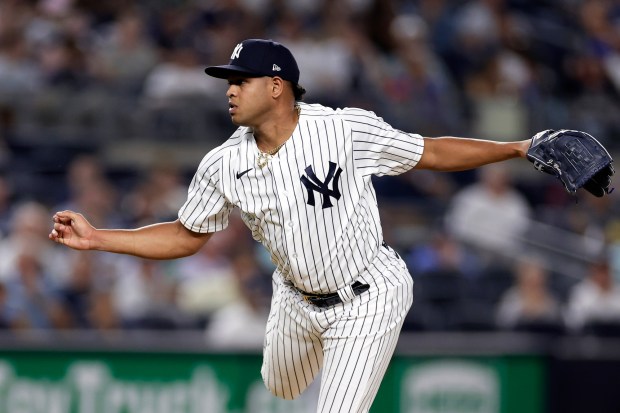 New York Yankees pitcher Randy Vasquez (98) pitches against the Detroit Tigers during the fourth inning of a baseball game Thursday, Sept. 7, 2023, in New York. (AP Photo/Adam Hunger)
You were 19 years old when you signed with the Yankees. Often, players from the Dominican sign when they are 16. Did you feel any stress about not signing earlier?
A: I did feel like I was a little bit behind the guys, but I still kept playing every day and I still kept working out. And luckily, Pena came out and saw me, and he signed me there.
What did it mean to you and your family to sign with the Yankees and see your dream be realized?
A: It was a crazy day, actually. I remember it. I was doing a tryout that day and there were several scouts there, and a scout (who was supposed to sign me) actually signed another guy. He was from the Cardinals, and he signed another guy. He came up to me and said, ‘Hey, the deal’s off. We aren’t able to offer you something right now, so we’ll try again next time.’ And so I just went home, sat there, and I get a phone call from Pena and he says, ‘Hey, look, I got two offers right now. I got an offer from the Rays. They say that it’s $20,000, but I also got an offer from the Yankees. It’s $10,000.’ And I’m like, ‘Man, what do you think? Is it worth it? What team should I sign with, do you think?’ He’s like, ‘Well, I don’t really care about the $20,000. I prefer the Yankees. That’s my team. You gotta go be with them.’ So that’s where I signed, with the Yankees.
I had never thought that I was going to be able to sign with the Yankees. My family, they knew about the Yankees. They were big fans of the Yankees at the time. And so when that time came, when Pena called me, I went straight to my mother. I told her, ‘Hey, I just signed with the Yankees.’ She’s like, ‘You’re crazy. You talk way too much. Like, why are you telling me this?’ Pena said, ‘No, no, let me tell you.’ And so Pena came on the phone. He’s like, ‘Hey, welcome to the family. You’re now with the Yankees.’ She started crying right there. She started bawling, and that’s where it took off.
What happened after that?
A: I started out in the Dominican Summer League, out in the Dominican. I tried to stand out amongst everyone else. I pitched 18 innings, and then they sent me straight to Florida.
What was that culture shock like?
A: Yeah, so I didn’t do anything at home at all. My mom did everything for me. She cooked everything, she cleaned everything, she did everything. So for me, I had to learn all that stuff. And my mom always told me, ‘Hey, just keep up with it. Keep up with it, work, keep doing what you gotta do to make it happen.’ Eventually, I was able to figure out how to maintain myself.
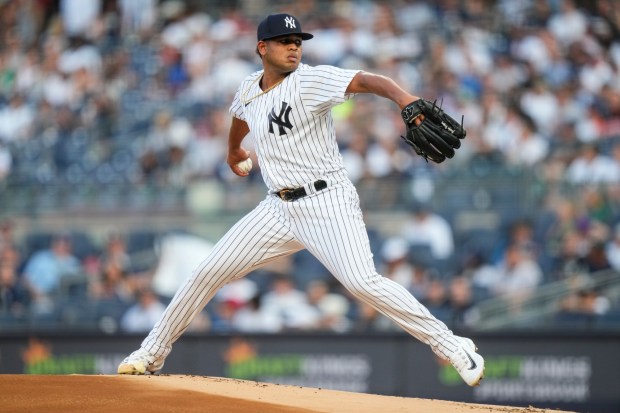 New York Yankees’ Randy Vasquez pitches to a Baltimore Orioles batter during the first inning of a baseball game Wednesday, July 5, 2023, in New York. (AP Photo/Frank Franklin II)
You and Wandy Peralta are close. How has your relationship grown since your time with the Yankees?
A: The relationship with Wandy, you know, I call him my dad in baseball. He’s been that guy that’s always been able to teach me all the things that I needed to learn out here, whether it’s on or off the field. He’s always been there teaching me how to become a baseball player, and he’s helped me out ever since the Yankees.
What about your relationship with Ruben Niebla?
A: He was the first person that called me right after I got traded over here. He said, ‘Hey, I know you’re a starter. We’re gonna work on some things and we’re gonna make you better.’ So ever since then, I’ve had that great relationship.
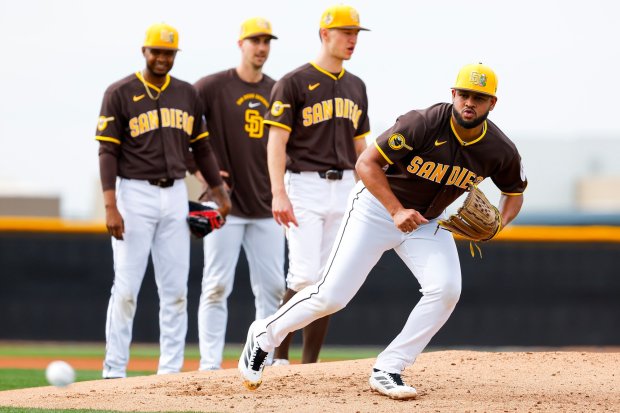 Randy Vasquez #98 of the San Diego Padres, center, participates in drills during the first day of spring training workouts at the Peoria Sports Complex on Wednesday, Feb. 11, 2026 in Peoria, Ariz.(Meg McLaughlin / The San Diego Union-Tribune)
Yu Darvish has become a friend and a mentor to you. What is the most important thing he’s taught you?
A: I think it’s just the preparation that I have going into the game. You know, every plan of attack that I have against these batters. And in the situation, whatever is in the moment, what can I attack the batters with? I think that’s what he’s helped me a lot with.
What does that say to you to have a pitcher of Darvish’s caliber take interest in your career?
A: I hope that he can continue on in giving me these things that have helped me out in my career. I appreciate him taking an interest in my career and really teaching me all these things. I’ll take that forever with me.
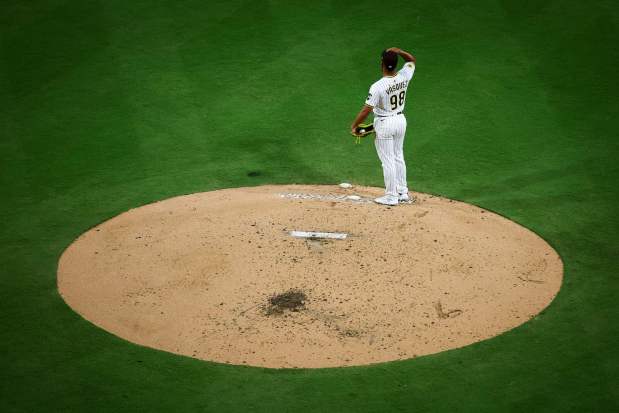 Randy Vasquez #98 of the San Diego Padres looks on after Pedro Pages #43 of the St. Louis Cardinals home run during the fourth inning at Petco Park on Saturday, Aug. 2, 2025 in San Diego, CA. (Meg McLaughlin / The San Diego Union-Tribune)
Over the past year, you’ve dialed in the strength and conditioning aspect of your game, and an uptick in velocity has followed. Did your diet change as well?
A: I haven’t changed my diet at all. I think it’s more of just my weight training and how I’ve changed that. It’s been pretty drastic on that part.
Do you have any hobbies?
A: Just to be in the water. Just jet skiing or being on a boat in the Dominican.
Have your parents seen you pitch in the majors yet?
A: My mother’s the only one that’s been able to come see me. She came to see me in New York against the Mets last year.
What did that mean to you?
A: It was really, truly, a great honor to have her there. She’s the one that raised me and really, it’s just important and an honor to have her there to see me achieve my dream.