
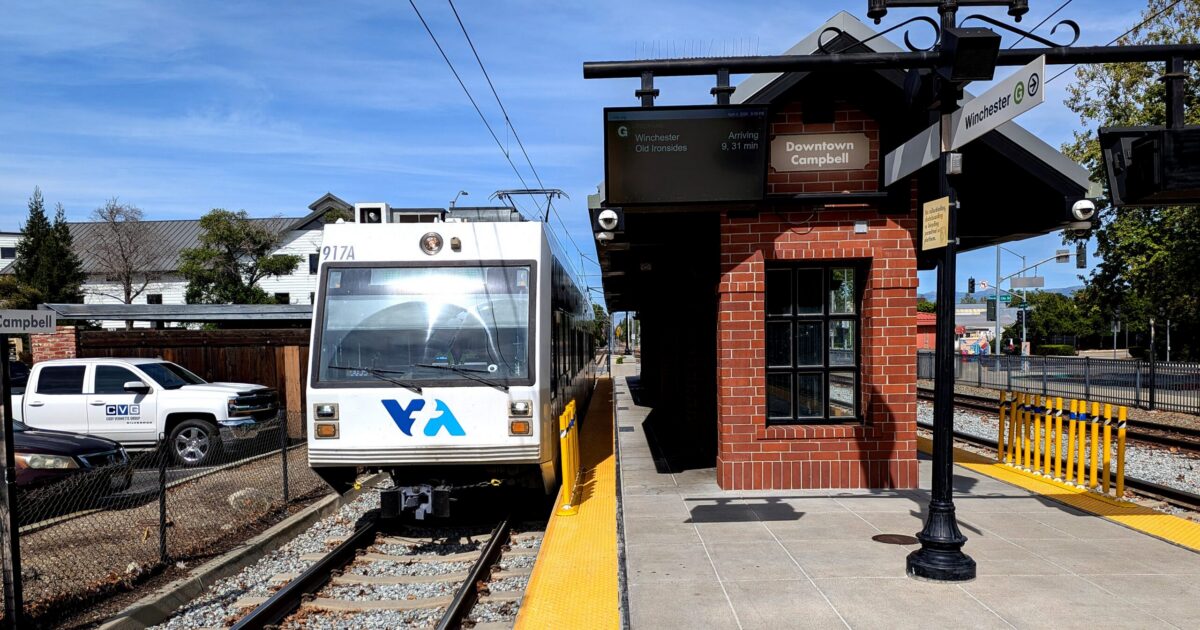
Campbell could add 40,000 homes — more than tripling the city’s current population — under a new state law aimed at boosting housing near public transit stations.
The City Council is working on plans to manage the huge surge in potential development being triggered by Senate Bill 79. The bill, effective July 1, could massively change the look and feel of the small city. The law allows for construction of high-rise apartment buildings within a half-mile of major transit stops without regard to local zoning rules. Covering just 6.5 square miles with a population of about 43,000, Campbell has three VTA light rail stations within its boundaries where SB 79 would apply.
Those stations are located on South Winchester Boulevard, in downtown Campbell and at Hamilton and Bascom avenues. A fourth location, the Bascom station in San Jose, sits just outside city limits and is in Campbell’s SB 79 zone.
Nearly a quarter of Campbell’s land area falls under SB 79, according to the Planning Department. If all parcels within the area were developed to the maximum allowed under SB 79, the city would have to accommodate 40,409 additional homes on top of the 18,200 homes in Campbell today. This could make SB 79’s impact on Campbell greater on a percentage basis than anywhere else in the county, Rob Eastwood, Campbell’s community development director, said.
“No other city in Santa Clara County is projected to have nearly 25% of its land area affected by SB 79,” Eastwood told San José Spotlight. “In terms of proportional impact relative to existing housing units, Campbell may experience the highest increase.”
Councilmembers have expressed concern with maintaining a diversified community that includes jobs as well as housing, because many of the city’s retail businesses, offices and light industrial sites are clustered along the light rail lines.
Other cities, including San Jose, are wrestling with the same issues. And Campbell has already moved forward on more housing along major streets and at the Winchester light rail station prior to SB 79.
“We all want to have housing for working families,” Councilmember Terry Hines told San José Spotlight. “It’s our watershed moment to manage through this and maintain a strong sense of community.”
Councilmember Sergio Lopez, who is also VTA board chair, is optimistic about SB 79.
“I think we’re poised to see some interesting opportunities open up,” Lopez told San José Spotlight. “I firmly believe it could be a net positive for the city financially.”
That would mark a shift from the past, when cities favored businesses — which pay sales taxes and don’t require extensive municipal services over housing.
Susan Landry, a former Campbell mayor, said she is a “MIMBY” — Maybe in My Backyard — who wants to know the specifics of any individual project before supporting it.
But Landry views SB 79 as unfairly pushing low-income families onto public transit.
“The person who makes $15 to $20 an hour is the one who most needs a car,” Landry told San José Spotlight.
She is also concerned Campbell won’t be able to afford all the infrastructure — electricity, streets, water and sewer – required for a massive increase in high-density housing.
Amy Taylor, president of the Downtown Campbell Business Association, said adding large amounts of high-density housing nearby could overcrowd the downtown strip on East Campbell Avenue, which is in the SB 79 zone.
“My biggest concerns are parking, especially in the downtown, and infrastructure needs,” Taylor, who lives in Campbell and owns the downtown business Cloud City Supply, told San José Spotlight. “To me, downtown doesn’t feel like the right place (for more housing).”

On March 24, the city council passed a short-term policy to make sure historic sites within the SB 79 zone are protected from development — already a provision of the state law.
Councilmembers decided they should wait on further action while the state Legislature considers two bills to amend SB 79. One of the bills would exempt mobile home parks, which typically offer affordable housing, from SB 79 developments. This would include the Timber Cove Mobile Home Park in Campbell with 137 homes. The other, Senate Bill 677, would tighten the definitions in SB 79.
Another big question is whether developers will choose to take advantage of SB 79. The law requires them to build high-density apartments or condos, not the lower-density townhomes that offer the highest rate of return in the West Valley. Nor does SB 79 require cities to meet specific goals for new housing, unlike other state housing laws.
“I agree that we need housing, but development has to be balanced,” Vice Mayor Anne Bybee said at the March 24 meeting. “We can’t just create 40,000 units in the city. To me, it’s an unattainable goal. It’s not going to happen in my lifetime. Our infrastructure can’t handle that unless the state provides the money and the resources.”
Contact Mike Langberg at [email protected].