
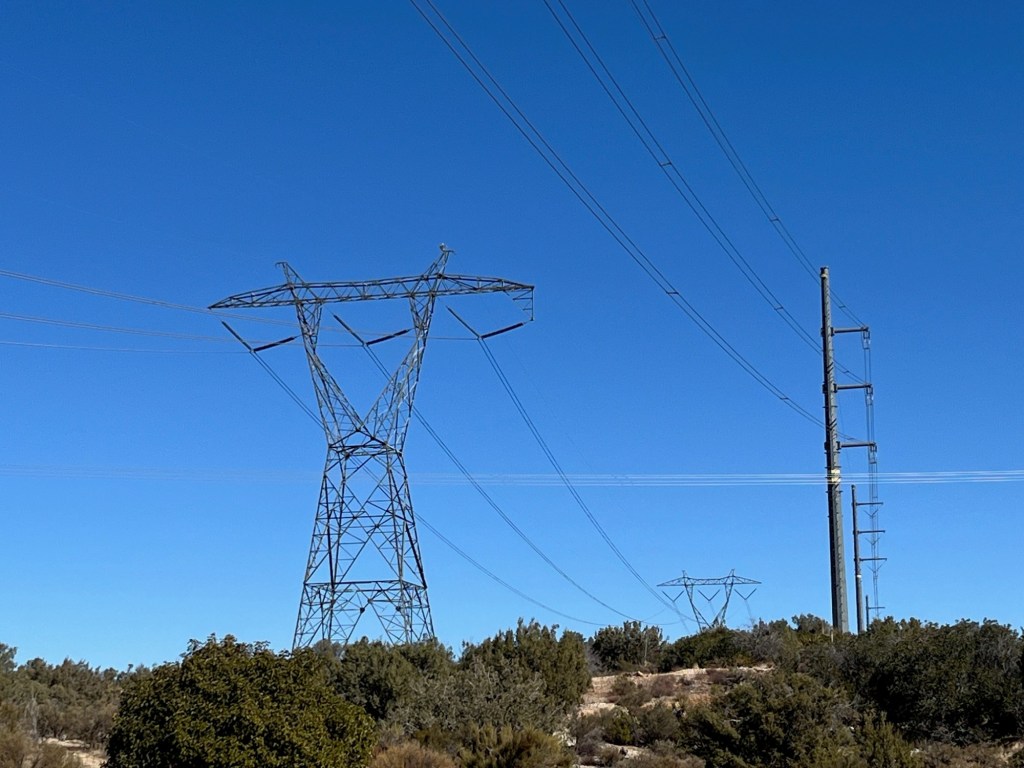
A draft proposal from the California Independent Systems Operator, which manages most of the state’s power grid, recommends $7 billion in transmission build-outs over the next decade to help the Golden State achieve its clean energy goals and meet growing demand for electricity.
Spelled out in 179 pages, the plan recommends 38 transmission upgrades to allow the grid to handle increased load growth over the next 10 years — driven in large part by data centers for artificial intelligence, the electrification of buildings and further adoption of electric vehicles in the transportation sector.
The proposal, scheduled to be considered by the California ISO’s board of governors on May 19, would have financial implications for ratepayers across the state.
The cost of the upgrades will be “ultimately determined,” the plan said, “as part of the rate design process between utilities and their regulatory authorities,” specifically the California Public Utilities Commission, or CPUC.
Potential increases in already-high bills that customers shoulder have become a touchy subject, to say the least. According to the Electricity Price Hub, a public data platform by Heatmap News and MIT, the average residential utility bill in California has jumped 33.7% in the past five years.
“We recognize the concerns around electricity affordability,” Neil Millar, the California ISO’s vice president of Transmission Planning and Infrastructure Development, said, “and are committed in our annual transmission planning process to find ways to meet system needs efficiently and cost-effectively while also providing the best customer value over the long term.”
ISO officials say the infrastructure investments “also have tremendous reliability and economic benefits for California” and the transmission upgrades are needed to bring “de-carbonized power to California consumers and industry across all seasons of the year.”
California has set a goal to derive 100% of its electricity from carbon-free sources by 2045, if not sooner. In addition, Gov. Gavin Newsom wants to phase out the sale of new gasoline-powered cars and trucks by 2035.
Mark Toney, executive director of The Utility Reform Network, a consumer advocacy group based in Oakland, fears the $7 billion figure “could be a low-ball estimate” compared to what the proposed upgrades will eventually cost.
“We’re worried that the affordability crisis is going to get worse, not better,” Toney said.
Pointing to the plan’s reference to predictions of large loads, “we want to make sure that data centers pay upfront for all of the transmission upgrades attributed to their growth and their consumption,” Toney said. “That’s important because otherwise it’s going to fall on ratepayers to subsidize the data centers.”
Gary Ackerman, a utilities and energy consultant with more than four decades of experience in California power issues, said the transmission additions are “critically needed,” and the $7 billion plan appears financially prudent, emphasizing the costs will be spread over the course of 10 years.
Ackerman also pointed to one particular transmission project — the Trout Canyon-Lugo 500 kilovolt line. It’s estimated to cost nearly $1.7 billion. That would account for more than 24% of the $7 billion in proposed upgrades all by itself.
But the project in Southern California Edison’s service territory will go out for competitive bidding, and “Californians won’t be at risk to put the money upfront,” Ackerman said.
“I take comfort in that, and I also take comfort that the cost will be as low as possible,” he said, “because the competitive nature of these things forces people to take a low rate of return and cut costs if they can.”
The ISO’s transmission plan is based on projections that California’s load will grow by 15 gigawatts in the next nine years and 20 gigawatts by 2045, while installed capacity needs to increase by more than 74 gigawatts by 2035 and 107 gigawatts by 2045.
Other proposed infrastructure projects include:
Access to battery storage projects in load centers in San Diego, the Los Angeles Basin and the Bay Area. The battery sites include stand-alone facilities and projects that co-located with renewable energy generation, such as solar.
Importing more than 10 gigawatts of wind generation from Idaho, Wyoming and New Mexico, largely over out-of-state transmission already in the works.
More than 4.5 gigawatts of offshore wind generated within the state.
Despite opposition from the Trump administration, California policymakers are counting on major contributions to the grid from floating offshore wind turbines. The projects are still being developed, but the 10-year plan anticipates 2.9 gigawatts of electricity from Morro Bay and 1.6 gigawatts off the coast of Humboldt.
The draft plan was developed in coordination with the CPUC and the California Energy Commission, with input from industry and other stakeholders.
The California ISO, also known as the CAISO, will hold a public meeting on the transmission proposal on April 15. The public can take part in the hearing by registering at caiso.regfox.com/2025-2026-transmission-planning-process-draft-transmission-plan.
The ISO, based in Folsom, manages the flow of electricity across high-voltage, long-distance power lines that make up 80% of California’s and a small part of Nevada’s power grid.