
A man who was shot by ICE agents in Northern California told his attorney that he only attempted to leave the scene after authorities had already fired on his vehicle — refuting the agency’s account of what prompted the shooting.
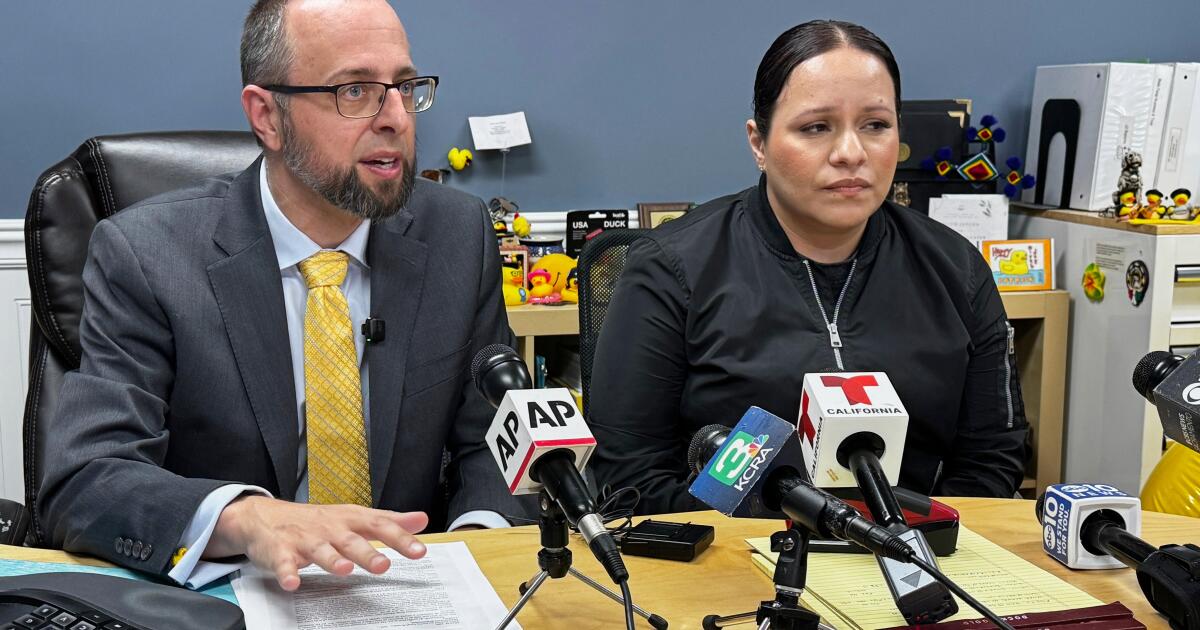
Patrick Kolasinski, the attorney for Carlos Iván Mendoza Hernández, said he spoke with his client at the hospital where he is undergoing several surgeries.
“The one thing he was adamant about was that he was fired on before he moved the vehicle,” Kolasinski said via Zoom from the hospital. “He was very clear on this point, that he moved backwards because he was trying to get away because he was shot at.”
Spokespeople for the Department of Homeland Security and U.S. Immigration and Customs Enforcement referred The Times to an earlier statement issued by acting ICE Director Todd Lyons on X, and did not respond to allegations made by Kolasinski.
After the shooting, Lyons said Hernández, a 36-year-old Salvadoran national, had “weaponized his vehicle in an attempt to run an officer over.”
Kolasinski, however, said, “It’s not that his movement of the vehicle triggered the shooting but quite the other way around,” adding that Hernández “fled in a panic because he was fired on.”
He said it was unclear how many shots were fired, but that Hernández may have been struck more than six times — including in the face and arm. The shooting is being investigated by the FBI.
“Officers are not being given good rules of engagement and good training on how to keep themselves and others safe,” he said, citing other controversial shootings involving federal immigration agents.
Hernández was shot early Tuesday during a targeted immigration enforcement operation in the area of Interstate 5 and Sperry Avenue in Patterson, a Stanislaus County suburb.
Kolasinski said Hernández told him that he was on his way to work when he noticed police lights and pulled over. He said he thought it was a routine traffic stop.
“Officers came up and asked him for his driver’s license. He handed over his driver’s license and then they told him they were ICE and they’re gonna take him into custody,” Kolasinski said.
Hernández asked to call his fiancee, “and the situation spiraled out of hand,” according to Kolasinski.
“He wasn’t doing what they asked, which is to step out of the vehicle and surrender,” he said. “He was simply saying he better call his [fiancee] and somebody shot him.”
A video obtained by KCRA 3 shows federal officers surrounding a black hatchback that is boxed between two unmarked vehicles on Del Puerto Canyon Road, which becomes Sperry Avenue.
The video shows the driver reversing with the front passenger door open and striking a pickup truck. At least three agents have their guns drawn. The car then goes forward, apparently in an attempt to make a U-turn, and narrowly misses two officers, who open fire.
An aerial view from the station’s helicopter showed several bullet holes in the vehicle’s windshield.
On Tuesday afternoon, Lyons said on X that Hernández was an “18th Street gang member wanted in El Salvador for questioning in connection to a murder.”
Kolasinski disputed those claims. He said his client was not a gang member and that, while Hernández had been accused of murder in El Salvador, he was acquitted of any charges pertaining to that case.
Kolasinski provided reporters with a copy of a five-page court document from El Salvador affirming his claim.
He also said he has retained an attorney in El Salvador to investigate whether there are any outstanding warrants for Hernández.
A Homeland Security spokesperson declined to say whether Salvadorean authorities had requested that Hernández be apprehended.
Kolasinski suspects the federal government may have been tipped off about his client’s immigration status after he was stopped and cited several days earlier for having a cracked windshield.
“ICE got bad information and acted on it in line with bad training,” he said.
Hernández’s fiancee Cindy, whose last name was not disclosed because she fears for her safety, said he is a loving man and father to their 2-year-old daughter. She said his absence has disrupted their daughter’s bedtime routine. The family lives in Patterson.
Kolasinski has created a GoFundMe page to help Hernández and his family cover medical bills and other expenses.
The incident marks the sixth shooting involving federal immigration agents in California since last August, and the second this year.
In January, Homeland Security said an agent opened fire on a man in a car after he tried to ram his vehicle into federal law enforcement while evading arrest during an immigration operation in Willowbrook.
That incident occurred three days before Border Patrol agents shot and killed 37-year-old Alex Pretti in Minnesota. Both shootings happened a little more than two weeks after an ICE agent shot and killed 37-year-old Renée Good.
The killings sparked congressional hearings, a partial government shutdown over Homeland Security funding and nationwide protests against the Trump administration.
Homeland Security maintains that there has been an increase in violence against federal immigration agents and officers.
Although there have been incidents of violence against agents, including the shooting death of Border Patrol agent David Maland in northern Vermont, controversial shootings and an unprecedented loss of federal court cases against suspects have raised credibility concerns about Homeland Security and its sub-agencies — including ICE and Border Patrol.
In August 2025, Border Patrol agents opened fire on Francisco Longoria, his son and 23-year-old son-in-law after breaking the driver’s side window of his truck, prompting him to drive off.
At the time, Homeland Security officials accused Longoria of driving toward agents and injuring them; surveillance video captured from across the street appeared to refute that. The agency arrested Longoria and charged him with assault on a federal officer. The agency later dropped the charges.
In October, ICE officers opened fire twice in two separate incidents: one in South L.A. and the other in Ontario. In the first shooting, Homeland Security officials accused a man of weaponizing his car and ramming a law enforcement vehicle in an attempt to flee.
But bodycam video raised questions about the moments leading up to the shooting. The man’s car also did not appear to be moving. A federal judge dismissed the charges against the man.
Kolasinski said Hernández is grateful for the public’s support.
“I can just tell you from what I saw, he is in significant pain,” Kolasinski said. “He is not really able to move around much and he has a long recovery ahead of him.”