
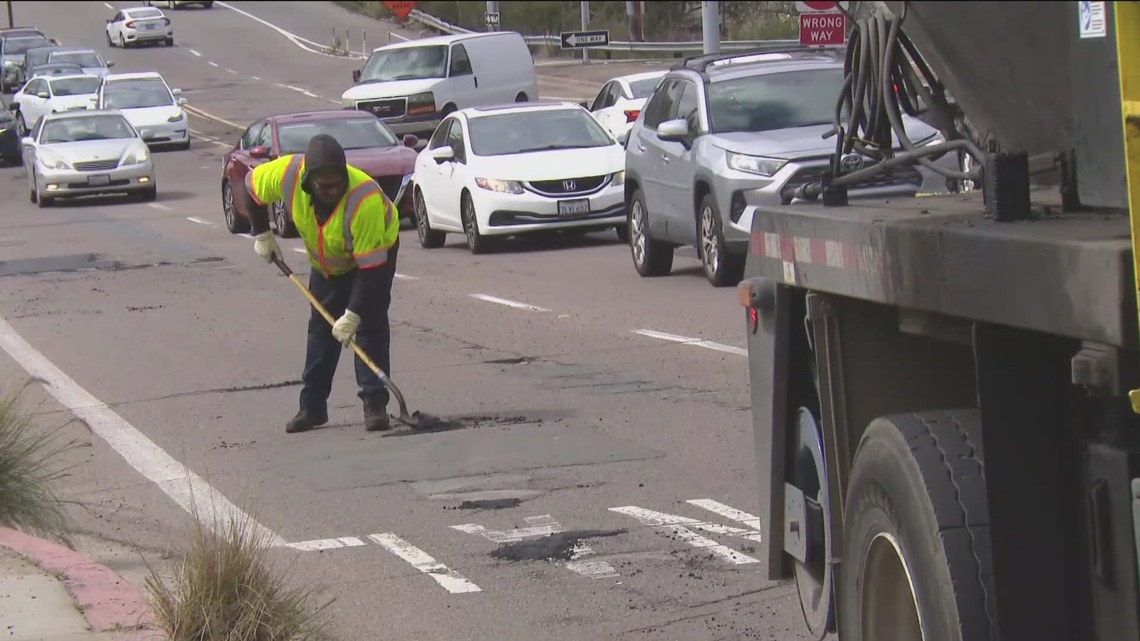
Self-driving vehicles can map road damage in real time, helping other cars steer clear, and potentially giving cities faster ways to fix potholes.
SAN DIEGO — Drivers in San Diego know potholes are hard to avoid and expensive to ignore. On busy roads like Mira Mesa Boulevard, hitting one can mean anything from a rough ride to serious vehicle damage.
“Potholes are very dangerous. They cause a lot of tire damage, front-end damage,” said driver Tom Aylott.
And it’s not just drivers feeling the impact. Cyclists say the bumpy rides are just as frustrating and costly.
“Yeah, there’s a lot. I’ve gotten like six flat tires just hitting them,” said bike rider Calen Mallory.
Now, companies like Waymo and Waze are working on technology designed to change that. Using sensors built into their self-driving vehicles, Waymo cars can detect potholes as they drive. The system relies on the vehicle’s motion control, essentially sensing how the car reacts when it hits a dip in the road.
“It’s through our motion control system. We basically feel the car might vibrate or tilt when we go over these dips, and that’s the information that we collect,” said Arielle Fleisher, a policy development and research manager at Waymo.
That information is then mapped and shared across vehicles, allowing other cars in the network to avoid the same trouble spots in real time. Now, that same data is also being shared with cities through the “Waze for Cities” platform, a system that connects road data directly with local governments.
“We realized, ‘Hey, cities are asking us for pothole data. We’re collecting this pothole data to improve the Waymo driver. Let’s get it to cities, let’s fulfill this need,’” Fleisher said.
The program is currently being piloted in five cities, but Waymo says it plans to expand, including to San Diego. In fact, Waymo vehicles are already test-driving on San Diego streets and freeways ahead of a broader public launch expected later this year. The goal isn’t just smoother rides but safer roads.
“Potholes cause people to swerve, possibly hit somebody that might be in their blind spot. They’re definitely a big, big danger out there,” Aylott said.
Right now, San Diego relies heavily on drivers to report potholes. More than 6,000 complaints have already been submitted so far this year, and it can take crews around 10 days to repair a reported pothole. Waymo says its real-time data could help cities respond more quickly and efficiently.
“If there is a way that the driving apps and maps out there can alert the city as to where the potholes are, that would be a tremendous help,” Aylott said.
When Waymo officially launches its driverless ride service in San Diego, the company says it plans to make that pothole data available to the city, potentially giving crews another tool to find and fix road damage faster.