
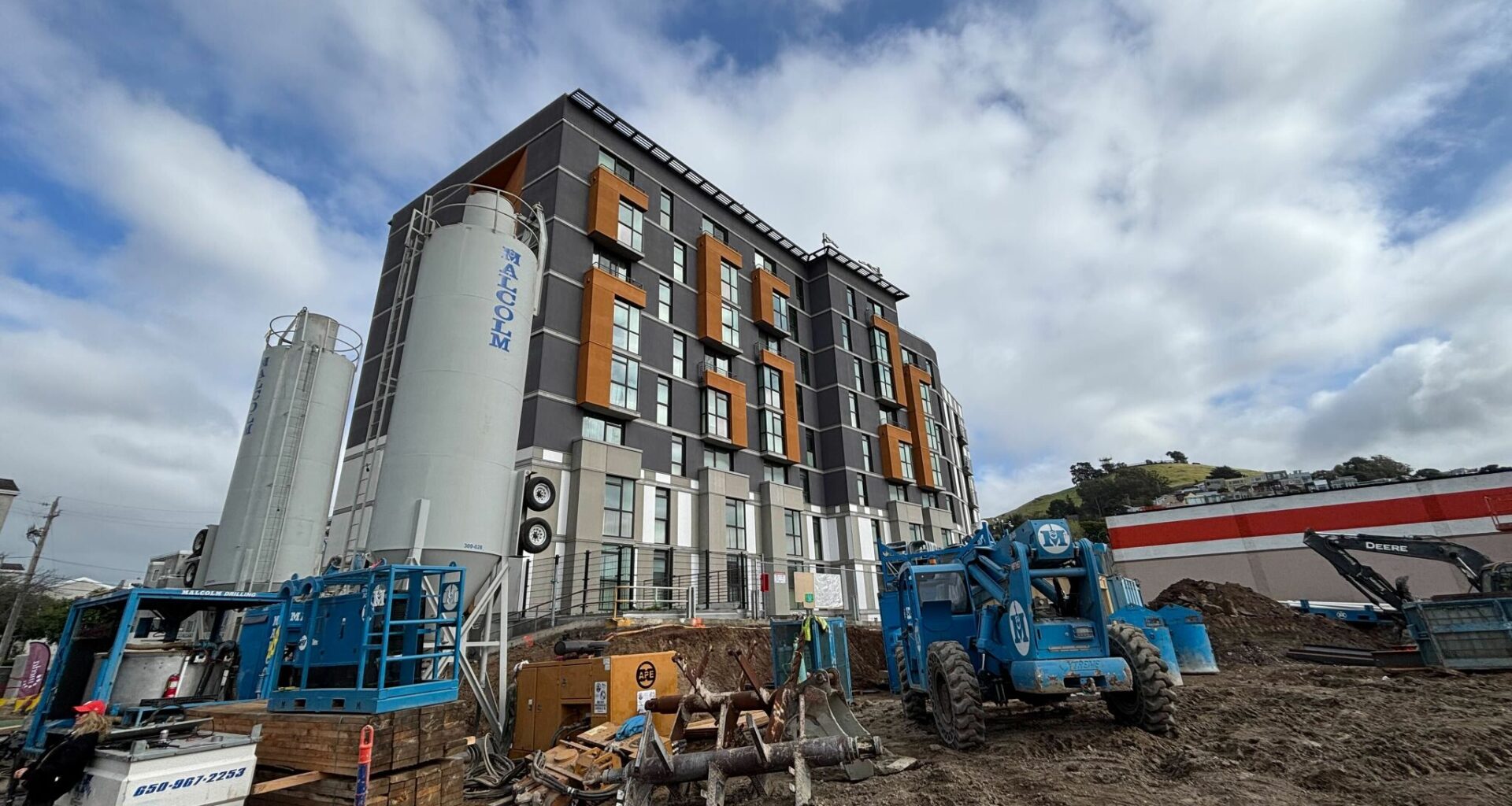
The development at 1515 South Van Ness, shown in 2025, became the largest affordable housing project in 20 years in San Francisco’s Mission District.
J.K. Dineen/S.F. Chronicle
Affordable housing advocates are pushing a new ballot measure in November that would earmark San Francisco’s real estate transfer tax revenue for subsidized housing, setting up a likely fight with Mayor Daniel Lurie amid a difficult budget climate.
Proponents of the new measure said it would dedicate all of the revenue generated by Proposition I — a voter-approved 2020 initiative that increased taxes on high-value real estate deals— to build and preserve affordable housing, rather than leaving the funds available for general city use.
If approved, the new measure, called the Affordable Housing Guarantee Act, would come as a poison pill to a current push by Lurie and Supervisor Bilal Mahmood to roll back San Francisco’s transfer tax on large real‑estate transactions. Lurie and Mahmood introduced a legislative package in January to halve the tax — currently at 5.5% for real estate sales over $10 million and 6% for transactions over $25 million — reverting these rates to pre‑2020 levels in an effort to jumpstart stalled housing projects.
Article continues below this ad
The groups, including the San Francisco Community Land Trust, are seeking to spend Prop. I only on affordable housing, and their measure would keep the tax rates as they are today. The citizen-led initiative will need 12,000 valid signatures to qualify for the November ballot and requires a simple majority to pass. The deadline to qualify ballot measures is July 6.
Lurie’s office did not immediately respond to a message seeking comment on the measure. However, the mayor is facing huge budget deficits for the foreseeable future, which means he will likely want maximum flexibility on how city revenue is spent.
San Francisco Chronicle Logo
Make us a Preferred Source to get more of our news when you search.
Add Preferred Source
The “Guarantee Act” comes with a new provision meant to appease Prop. I critics: residential buildings of four or more units that are selling for the first time in the five years after completion are exempt from the transfer tax — a response to concerns about the levies discouraging new housing construction. Other groups that worked on crafting the “Guarantee Act” include the Council of Community Housing organizations, the Race and Equity in All Planning Coalition and the San Francisco Anti-displacement Coalition.
Their measure comes as San Francisco’s housing landscape is bifurcated. New construction has slowed to a trickle, while blockbuster property transactions, like the recent sale of the Transamerica Pyramid, which sold for $691.6 million last month, continue to generate outsized tax receipts. Prop. I, which was spearheaded by former Supervisor Dean Preston, raised transfer tax rates on property sales above $10 million with the intent of funding affordable housing but it was written in such a way that it gave discretion over how to spend it.
Article continues below this ad
Prop. I has raised more than $400 million in tax revenue since its passage five years ago and it’s expected to raise another $109.6 million in the current fiscal year and about $100 million annually over the next four years. The Controller determined in a March report that the city would lose $390 million in revenue over the next four fiscal years if the transfer tax is reduced.
Prop. I was originally designed and intended as a tool to support the city’s housing goals, particularly around affordable housing and anti-displacement efforts, said Kyle Smeallie, policy director for the San Francisco Community Land Trust and former chief of staff to Preston. However, it was structured as a general tax rather than a dedicated tax per the advice of the City Attorney, meaning funds from the tax have more recently been used for non-affordable housing purposes, he said.
Smeallie said that the legal landscape has shifted since 2020. Multiple jurisdictions in California have passed dedicated transfer taxes for affordable housing, including Los Angeles in 2022 and Santa Cruz in 2025.
“Based on that, we believe that there is a clear legal path to dedicate these funds,” Smeallie said. He confirmed that, regardless of what happens with the mayor’s effort to scale back the tax, the Guarantee Act, if approved by voters, would “restore Prop. I as it currently is and dedicate its revenues to affordable housing.”
“If our measure doesn’t pass, then (the city) would be blowing a $400 million hole in the budget,” Smeallie said.
Article continues below this ad
Under the Guarantee Act, a minimum of 60% of Prop. I revenues would be dedicated to new affordable housing construction, while 25% would fund the acquisitions and preservation of existing buildings. Programs that serve to stabilize the city’s tenants and prevent homelessness would get 10%, and the rest is earmarked for administration and oversight.
The groups championing the new measure have said that they are frustrated that the Mayor’s Office has not committed to a clear plan for funding affordable housing construction and preservation as the city faces a looming state mandate to allow for the construction of 47,000 affordable homes. The city faces a $26.6 billion funding gap over the next decade to fully build out the required affordable housing, according to Prop. I’s advocates.
“There are more than 17,000 approved affordable housing units in the current pipeline awaiting subsidy. Where is the plan to fund those homes?” CCHO Executive Director Quintin Mecke told the Chronicle.
Earlier this week, a key committee of developers and advocates advising City Hall voted to slash the percentage of affordable units that developers must include within their market-rate housing projects to 5%, down from the current 15%. They conceded that the higher requirements have made many projects financially infeasible in today’s high-cost, high-interest-rate environment and have contributed to a sharp slowdown in housing construction.
Some members only agreed to the dramatic reduction pending a commitment from Lurie to identify and secure alternative funding streams — including dedicating revenue from the city’s transfer tax to affordable housing.
Article continues below this ad
But developers serving on the committee pushed back against dedicating Prop. I funds to affordable housing.
Strada Investment Group Managing Partner Jesse Blout called the transfer tax “pretty lumpy” because it might balloon in good times and dwindle in down years.
“It’s inherently not a consistent source of revenue year-to-year,” he said. “If the goal is to create a long-term sustainable source (for affordable housing), it’s probably not the best bucket to count on.”
Erique Landa, a managing partner with the group developing Dogpatch Power Station, said transfer tax scares off the equity investors who are needed to get housing going. He said that other funding mechanisms should be explored, including increasing the Housing Trust Fund.
“Prop. I makes housing more expensive,” said Landa, who called the transfer tax a “major obstacle on our city’s ability to attract equity for all kinds of projects.’
Article continues below this ad
“Right now we have the highest transfer tax in the country and if we reduce it to where it was (before 2020) we would have the second highest in the country,” Landa said.
Mahmood, the city supervisor seeking to scale back Prop. I agreed. He said that increasing the transfer tax has added a per-unit cost of $32,000 to the price of building housing, citing a 2020 report from the Controller’s Office.
“The Building Trades have indicated that not only are housing projects that are not penciling leaving them out of work, but also the tenant improvement work they do on offices that have sold,” Mahmood said.
Labor leader Rudy Gonzalez, representing the San Francisco Building Trades, said “people need to be clear eyed about the economic conditions that we’re facing. San Francisco has been suffering from a construction recession for the last several years now.”
“Ideology doesn’t build and create jobs for blue collar workers in San Francisco, feasibility and understanding the economics of construction does,” Gonzalez said.
Meanwhile, proponents of the Guarantee Act said that more than half of the transfer tax revenue comes from office sales, not multifamily housing.
“Construction costs, interest rates, and capital markets are the binding constraints — not transfer taxes,” Mecke, of CCHO, said in a statement to the Chronicle.
The repeal effort by Mahmood and Lurie includes both an ordinance and a not-yet-filed ballot measure: The ordinance would roll back transfer tax rates, while the measure would eliminate a loophole that lets some investors avoid the tax through out-of-court foreclosure deals.
Mahmood said the ballot measure proposed as part of the Build Act would ensure that properties trading hands through these proceedings would also be subject to the lower tax rates.
Mahmood said his legislative package with Lurie also commits the city to creating a working group to study funding paths for affordable housing.
But the groups seeking to use Prop. I only on affordable housing aren’t persuaded.
“The core of our measure is: People who are trading buildings at $10 million or more have to be paying more of their fair share to address the dire need of affordability in San Francisco,” Smeallie, of the Community Land Trust, said.