
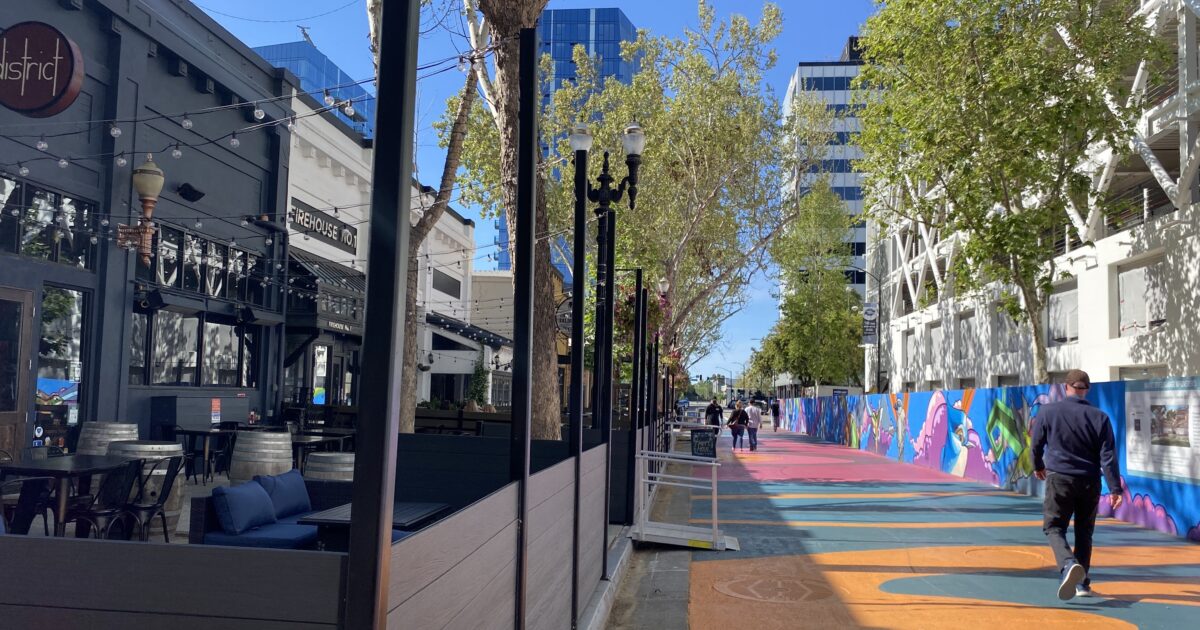
When COVID-19 struck in 2020 and health officials banned most indoor business activities, Doug Cookerly was among dozens of San Jose business owners who took advantage of the city’s emergency Al Fresco outdoor dining program to add outside seating.
“It was a savior,” Cookerly, who owns the bar Hop & Vine located on The Alameda, told San José Spotlight.
But the program — which loosened regulations for businesses to operate on sidewalks, private parking lots and to set up parklets — has since lapsed. To keep using his five sidewalk tables, Cookerly has had to reapply through the city’s standard permit application process. This has meant several months of back and forth correspondence with city officials as he works to meet all the city’s paperwork demands, he said. The application still has not been approved.
“This is literally a pop-up patio,” Cookerly said. “Why does it take six months for you to rubber stamp this?”
With other business owners voicing similar frustrations, a group of councilmembers is pushing to revive the outdoor dining program and make it permanent.
Under a new proposal approved by the Rules and Open Government Committee earlier this month, the City Manager’s Office has been tasked with drawing up a plan to reduce the regulatory barriers many say have discouraged businesses from even attempting to offer al fresco dining. A memo outlining the request had the sign on from Councilmembers Peter Ortiz, Anthony Tordillos, Rosemary Kamei, David Cohen and Michael Mulcahy.
“These changes would help maintain the accessibility that defined Al Fresco’s success while providing businesses with a predictable, efficient pathway to invest in long-term outdoor dining Improvements,” the councilmembers wrote.
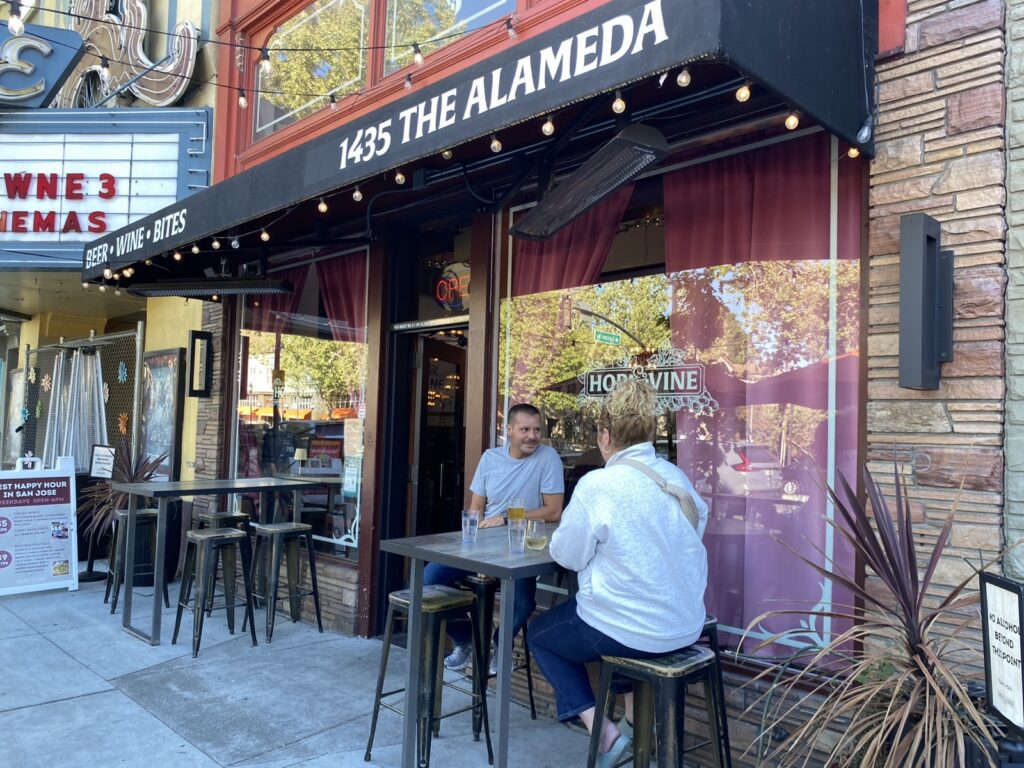 The owner of Hop & Vine on The Alameda said he’s been trying for months to obtain permits for the pop-up patio seating on the sidewalk in front of his establishment. Photo by Keith Menconi.
The proposal — which focuses on certain growth areas like downtown and business improvement districts — directs the city to establish a “clear, predictable permitting pathway” for outdoor dining setups, including patios, railings, pergolas and semi-permanent structures. The memo calls for fast-tracking approval of simple outdoor arrangements that follow city code.
Councilmembers are also asking for a new coordinator role within the Public Works Department. The coordinator would be responsible for shepherding applications for outdoor operations through the city’s sometimes circuitous permitting process, which often involves multiple city departments.
The effort to revive the Al Fresco program — which also covered non-restaurant business activities like outdoor retail — has sparked enthusiasm among San Jose’s business community.
Restaurateur Marcio Da Silva, who owns Silva’s Brazilian Steakhouse on Alum Rock Avenue, said he intends to apply for outdoor seating, but is holding off to see if reforms are adopted — and succeed in making the process easier to navigate.
“Outdoor dining helps the business to increase revenue, attracting more clients, more customers, creating a lively atmosphere that boosts visibility and repeat visitors,” Da Silva told San José Spotlight in Portuguese through a translator.
Nate LeBlanc, economic development director for the San Jose Downtown Association, said such reforms are urgently needed.
“We hear from city leaders that they want vibrancy, that they want us to take advantage of our world-class weather, that they want people interacting in third spaces,” LeBlanc told San José Spotlight. “This desire needs to be codified in an easy-to-follow set of instructions that respects how busy and resource-depleted our small businesses are.”
In contrast to the cumbersome application process reported by business owners today, LeBlanc said application materials could be filed within minutes through an online portal when the Al Fresco program was up and running through 2023.
But for a revived outdoor dining program to be successful, reformers must contend with a host of thorny issues.
During the pandemic years, some businesses objected to the loss of parking spaces claimed by outdoor setups. In addition, some disabled residents said the extra obstructions made public spaces less accessible.

Meanwhile, under the original Al Fresco program, the city handed out $825,000 in grants to help businesses invest in infrastructure such as parklets enclosed by barriers that extended beyond the sidewalk. These grants drew on one-time federal COVID relief funds. Today, it’s not clear where businesses in need of such support will be able to turn.
Financial constraints, along with the temporary nature of the program, likely dissuaded many businesses from taking part, especially those in economically disadvantaged neighborhoods, according to a 2023 report from urban think tank SPUR.
A spokesperson for the City Manager’s Office told San José Spotlight any new proposals for al fresco guidelines would be designed to maintain neighborhood aesthetics, public safety and emergency access, as well as pedestrian access standards that align with Americans with Disabilities Act requirements.
Despite the challenges, a well-designed outdoor program could generate an economic windfall for San Jose, Sujata Srivastava, SPUR’s chief policy officer, said.
“To the extent that you can just create more of a vibrant experience for people, it helps attract more people to the commercial districts and the downtowns,” she told San José Spotlight. “And then that is a virtuous cycle, because the more activity generation you have, the more people you have in the street, the easier it is for other types of businesses to come back to our urban centers.”
Contact Keith Menconi at [email protected] or @KeithMenconi on X.