
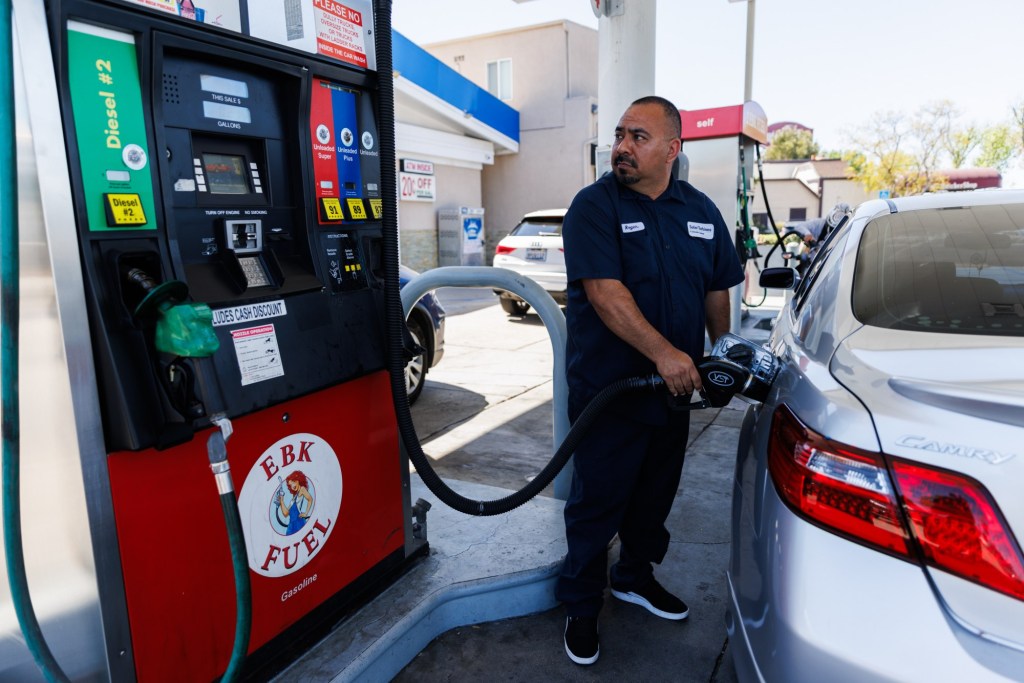
San Diego County’s inflation rate rose in March, along with the rest of the nation, as gas prices surged at the start of the Iran conflict.
The region’s inflation rate was 3.2%, up from 2.6% in January, according to the U.S. Bureau of Labor Statistics’ Consumer Price Index on Friday. The gain was led by a 24.1% increase in motor fuel costs for the two-month period.
The impact of higher oil prices could continue for several months. Iran effectively closed the Strait of Hormuz starting March 2, sending shockwaves through the global oil supply. The strait, where 20% to 25% of the world’s oil passes, was still mostly closed Friday despite a recent ceasefire.
San Diego was not alone in pain at the pump, with national motor fuel prices rising 21.2%. Also, America’s Finest City was uncharacteristically not experiencing the highest inflation in the nation. Denver’s inflation rate was the highest at 4.2%, for the 12 metro areas the bureau released information for. It was followed by the metro areas of New York, up 4%, and urban Hawaii, up 3.7%.
Kelly Cunningham, of the San Diego Institute for Economic Research, said higher oil costs go far beyond just a hit to the wallet at your local gas station.
“Oil prices translate into what we pay at the pump,” he said, “but also filters into costs of transportation to move goods from overseas, and around the country. All of this increases the cost of doing business. Ultimately, the consumer is at the end of the line and pays for it.”
As of Friday, AAA said San Diego’s average cost for a gallon of gas was $5.94 for regular, up from $4.88 a year earlier. Diesel prices were up the most at an average $7.71 a gallon, up from $4.92 at the same time last year.
Cunningham said higher gas prices have a secondary effect on the San Diego economy whereby people feel cash-strapped and don’t spend as much at restaurants, retail stores and other local businesses.
Another report released Friday showed that Americans are feeling worse about the economy than ever before. Consumer sentiment fell in April to 47.6, its lowest on record in the more than 70-year-old University of Michigan Survey of Consumers. That is down 10.7% from the previous month. The previous low point was in June 2022 when inflation exploded across the country, hitting 8% in San Diego County.
On an annual basis, here are the areas where prices changed in San Diego County:
Motor fuel: The price for unleaded regular was up 17.7%; unleaded midgrade was up 17.3%; and unleaded premium was up 16.8%.
Food: Cereals and bakery products were up 2.3%; dairy, up 5.3%; fruits and vegetables, down 1.1%; and meats, poultry, fish and eggs were up 1%.
Energy, including household energy and motor fuel: up 15.9%.
Shelter, including rent and owners’ equivalent of rent, was up 2.5%.
Transportation costs, which include automobile maintenance, vehicle parts and car insurance, were up 5.4%. Used car and truck prices were down 4.1%.
Apparel: It was up 2.8%.
Medical care, which includes hospital and related services, drugs and medical equipment and supplies, was up 5.3%.
When volatile food and energy costs are removed from the overall inflation rate, so-called core inflation in San Diego County was 2.5%, below the nationwide average of 2.6%.
Nationally, inflation was highest in the Northeast at 3.6%. It was followed by the Midwest at 3.4%, West at 3.1%, and the South at 3%.
Inflation rate by metro area
Denver-Aurora-Lakewood, CO: 4.2%
New York-Newark-Jersey City, NY-NJ-PA: 4%
Urban Hawaii: 3.7%
Los Angeles-Long Beach-Anaheim, CA: 3.4%
San Diego-Carlsbad, CA: 3.2%
Riverside-San Bernardino-Ontario, CA: 3.1%
Dallas-Fort Worth-Arlington, TX: 3%
Washington-Arlington-Alexandria, DC-VA-MD-WV: 3%
Minneapolis-St.Paul-Bloomington, MN-WI: 2.8%
Chicago-Naperville-Elgin, IL-IN-WI: 2.3%
Tampa-St. Petersburg-Clearwater, FL: 2.1%
Boston-Cambridge-Newton, MA-NH: 2%
Source: U.S. Bureau of Labor Statistics’ Consumer Price Index