
Caltrans officials are recommending the installation of a roundabout at the Mussey Grade Road and state Route 67 intersection in Ramona, saying it is the best way to reduce the number of fatal traffic collisions.
After considering five options including a signal light, all-way stop, and a right-turn only when exiting Mussey Grade, Caltrans engineers said at a public meeting Thursday that a multi-lane roundabout is the preferred strategy for improving “safety and mobility” at the site.
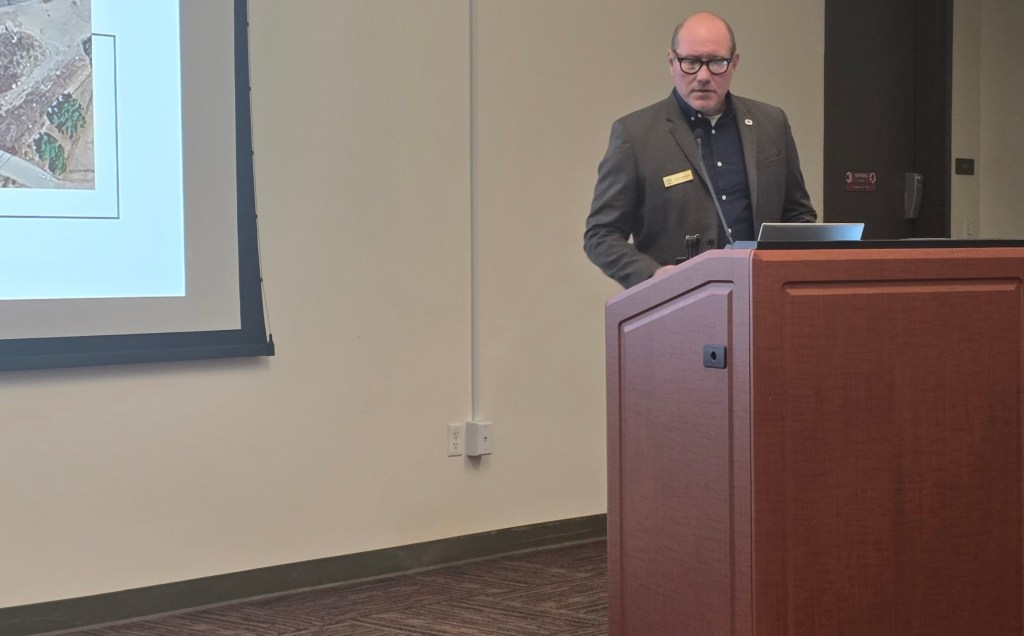
A multi-lane roundabout results in a 78 percent reduction in fatal and injury collisions, said Safwat Ibrahim, a Caltrans chief of traffic engineering and analysis.
“A roundabout works perfectly to meet the comfort of the driver and mobility,” Ibrahim told a crowd of about 200 attendees at the Ramona Community Library.
The solutions not chosen failed to appropriately address the concerns and challenges of Mussey Grade, Caltrans officials said, but they stressed alternatives for the intersection will continue to be studied.
One of the key safety features of the roundabout will be reducing the speed limit to 25 miles per hour versus the 55-plus mph speed limit that drivers are accustomed to, Ibrahim said. The consequences of a collision at high speeds are much worse, he said.
Julie Gallant
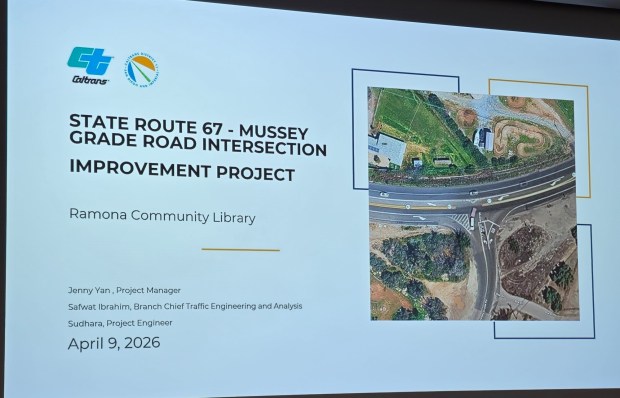
Caltrans gave a presentation on the state Route 67 – Mussey Grade Road intersection improvement project on April 9 at the Ramona Community Library. (Julie Gallant)
Two fatal collisions occurred at the intersection in 2022. Among them was a June 6 head-on collision that pushed the vehicle of a 90-year-old man backward into the path of another vehicle. The collision led to the man’s death. A Sept. 19 rollover crash resulted in the death of a 68-year-old Ramona woman when she attempted a left turn from westbound Mussey Grade to south SR-67 and was broadsided by a pickup truck.
Caltrans showed several intersections in California that already have roundabouts. Among them are U.S. 50 and state Route 89 in Meyers and the state Route 129 and Lakeview Road intersection in Watsonville. Caltrans is also working on a half-dozen roundabouts in San Diego and Imperial counties, Ibrahim said.
“We’re trying to make roundabouts more common in California,” he said. “This is the future of it. It’s a proven countermeasure.”
Not all of the meeting attendees were on board with the concept of a roundabout.
One woman questioned the ability of motorhomes and campers with trailers to navigate through a roundabout during bumper-to-bumper traffic. Sometimes these recreational vehicles caravan in groups of 10 or more, especially during peak camping periods, she said.
“When you do your studies, go to the intersection at certain times of the year and at certain times of the day,” she said.
Caltrans engineers responded that the proposed multi-lane roundabout can handle numerous trucks traveling through the lanes and the design can accommodate the largest types of semi trucks.
“The largest size trucks will fit and go through at a reasonable speed,” said Steve Welborn, public affairs manager for Caltrans District 11. “To keep traffic moving and safe, this is the solution.”
Others in the audience questioned why Caltrans is focusing on a roundabout while continuing to study options.
Ramona resident Kim Newcomer asked if Caltrans considered acquiring property on Dye Street that could be used as a route to connect to a signalized intersection at Dye Road.
Welborn said that option would require the agency to take ownership of Dye Street property.
“Everything built here is in the state’s right-of-way so no land is taken away and there will be no land acquisition process,” he said of the proposed roundabout. “The designs we’re studying have no intention of taking any land.”
Casey Lynch, the former Ramona Community Planning Group chairman who now serves on the Ramona Municipal Water District board, said a Dye Street connection to Dye Road was considered years ago. That option was rejected because the property is on county-maintained land and is not owned by Caltrans, he said.
Lynch suggested an interim solution could be to add flashing warning lights to slow traffic down. He said it could be particularly helpful during daylight hours when it’s difficult to see oncoming traffic.
Julie Gallant
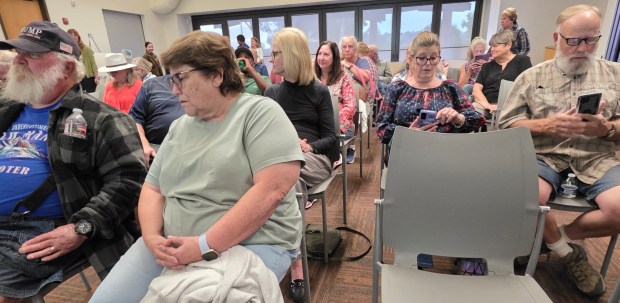
About 200 attendees listened to a presentation and asked questions about potential Mussey Grade improvements during an April 9 Caltrans meeting in Ramona. (Julie Gallant)
“We have to make decisions for the greater good of the whole,” Lynch said. “My opinion is we want the best solution to keep everybody safe.”
He said roundabouts such as the one at Miller Road/Valley Center Road in Valley Center are gaining in popularity and people will start to encounter them more often.
When questioned about the option to add a signal light at the Mussey Grade intersection, Caltrans engineers said a signal is not the safest control of the T-shaped intersection.
Welborn said a signal light would cause traffic to back up for a half-mile in each direction at the Highland Valley/Dye Road intersection and at the Rancho de Oro Drive intersection on SR-67.
“The conclusion of modeling is that signalization would not be safer than a multi-lane roundabout,” he said, adding that Caltrans staff are studying other improvements such as additional signs, road striping and channelizers at the intersection. “It would have more issues.”
One woman in the audience agreed, saying “massive accidents” still occur on SR-67 at the signalized intersections with Poway Road and Scripps Poway Parkway.
“Please understand, change in the community is hard but this is their job and they’re experts on it,” she said. “It’s really difficult to bury friends and family. We need to make decisions and choices for safety.”
Another improvement suggested at the meeting is enabling drivers to make a U-turn at the Highland Valley/Dye Road intersection. That would enable drivers to turn right from Mussey Grade onto SR-67 without having to cross two lanes of traffic to turn left onto the highway.
Sam Amen, Caltrans District 11 division chief of design, said designing a U-turn could be possible but may involve a costly land purchase and additional studies.
Welborn said the next step in the process is an environmental study to determine how homes and businesses could be impacted by improvements near Mussey Grade. That phase could take a year or two, followed by a design phase and then a construction phase, he said, adding that more community meetings will be held to address the Mussey Grade Road intersection in the future.