
Faced with rapidly declining ecosystems around the world, Scripps Institution of Oceanography and the San Diego Zoo Wildlife Alliance have entered into a partnership, combining forces to develop conservation solutions more quickly at a time of urgent need.
The esteemed San Diego institutions have agreed to work together in three areas: sharing best practices for collecting and cryopreserving living cells in biobanks; using technology to create a virtual ecosystem that can be studied and used in simulations; and developing the next generation of conservation leaders at UC San Diego.
“This partnership is an example of the strategic thinking and the strategic approach that we want to bring to our future,” said Dr. Nadine Lamberski, the alliance’s chief conservation and wildlife health officer.
“This is a time when biodiversity loss is happening at the speed and scale really making it difficult for us to keep pace,” Lamberski said. “We don’t have many years left before we’ve caused irreparable harm to our planet, and combining forces is the most effective and efficient way” to come up with solutions.
The formal partnership grew out of collaborative work involving both organizations over the past couple of years.
Scripps and the alliance are each 100-plus-year-old institutions with different strengths and areas of common interest.
It brings together “the depth of scientific acumen” of Scripps with alliance experts who practice applied conservation science and work closely with indigenous communities around the world, Lamberski said.
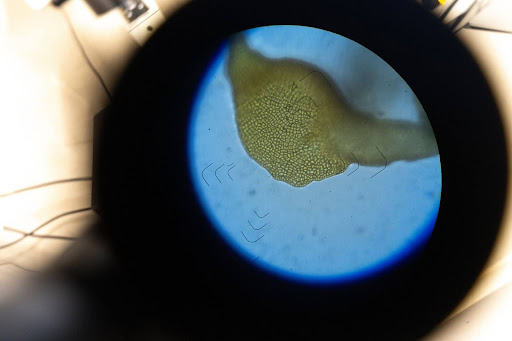 Researchers are working with embryos of giant kelp in the lab at Scripps Institution of Oceanography, where experiments are underway to grow kelp from frozen samples. (Erik Jepsen/UC San Diego)
Under the partnership, zoo experts will host workshops for Scripps researchers on biobanking techniques. Zoo researchers began amassing its Frozen Zoo more than 50 years ago. It is the world’s largest and most diverse cryobank for endangered species.
Scripps also holds a vast collection of marine organisms in its Scripps Oceanographic Collections, and the two organizations are identifying sampling opportunities for fish, invertebrates, microbes and seaweeds that are not in the zoo’s collection. Scripps scientists are also working to gather and preserve giant kelp embryos and genetic material as kelp forests rapidly decline along the California coast.
Collecting such material preserves genetic diversity and provides an emergency backup for species in decline and at risk of becoming extinct.
“We are trying to make them evolve as one, and that means that the best practices that were used to create the Frozen Zoo or the frozen aquarium can be cross-pollinated to make one really good system that works effectively,” said Dr. Jack Gilbert, deputy director of research at Scripps Oceanography.
He said the two institutions need to be “making sure we’re conserving the land and the ocean at the same time, in the same way, in a way that would facilitate us recreating those environments in the future, if we needed to.”
Gilbert said Scripps scientists will adopt methods that have worked well for the zoo. “We want to make sure that whatever they’ve learned, that we adopt it, whatever we’ve learned, they adopt, so that we’re working together to create a stronger future for conservation action,” he said.
Under the partnership, the two organizations are also creating an artificial intelligence-powered “digital twin” or virtual copy of a real-world ecosystem, initially focusing on a 900-acre reserve in North County near the Safari Park. The project will give scientists the chance to simulate and predict the impact of climate and other factors.
Gilbert said the digital twin initiative leverages Scripps Oceanography’s expertise in marine science, weather forecasting and machine learning, with the alliance’s knowledge of wildlife and conservation practices.
The prototype, described by officials as “an intricate digital replica” of the Safari Park Biodiversity Reserve, will look at a wide array of data, including information from trail cameras, acoustic recorders, environmental DNA sensors and weather stations, as well as other factors, such as human activities in the area.
“We’re taking all of that information and asking AI, what are the connecting pieces here between these features, which might help us to identify a lever, like a dial, that we could either dial up or dial down, that would affect real and beneficial change in the conservation practice,” Gilbert said.
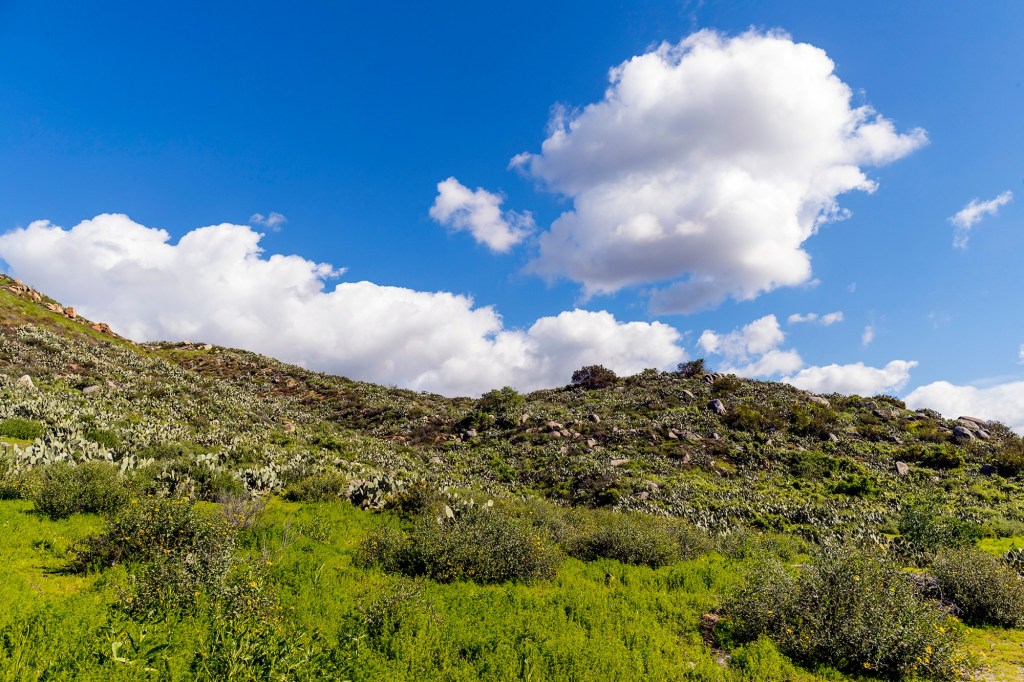
Scientists will initially focus on the cactus scrub habitat in the preserve, which is home to threatened and endangered species, and use predictive analysis to see what happens if changes occur, such as if rainfall increases or decreases, or if vegetation types change from grass to shrubs.
And they have a real-world problem they are trying to solve — how best to address an invasive plant called the stinknet or globe chamomile. The plant, which is native to South Africa, has spread across San Diego County and east into Arizona and is a problem because it overtakes native plants, and its dried-out yellow flowers serve as fuel for brush fires.
“What we’d like to do is understand how the stinknet is spreading and intervene upstream, and not wait for the plant to flower,” Lamberski said. “Using this predictive model, we can test various interventions or strategies to try to control and eventually prevent the spread of stinknet.”
Megan Owen, the vice president of conservation science at the alliance, said the prototype “has the potential to revolutionize conservation science.”
Gilbert said the biobanking and digital twin projects are key pieces in the conservation effort — with one serving as a backup if conservation efforts falter.
“If we fail to be quick enough in our ability to conserve environments effectively, then we need to be able to dip into our frozen zoo or our frozen aquarium to facilitate restoring the species, which could be keystones of ecosystem restoration in the future,” he said. “We can only move as fast as our ability to improve the management practices for conservation broadly.”
The third facet of the partnership focuses on education, helping build a pipeline for university students interested in pursuing careers in conservation. That effort includes developing classes in applied conservation and providing internships and other professional opportunities for students and graduates to work hands-on with organizations around the world that partner with zoo researchers.
“We really need more folks who are trained and able to take significant conservation actions that will stop the loss or the degradation of natural areas as well as species declines,” Lamberski said.
While scientists are expanding biobanking of endangered species and using technology to come up with innovative solutions, Lamberski stressed that the best option is protecting what still exists in nature.
“There really is no substitute for nature itself, and efforts really should be focused on preserving and safeguarding the natural system that we have in front of us,” she said. “These are tools that we can use if we have to, but wouldn’t it be great if we didn’t have to use them?”