
In the 1960s, to build the Grove-Shafter Freeway through Oakland, Caltrans razed a home on a small lot at 53rd Street and Shattuck Avenue, then left it to sit vacant. In the decades since, it has been a parking lot for a nearby auto body shop, a weekend gathering spot for teenagers and a dumping ground for garbage.
But over the past year, a group of neighbors has worked alongside Caltrans to give this lot at the end of their residential street a new life. On a sunny weekend in March, they gathered in the shadow cast by the freeway above with their shovels and safety vests to plant a pollinator garden.
“The highways cut through neighborhoods and left all these lots that weren’t planned for,” said Rob Selna, who leads the Sidewalk Trees and Gardens community group. “They’ve just stayed empty for decades. We wanted to reclaim it.”
At left, Fasih Awan and Naomi Wiener, volunteers for Sidewalk Trees and Gardens, plant a tree in an abandoned lot in Oakland to beautify the neighborhood and discourage illegal dumping. Nathan Weyland/For The S.F. Chronicle
Perhaps no other city in the Bay Area has been carved up by highways the way Oakland has — four interstates and a state highway run through the city, 180 miles of roadway. But Caltrans bought more right of way than it needed, leaving behind a scattered geography of leftover land beneath overpasses or wedged near on-ramps.
These leftover parcels are a magnet for illegal dumping and encampments. In Oakland alone, Caltrans spends close to $1 million a year cleaning up trash on these sites.
But city leaders and groups of motivated neighbors are looking to turn some of these Caltrans rights of way and vacant lots into places that people actually use, with hopes it will discourage dumping and help stitch together neighborhoods divided by freeways.
“You can keep picking up trash and calling 311, but unless you change the space itself, you’re just going to be running on a hamster wheel,” Selna said. “If we have people investing in a space, then it gets maintained, and it’s not as much of a target.”
Sidewalk Trees and Gardens volunteers recently planted this yaro seedling on a vacant lot in Oakland. Steve Keller, a volunteer for Sidewalk Trees and Gardens, waters a newly planted tree at 53rd Street and Shattuck Avenue in Oakland. Nathan Weyland/For The S.F. Chronicle
Redesigning spaces is just one strategy among many to discourage dumping. Last month, Mayor Barbara Lee and Council Member Zac Unger announced new legislation that would increase fines on illegal dumping to $1,500 from $750 for first-time violators. And state Sen. Jesse Arreguín, who represents Oakland and Berkeley, is sponsoring a bill that would deny vehicle registration renewal to people who haven’t paid fines for illegal dumping.
By transforming the lots, Selna hopes they’ll change behavior in a way that enforcement alone can’t. Sidewalk Trees and Gardens spent the past year working with Caltrans through its Adopt-a-Highway program, getting permits, recruiting a landscape architect and lining up volunteer labor to turn the Shattuck Avenue lot into a garden.
“It feels like a destination — not just somewhere to get through,” said neighbor Stephanie McKenna, seated on one of the log benches donated to the park.
John Miller, 63, right, and Demetriause Britton, 61, left, talk near Miller’s car, across from Grove Shafter Park in Oakland. Yalonda M. James/S.F. Chronicle
Beyond these vacant parcels, the Oakland Department of Transportation is also looking to redesign a few of the underpasses along Interstate 880, which cuts between downtown and the waterfront. The upgrades are meant to be relatively simple — better lighting, some murals — in an effort to make the spaces feel less like tunnels and more like streets.
Oakland Transportation Director Josh Rowan remembers his first visit to Oakland, when he tried to walk with his family from their hotel downtown to Jack London Square. As they approached the underpass from Broadway, they decided to turn around.
“The darkness, more than anything, scares you off,” said Rowan, who now lives in Jack London Square and makes the traverse daily. “The underpass completely separates Jack London from the rest of the city.”
Other cities offer examples of more ambitious underpass transformations that have sought to renew these spaces with activity. Toronto placed a skatepark under one of its major underpasses. Miami is developing a linear park beneath its elevated metro lines, with basketball courts, gardens and eventually pickleball.
Some transportation activists are even encouraging Caltrans to tear down Interstate 980 entirely. The freeway, which separates downtown and West Oakland, was one of the last pieces of the city’s highway system to be built, opening in 1985. Removing it could free up 42 to 67 acres for new development.
But even if Interstate 980 came down, that would still leave hundreds of parcels under and along Oakland’s other highways.
Campers and RVs are parked in the shadows of the MacArthur Maze on Martin Luther King Jr. Way. Yalonda M. James/S.F. Chronicle
The city has placed boulders at an Interstate 880 underpass at Seventh and Castro streets in Oakland to deter encampments. A pedestrian walks underneath the underpass at Broadway and Interstate 880, one of the intersections that Oakland is looking to improve with additional lighting and art. Yalonda M. James/S.F. Chronicle
The idea of transforming these spaces isn’t new — and it’s already been done with success in Oakland. In the late 1990s, as Caltrans was planning for a seismic retrofit of the Grove-Shafter Freeway, the Rockridge Community Planning Council convinced the agency to build a dog park beneath the highway. Later, neighbors helped revive a nearby creek and construct a playground for what is now Frog Park.
Caltrans might be willing to sign off on a project’s development, but typically upkeep falls on either the city or residents, Rowan said. There are plenty of examples of what happens when a citizen-led initiative loses steam.
In 1968, a group of neighbors in Oakland’s Longfellow neighborhood rallied to convert vacant Caltrans land under the weaving freeways of the MacArthur Maze into a public park. Grove-Shafter Park opened in 1972 — debuting wooden play structures, a picnic area and a miniature train made out of logs.
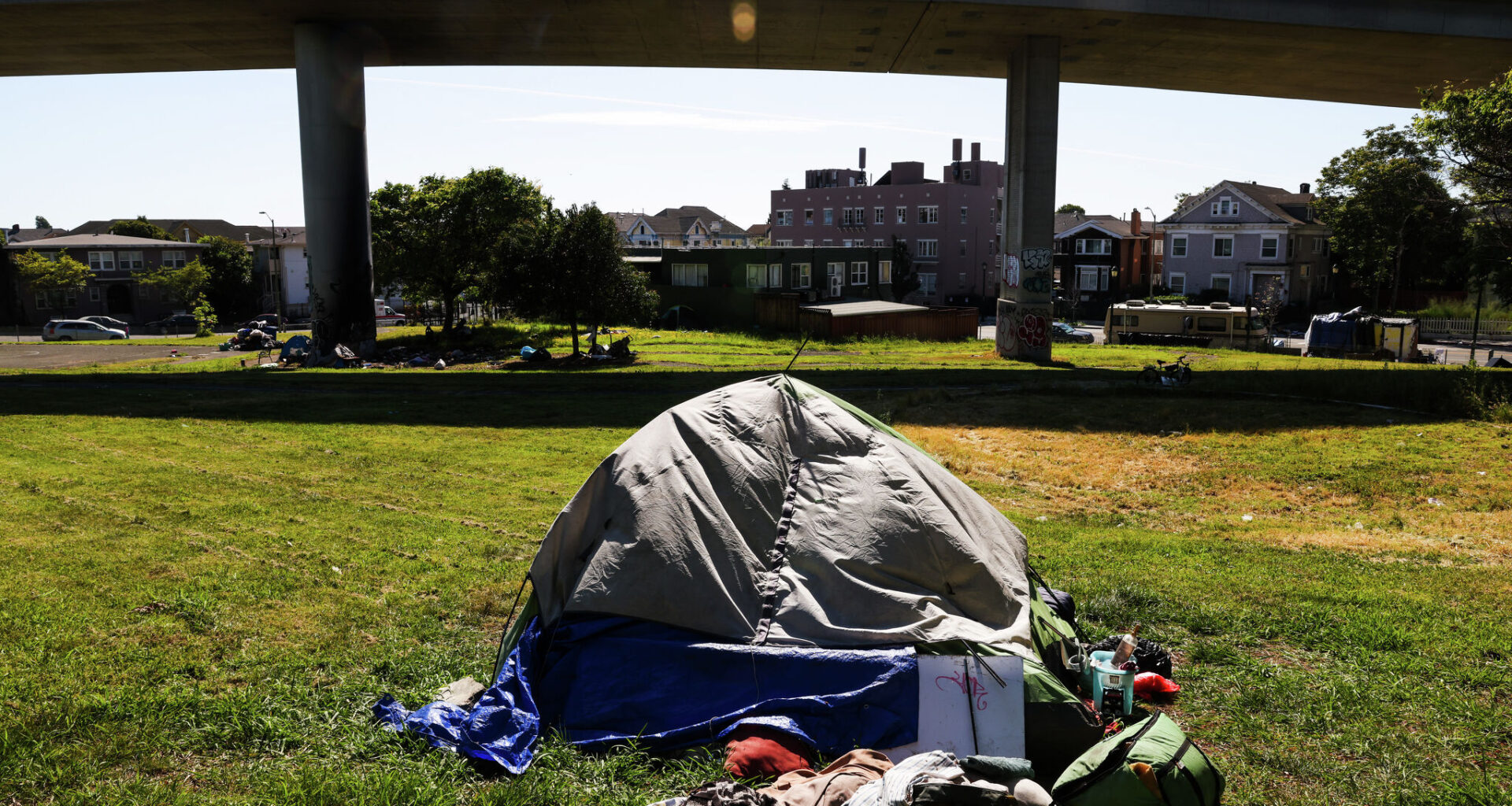
Today, little of the original park remains. Unhoused people live around the park’s edges in RVs, and in tents clustered at the park’s back edge.
The park has also become a dumping ground. On a recent spring afternoon, a couch stripped of its cushions leaned vertically against one of the massive concrete pillars. Cans of tomato sauce littered the overgrown grass. The park’s only evidence of children was a pile of faded picture books, their pages warped by rain.
On the northern side of the park, a 30-something man who identified himself only as Bob shoveled dirt into a pile.
He, too, was reclaiming the space, albeit unsanctioned. He pointed to a few makeshift ramps for BMX bike riders that “volunteers” like himself had installed, including an unfinished one. A dozen bags of concrete mix were still sitting next to it, apparently left behind for whoever wanted to take over the project.
“It’s an unused space,” Bob said. “We’re trying to use it.”
John Miller, 63, picks up trash tossed near his car. He said people frequently dump garbage along the freeway where he lives. Yalonda M. James/S.F. Chronicle
Many of the spaces under Oakland’s freeways have already been claimed — just not in the way the city or Caltrans had in mind.
Because they are largely out of the way, underpasses have become some of the most durable sites for encampments. While Caltrans has swept a few — including the city’s largest encampment at Wood Street in 2022 — the underpasses still attract RVs and tents, offering shelter from the elements and a space where the unhoused feel they won’t be bothered.
Across from Grove-Shafter, underneath the overlapping concrete of the MacArthur Maze, John Miller, 63, lives out of his pale blue Honda Odyssey. He moved to this spot about a year ago, after the city placed bollards along an underpass he was living on a few blocks away.
“They can put bollards over here and over there, but they’re not going to stop it,” Miller said.
On Tuesday afternoon, he carried a bucket and trash-grabber, picking up bottles and to-go containers from the sidewalk outside his home. People were illegally dumping there all the time, he said. He tried to keep the area outside his car clean.
But where would he dump the bucket of trash he’d collected?
“Across the street, at the park.” The city, he said, would eventually pick it up.