
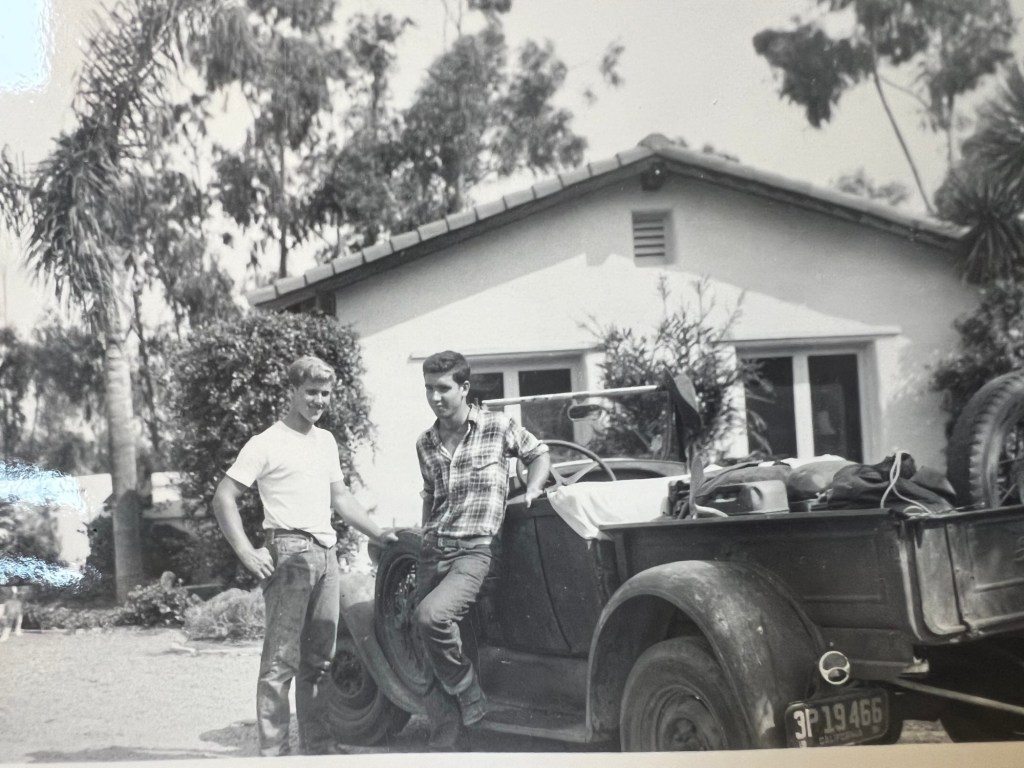
In the Curator’s Words is an occasional series that takes a critical look at current exhibitions through the eyes of curators.
It’s rare for modern-day artists to have exhibitions of their work curated by a family member. So it was a welcome surprise to hear that Brennan Hubbell is the man behind “Brothers in Arts: James Hubbell and Bert Hubbell,” which opened April 11 at the Oceanside Museum of Art. The brothers passed away within weeks of each other in 2024.
In an interview with the Union-Tribune, the younger Brennan, an accomplished artist himself who lives in La Mesa, said: “The two brother artists in this show, James Hubbell and Bert Hubbell, are also my father and my uncle. Bert was two years younger than my father James. They moved around a great deal as children and at times one or the other was in boarding school. Almost their entire adult lives, they lived on opposite sides of the Pacific Ocean. Yet through letters and sharing of art, they maintained a unique connection to each other.”
San Diegans should be familiar with James Hubbell, long revered by locals and beyond for his multihyphenate presence in the artistic world as a sculptor, painter and designer. He was born in Mineola, N.Y., and found himself exposed to art through a maternal aunt who married into a family that owned galleries in Kansas and New York. He briefly studied at the Whitney Art School and Cranbrook Academy of Art. With his wife, Anne, James nurtured a 40-acre ranch in Wynola, near Julian, that housed his art studio as well as visually distinct buildings that have come to be associated with James’ organic approach to architectural design. His work, both on his own and through his Ilan-Lael Foundation, can be found all over the region, from the Rancho La Puerta Resort and Spa in Tecate to the San Diego Botanic Garden.
His brother, Bert, lived a quieter artistic life in Japan, where he lived for 60 years with his wife, Hiroko. The couple lived near Lake Yamanaka at the base of Mount Fuji, where Bert found solace in nature, creating artistic homages in the form of paintings, sculptures, poetry and other artistic forms.
Dylan Hubbell, James’ grandson and Bert’s grand-nephew, wrote of his visit to his uncle Bert’s home in Japan: “Walking through the entrance gate transported us into a magical world not unlike arriving at our grandparents’ home in Santa Ysabel. We walked down stone steps beneath tall pines growing amidst volcanic rocks covered in moss. Little clay people greeted us along the way to a wooden front door carved with Mount Fuji. Poetry was on display everywhere, with themes of Mother Earth, natural disasters, cycles of life, junk and waste, spiritualization vs. technology, civilization, nuclear war, the unborn, and more. His work was a prayer for all these things. The hundreds of sculptures and clay figures throughout the ‘Soul Garden’ protect the world from the harms that come with civilization, and pray that humans can find the good.”
Before the show’s opening this spring, Brennan Hubbell, 57, talked about what it was like to curate this very personal exhibition, which is on view through Sept. 6, with the help of staff at the Ilan-Lael Foundation, a nonprofit organization in Santa Ysabel “honoring organic architecture and the legacy of James Hubbell and Anne Hubbell.”
 James Hubbell in front of Ilan Lael’s Big Studio under construction, shot for the 1967 article “The Free Form of James Hubbell.” (John Wagg)
Q: This exhibition is quite poignant in that it brings together two brothers who were separated for much of their lives. What was the genesis of this exhibition?
A: The genesis for this show grew out of their deaths. There was a bit of a magical quality to their passing. There are many reasons I feel that way, but one that stands out is that they passed away within weeks of each other. After almost a year of not hearing from each other, they were able to connect via Zoom. In that call, my uncle was silent, unable to speak due to advanced pneumonia. He was in Japan in a hospital bed and isolated. My father had his own end-of-life limitations. One was a very faint voice, often to the point of being inaudible. So even though they were not really able to communicate with a Zoom call, these events seemed a bit poetic. Perhaps we all notice these things to comfort ourselves in the harshness of death. These things were a sort of spark that created this show.
A few months later, Laurel Costa wrote an article about Bert’s life for the Ilan-Lael publication. Laurel is a key contributor to the curation of this show. After that article and the response to it, Marianne Gerdes, the executive director of Ilan-Lael, saw an important connection between the brothers, so she pitched the idea for this show to OMA.
After OMA accepted, Marianne asked me to curate it. It didn’t take much to convince me. I got excited by the prospect of having both of their art side by side, presented with equal attention. Neither of the brothers ever proposed showing their work together. There probably are a lot of reasons for that. I think it is fair to say that neither could imagine the potential of showing their art together. Something about them having passed away allows for them to be presented on a level playing field, and this is what excites me about this exhibit.
 Bert Hubbell standing in front of his home in Japan, circa 1971. (Hiroko Onodera Hubbell)
Q: As you curated this exhibition, were there parts of the brothers’ lives you felt should remain private, or did you give yourself the flexibility to consider everything for inclusion in the final exhibition?
A: I have not felt that anything is too private to have in the show. Everything has been considered. At the same time, there is so much art from both of them. It has not been possible for even a team of us to see all the art, poetry, letters and ephemera. It is wonderful to have so much rich detail and abundance of material. I hope the exhibit conveys how outlandishly productive both of them were in their lifetime. People are complex and their motivations are layered. To have two brothers so devoted to their art, I hope that this exhibit sheds light on their inner drive.
An anecdote to illustrate what I mean, Bert never wanted to sell his art. He never tried to, and he sent people away who asked. In this way, Bert and his wife Hiroko’s entire home, traditional Japanese farmhouse and the unique art that fills basements and attics exists in defiance of commercialism. My brother Drew and I, and our friend Aki, were in Japan this past fall to investigate what is to become of his work and this anomaly. We asked his friends why Bert did not sell any of his work, exhibit it, or try to get it out into the world to be seen. Each time, this question solicited a smile. We were told Bert had said the world is not ready for it yet.
James had lots of things he did that were not commercial also. An example is all the years of volunteering he did on the Colegio La Esperanza in Tijuana. Bert writes about other humanitarian projects of James’ in his letters. This is an example of how I think they shed light on each other.
 Ceramic by Bert Hubbell (circa 1960) and carved wooden sculpture by James Hubbell (circa 1963) are both part of the “Brothers in Arts: James Hubbell and Bert Hubbell” at the Oceanside Museum of Art. (Laurel Costa)
Q: What was the most surprising thing you discovered during the curation of this exhibition?
A: The surprises of this show have been frequent synchronicities, pieces coming together just at the right moment, information emerging, someone making a suggestion, new volunteers with specific interests and expertise. For example, the other day, my nephew walked into the room where we work on the show. He was there for something unrelated. He hasn’t been involved, but he asked one question and then said, “Oh what about that video you made with Jim in it?” His off-the-cuff suggestion just might make it in the show. There definitely has been a sense in this project of being helped and in doing something that is meant to happen. I believe that this show is a first step towards figuring out a long-term future for Bert’s art.
 A previously unseen drawing by Bert Hubbell is part of the “Brothers in Arts: James Hubbell and Bert Hubbell” exhibtion at Oceanside Museum of Art. (Brennan Hubbell)
Q: Do you have a favorite in the exhibition — a piece of artwork, a letter, an artifact — that you think really helps tell the brothers’ stories?
A: There is a letter from Bert that tells a story of a regular trip he took from his country home into Tokyo. He calls it “art journey.” He rises before dawn to catch a bus into Tokyo and describes the crowing of roosters as the chanting of monks. His destination is a busy urban street corner to station himself on a stool with a large pad of paper and pen. In a floppy hat, he is a still foreigner sitting in the explosive hustle of Tokyo. He made these art journeys a consistent practice.
There are drawers and drawers of his drawings in his home in Japan. A few people have seen Bert’s ceramic sculptures but almost no one has seen his drawings. The OMA show will be the first time these drawings are public. It is striking how his world view and global concerns and way of being are expressed in each location.
James has many varied versions of what I now call “art journeys” in his work. One might be how he painted many variations of Volcan Mountain, which overlooked his property and home.
Later in life, almost every summer Sunday, he returned to Torrey Pines beach to paint a different watercolor at the same spot of sand. When his hands began to shake from Parkinson’s and he no longer felt confident with his hand, he started using found objects to create collage paintings, getting help from an assistant to do the gluing.
In the last two years of his life, while living in an assisted care apartment, he continued exploring. Seeing his hands that sometimes fluttered like a butterfly and his steps that inched across the room, it was hard to imagine. These abstract watercolors explore what a color looks like next to another, how it bleeds across a wet page. These paintings explore losing control of his most faithful and reliable companions, his artistic hands.
Were it not for Bert’s story about his early morning “art journey,” I would not have thought of calling what my father was doing an “art journey.”
 A painting by James Hubbell is part of the “Brothers in Arts: James Hubbell and Bert Hubbell” exhibtion at Oceanside Museum of Art. (Ilan Lael Foundation)
Q: What do you hope the viewer takes away from seeing this show?
A: There is a photograph in this OMA exhibit of a sailboat named The Golden Rule. The photo is of this small boat setting sail from San Pedro, California, in 1958 to the Marshall Islands, where nuclear bombs were being tested by the U.S.A. Bert had been working and organizing to support and to be on that ship. The plan was for a handful of civilians to get in the way of and to stop development of the most destructive technology man has ever invented. Bert ended up not going on this vessel and not getting arrested with the WWII veterans that did, but Bert references this boat many times in correspondences and in his work.
James had his own versions of a moment in his own life when a choice was made. A moment when he made a choice between going down a path of destruction and darkness, or a path of “seeking beauty,” which I think is James’ way of saying, “going on an art journey.”
Some of Bert’s drawings are like maps. The “art journey” is an artistic process designed to understand a complex world. The riding of the bus or the sweeping of one’s floor before starting one’s work might be part of that process of getting to someplace unknown.
It is my hope that the visitor to this show can relate to this process and leave with a sense that in daily everyday choices there is creativity. It seems that James and Bert Hubbell lifted each other up with their letters to each other sharing their interests and what they were curious about. I hope that we all cultivate curiosity in our own lives and in doing so spark that curiosity in the bigger world around us.
 James Hubbell’s forged iron work, “Big John’s Folly (2018), is part of “Brothers in Arts: James Hubbell and Bert Hubbell” at the Oceanside Museum of Art. (Laurel Costa)
Oceanside Museum of Art presents “Brothers in Arts: James Hubbell and Bert Hubbell”
When: Through Sept. 6
Where: Oceanside Museum of Art, 704 Pier View Way, Oceanside
Admission: $15 adult; $10 seniors 65 and up; free for members, youth 17 and under, college students with I.D., and active military and dependents with I.D.
Phone: 760-435-3720
Online: oma-online.org