
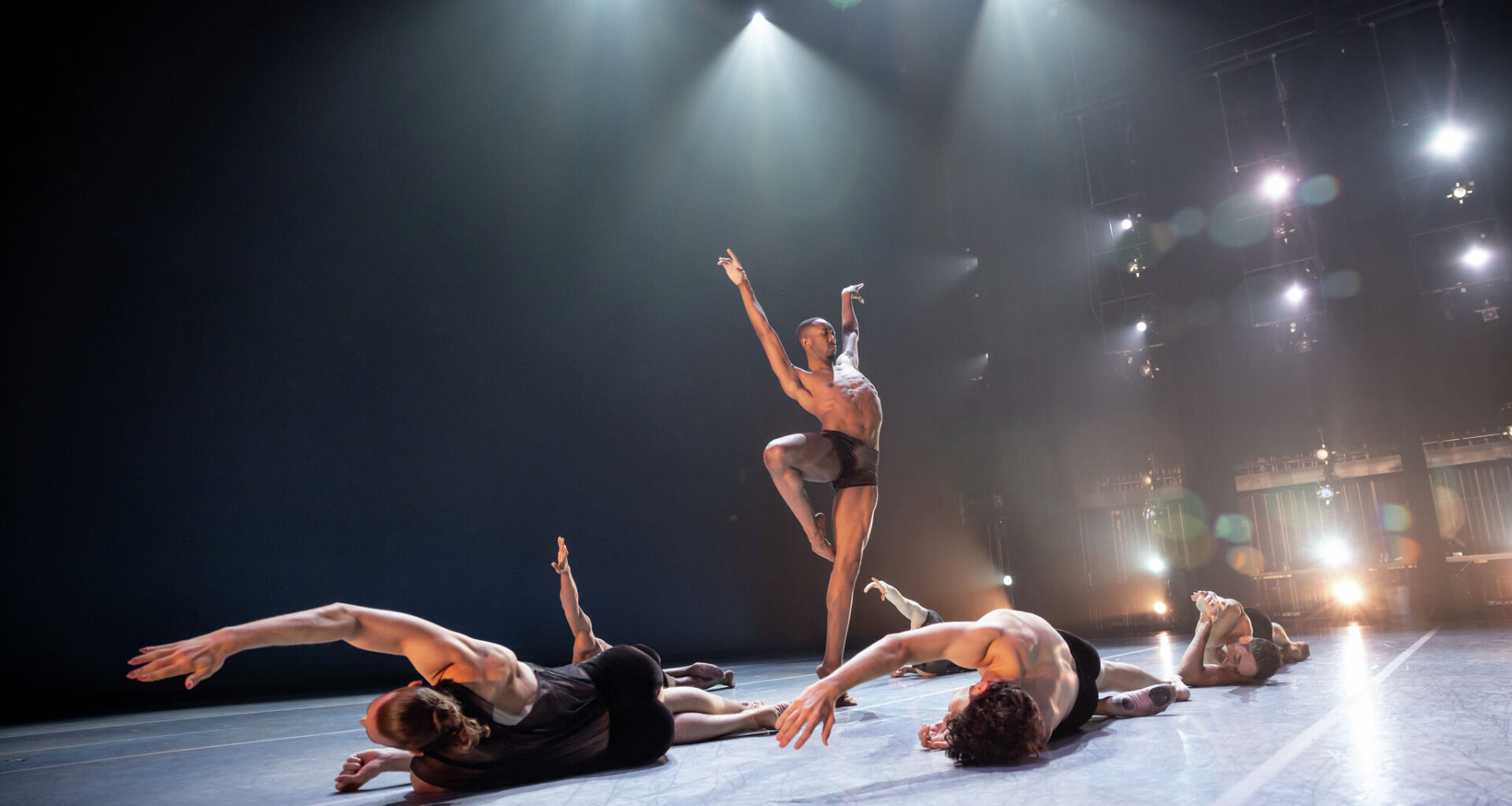
Alonzo King Lines Ballet dancer Mikal Gilbert and company in “Legacy.”
Chris Hardy/Lines Ballet
The dank corner of Third and Howard streets is not where most San Franciscans would expect a meeting of heaven and earth. But there, inside the less-than-transcendently named Blue Shield of California Theater at YBCA, the two realms stood side by side.
The occasion on Saturday, April 11, was the opening of Alonzo King Lines Ballet’s spring home season. The marquee offering was a premiere collaboration between King and the Grammy-winning jazz bassist, vocalist and composer Esperanza Spalding.
Unearthliness is nothing new at Lines Ballet. Over the 44 years since his company’s founding, King has consistently transformed his dancers into celestial beings, their spiralings both emotionally raw and exquisitely superhumanly. But in “Legacy,” King’s collaboration with Spalding, that superhuman unfurling seems to happen in a grounded place.
Article continues below this ad
Esperanza Spalding, left, with Lines Ballet dancer Maël Amatoul in “Legacy.”
Chris Hardy/Lines Ballet
Spalding stands downstage right plucking the bass, her voice’s timbre clear as water. A program note reveals that she began creating the score for “Legacy” with a visit to the eastern Tygh Valley of her native Oregon. Were it not for the voluminous, priest-like green robe she wears in “Legacy,” she might seem like she’s still there, the complex counterpoint of her music wafting like a breeze above the low, yellow hills.
“Legacy”: Alonzo King Lines Ballet with Esperanza Spalding. 5 p.m. Sunday, April 12 and 19; 7:30 p.m. Thursday-Friday, April 16-17; 2 p.m. Saturday, April 18. $46-$149. Blue Shield of California Theater at YBCA, 700 Howard St., S.F. https://linesballet.org/esperanza
Singing against her own pre-recorded voice and occasional soft percussion, Spalding is thrillingly live. Her bright eyes keenly watch to respond to the dancers in the quieter interstitial moments, and she faces them the entire 32 minutes, her attention always outward, connecting. Onstage for every show of this two-week run, she’s a gift for Bay Area audiences.
San Francisco Chronicle Logo
Make us a Preferred Source to get more of our news when you search.
Add Preferred Source
The dancing, too, feels close to the earth. In the most memorable passage, Adji Cissoko climbs atop Shuaib Elhassan’s knees as he crouches, then somehow cascades her limbs over and around his shoulders and torso, again and again as he remains squatting. In their final duet, she wraps arms and legs around him, the two frenzied with a need for one another that feels oddly gentle and reassuring.
Article continues below this ad
Lines Ballet dancers Adji Cissoko and Shuaib Elhassan
Chris Hardy/Lines Ballet
The costumes by Lines Creative Director Robert Rosenwasser gradually strip down from shimmering drapings to simple dark trunks. But if there’s a feeling of thoughtful containment in “Legacy,” it comes mostly from Spalding’s lyrics. Ideas of lineage accumulate, in quirky prosody. “If we untether from a narrow monetary definition of inheritance …” Spalding offers in lighthearted melody, while Elhassan and the extraordinarily rippling Theo Duff Grant circle each other, and Maël Amatoul and Tatum Quiñónez sit in a window of designer Alexander V. Nichols’s light.
Bits of language and musical ideas cycle through in 16 sections, gradually making the case that the gift of honoring our ancestors is an unshakeable sense of home. In the middle of “Legacy,” we suddenly hear a private voice message from a warmly cajoling speaker: “Hey! Where are you going? You’re supposed to be here.” It’s jarring, yet feels intentionally placed.
Tatum Quiñónez and Lines Ballet company
Chris Hardy/Lines Ballet
Like a well-constructed poem, Spalding’s lyrics and music create a delicately patterned form. This clearly influenced King’s choreography in ways a first viewing can only begin to reveal. King’s ballets, for all their genius, typically seem episodic and sprawling, the ordering of sections interchangeable. But “Legacy” leaves a sense of compositional just-rightness.
Article continues below this ad
From such groundedness, King’s 2024 work “Ode to Alice Coltrane” takes us to a heavenly realm, the aurora borealis of Seah Johnson’s lighting design shining overhead as the visionary jazz harpist music’s shimmers. How appropriate that “Legacy” is placed alongside this tribute to one of Spalding’s greatest female jazz ancestors. (I have to admit that at 47 minutes, I expected “Ode” would feel overlong. I was wrong.)
Some of King’s best unison ensemble work frames the wildly ecstatic sections of this suite, beginning with a line of crawling dancers in front of glowing panels that later become tall portals of blue light. From the low rumblings of “Migration Walking,” the company fully caught the groove of Coltrane’s most famous composition, the opening track of her 1971 album “Journey in Satchidananda.”
Alonzo King Lines Ballet dancers Joshua Francique, left, and Maël Amatoul in “Legacy.”
Chris Hardy/Lines Ballet
Quiñónez, leggy as an egret in a diaphanous russet dress, seemed to flick the rhythm of the drumming right from the tips of her flinging arms. Amatoul is a wonderful young addition to the 11-member company, his bright jumps providing a beguiling contrast with the calm, rooted height of Lorris Eichinger. Marusya Madubuko, outstanding through the whole evening, kept drawing all the attention to her balance on one foot, as if ready to step into eternity.
“Ode” delivers us finally to “Going Home,” with its awesome overwhelm of strings, bass, drums and Coltrane layering organ, piano, harp and timpani. It all lifts us, again and again, through a surprising chord change to a higher bliss. Cissoko stretched her taut instrument of flesh and bones into stunningly extended arabesques, then exploded in joy. It was almost too much. Almost.
Article continues below this ad
How unbelievable that these artists make their home right in San Francisco, in studios near the dirty, blessed corner of Seventh and Market streets.
Rachel Howard is a freelance writer.