
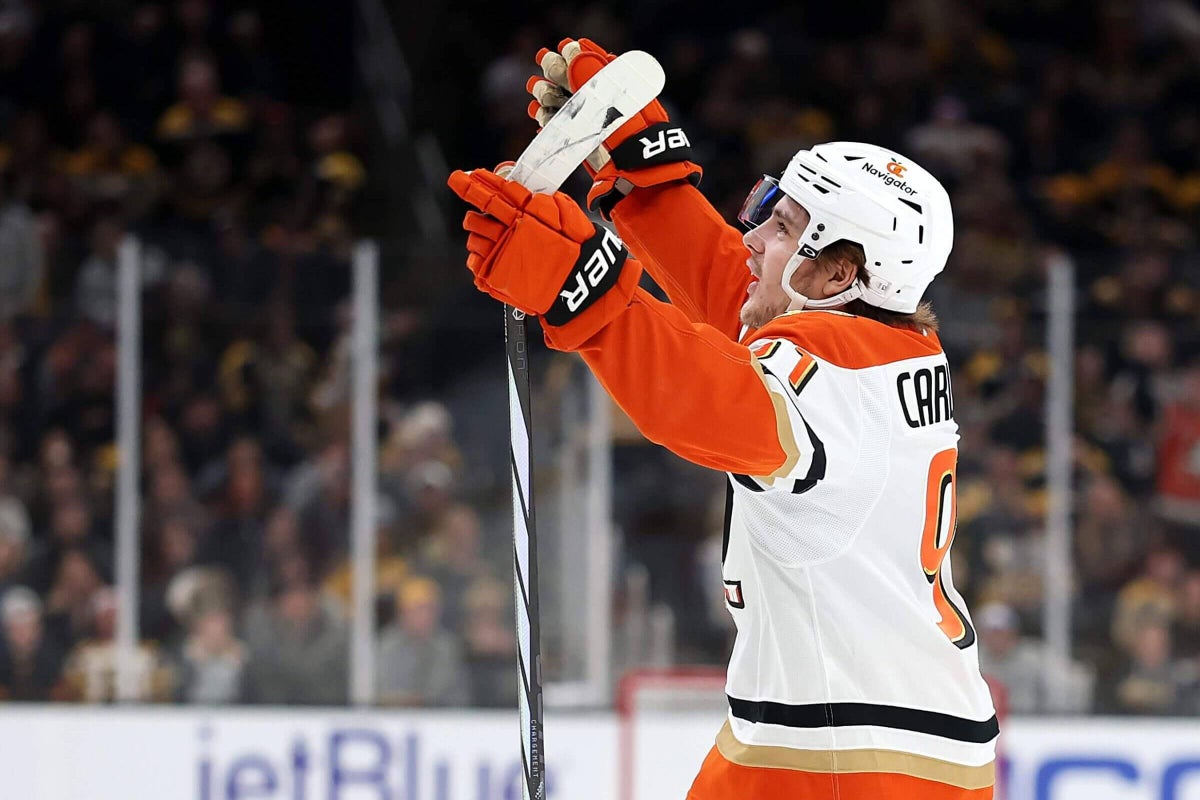
The Anaheim Ducks aren’t acting like a team that’s still in the throes of rebuilding. Last week, they handed out a total of $114 million in new contracts to Jackson LaCombe and Mason McTavish, and that followed other roster moves — dating to last winter — that took on another $97 million.
Throw in what it took to sign Joel Quenneville as head coach, and the Ducks have laid out an assortment of reasons why they view this season as the one to take aim at ending their seven-year postseason drought.
“I think it’s great to have some expectations,” said forward Mikael Granlund, who signed a three-year, $21 million contract as a free agent. “I think this group is good. We really want to get to the playoffs. If you want to succeed, you need to have some expectations. We’re on the right path here. But, you know, it’s a long process. You got to go day by day. It’s a good thing.”
The heightened expectations start at the top. Ducks owner Henry Samueli, who doesn’t often grant interviews, stepped into media scrum after the hiring of Quenneville in May and said, “It has been a long, painful process, but we felt that we’ve reached a point where the rebuild is coming to an end. It really is. And it’s time to take the step to becoming a perennial playoff contender and eventually Stanley Cup contender.”
With core pieces in No. 1 defenseman LaCombe (eight years, $9 million AAV until 2033-34) and second-line center McTavish (six years, $7 million AAV until 2030-31) now locked in, the Ducks have taken initial steps toward building a sustainable contender. Those two must deliver, as must No. 1 center Leo Carlsson and scoring winger Cutter Gauthier (both RFAs in 2026). Carlsson and LaCombe gave a snapshot of what is possible on Saturday as they each factored in three of the four goals in a third-period explosion that rallied Anaheim from a 4-0 deficit against the Los Angeles Kings.
That was preseason, and the slate is now wiped clean ahead of Thursday’s season opener at Seattle. But the Ducks feel they’re now beyond hoping or wanting to get better.
“It’s a very exciting time for our group here,” McTavish said. “We all kind of grew up together, a young core, and obviously a couple of us have signed the longer-term deals now so we’ll be together for a while. It’s really exciting.”
Another 21-point leap in the standings — which the Ducks accomplished last season — might be required to get them to the playoffs. Regardless of the number, it won’t be easy. Most prognostications don’t have them unseating any of the expected top three in the Pacific Division – the Kings, Edmonton Oilers and Vegas Golden Knights – and their likely battle for a playoff spot would be with the Minnesota Wild, St. Louis Blues, Vancouver Canucks, Calgary Flames and Utah Mammoth.
But they have a believer in our Sean McIndoe, who counted the Ducks among his postseason possibilities and wrote last week, “I kind of, sort of think they’re making the playoffs this season.” What will it take for them to make their rebuilding days a thing of the past? Here are five big factors.
The young core leveling up
We’ve talked about the huge investment the Ducks made in their youth. But they’ve got to perform. If the Ducks are to surge into the playoff conversation, they need players such as McTavish, Carlsson and LaCombe to be among their best players and to be properly supported by an able cast of veterans. Not the other way around.
All three players took necessary steps forward last season, with LaCombe breaking out and Carlsson and McTavish having big second halves after slow starts. But they are capable of becoming formidable players league-wide in their respective roles. Gauthier could be bound for a 30-goal season, given the way he finished last season. And that youth movement extends to their defense, with Olen Zellweger, Drew Helleson and Pavel Mintyukov bound to be part of the regular six.
It starts with Carlsson, who had two goals and an assist in Saturday’s comeback against the Kings.
“He’s had stretches in games where he looked like he did in the third period,” Quenneville said. “The consistency for a young player is which you want to get to. But I thought last year he really trended in there in the right fashion.”
Dostal being a high-level No. 1 all season
These reasons aren’t particularly listed in order of importance, but any shot Anaheim has at the playoffs rests on the shoulders of goalie Lukáš Dostál. The 25-year-old now has been around for five years, including three as a full-time NHL goalie. But this will be his first season as the Ducks’ outright No. 1. And he’s now highly paid after the five-year, $6.25 million AAV deal he signed in July.
Any assessment of a Ducks goalie in the last few years has to include the woeful defensive environment he has operated in. Dostál’s numbers in 2024-25 — 23-23-7, .903 save percentage, 3.10 goals-against average — aren’t all that impressive when measured across the league. But MoneyPuck tracked him with 14.3 more goals saved than the average netminder and worth 2.39 wins above replacement. He’s been able to flourish under difficult circumstances.
What Dostál must show in 2025-26 is what a high-level No. 1 does: that he can be a consistent backbone across an entire season. If you break his 54 games in two halves, the intensely diligent yet easygoing Czech backstop had a .910/2.88 split in the first half of the season and an .895/3.33 in the second.
It’s not only on him. The mercurial Petr Mrázek will be counted on to win games and ease Dostál’s burden. And if he can’t, No. 3 goalie Ville Husso may need to step in.
Respectable special teams play
Simply put, the Ducks won’t be much better if they don’t lift their power play and penalty kill toward league average — or even above average. Once a strength of the franchise, the penalty kill has ranked 31st, 31st and 29th the last three seasons. And a 30th-ranked offense last season was weighed down by an atrocious league-worst power play.
Quenneville wasn’t only offseason coaching change, as the Ducks also brought in Jay Woodcroft and Ryan McGill to run the power play and penalty kill, respectively.
Improvement isn’t expected to happen overnight. The penalty kill showed promising signs in the preseason, and Quenneville wants his best players on it. Carlsson and Troy Terry are taking on a greater role, supported by experienced killers in Granlund and Chris Kreider. Fourth-line center Ryan Poehling could also see time on it. The power play is a different story: Multiple combinations were used, and Quenneville said that figures to continue into the season as they find the correct five-player units to connect with each other.
“That’ll be a work in progress through 82 games coming up,” Quenneville said. “I assure you that. That’s always something that you’re going to be talking about, whether it’s a revamp and technically putting different things involved with movement, personnel. And rewarding for doing the right things and being productive.” And then he added, “Let’s be special.”
Total buy-in to Quenneville’s plan
Competitiveness has ebbed and flowed under previous head coaches. In some games — and at times in many games — the Ducks did compete, but the roster wasn’t good enough to overcome better teams. But what has often plagued them is a consistent five-man connectivity between forward lines and defense pairs, and even connectivity within those units themselves. System play didn’t always emphasize their strengths or minimize their weaknesses.
One notable change to Quenneville from former coach Greg Cronin is the switch away from man-to-man defense to zone defense. Quenneville’s teams have also long been known to value puck possession more than others. Puck support won’t be a request; it will be a demand. Those who have felt adrift away from the puck will need to digest Quenneville’s system and execute it. From breakouts to neutral-zone play, the Ducks must get to a point where exits from their zone are clockwork, even within hockey’s chaotic nature. For once, they need to dictate play more often than chasing it.
This is where the veterans on the Ducks play a large role. They’ve got to perform and can’t become anchors in a bad way. But between the additions of Granlund and Kreider, and returnees such as Alex Killorn, Radko Gudas, Ryan Strome and Jacob Trouba, they’ve got veterans who have played in big games, including the Stanley Cup Final or conference finals. They need to be on board and provide a positive example for the young stars.
Impact beyond the roster
The heightened standards Samueli put out there in May aren’t limited to who’s on the ice.
“That is the pressure we’re putting on both (general manager) Pat (Verbeek) and Joel,” he said. “They know that the fans and the ownership expect to make the playoffs this (next) season. There’s a lot of pressure to put on a coach and a GM. But you got to do it.”
The conditions for a strong start are there. Six of Anaheim’s first seven games are against teams that failed to make the playoffs last season. The schedule intensifies with two games against Florida, two with Vegas and road contests at Dallas and Colorado, but there are only two sets of back-to-back games before Thanksgiving. Being in playoff position then would be that first definitive step toward ending their drought.
“I don’t know how many times I mentioned it up to this day, but when we get back on the ice on Monday, we’ll be mentioning it every day probably,” Quenneville said. “I don’t know how long into the season we’ll be saying it. There’ll be plenty of reminders how the importance of getting off to a great start and set up and make your whole year.”
(Photo of Leo Carlsson: Maddie Meyer / Getty Images)