
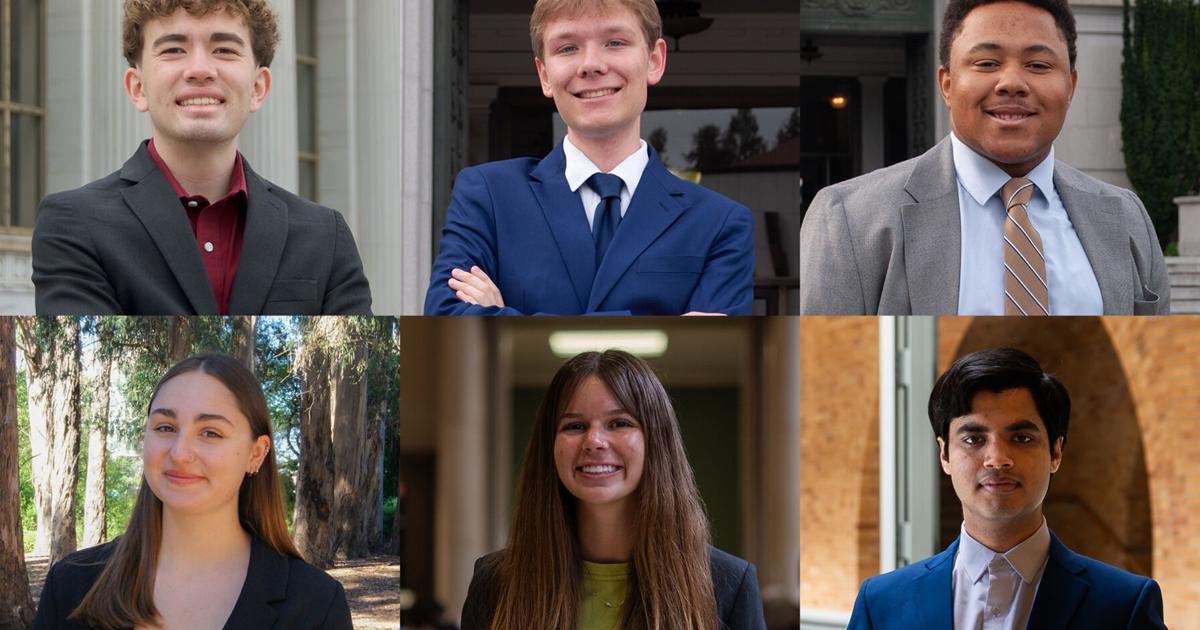
Historically, The Daily Californian’s editorial board endorses 20 candidates for the position of ASUC senator.
We approached this year’s election cycle hoping to do the same; however, we were met with a concerning number of underbaked, half-assed platforms which frankly stopped us in our tracks. At a time when students are desperately seeking support and have begun to give up hope in finding it within the ASUC, this was disheartening to see.
Over the fall semester alone, we saw campus send 160 names of students, faculty and staff to President Donald Trump’s administration and the suspension of CS lecturer Peyrin Kao for advocating for Palestine in the classroom. These were watershed moments in UC Berkeley’s history that rocked our campus to its very core, and the student body is sure to feel the aftershocks of these decisions in the years to come. With this premonition in mind, we conducted interviews of our senate candidates over the first week of April; however, the vast majority of senator hopefuls could not convince us that they were capable of being representatives who will ensure that the student body stands tall and strong in a moment of unprecedented uncertainty.
During our interviews, the board primarily saw candidates who made big promises. To be perfectly clear, we see nothing wrong with this. Big promises can lead to big changes and we require nothing less in our current moment. However, when making a big promise, especially to an undergraduate student body of more than 33,000 people, we expect that at least some thought has been put into how this promise will be kept.
It takes just nine words to ask yourself, “How am I realistically going to get this done?”
Yet throughout our interviews, this question — the bare minimum for any candidate running for an elected position to consider before advertising their platforms — was often left unanswered. Instead, candidate after candidate repeated the same hollow rhetoric about the importance of their platforms, justifying their claim to a seat in the ASUC Senate by touting the communities they hoped to represent rather than offering tangible ways through which they were going to benefit said communities. We did not see these candidates as being effective representatives.
Thus, the board cannot, in good faith, endorse candidates who we fundamentally do not trust to adequately lead the student body. As a result, we will not be offering a full slate of 20 candidates that students should vote for this year.
Instead, from the 27 candidates who are up for election, we have chosen solely the students who we believe have both accurately identified problems on campus and proven to us that they have the competence, grit and institutional knowledge necessary to work towards solving them.
These six are the candidates we trust to rise to the occasion.
Editorials, including endorsements, represent solely the opinions of the student editorial board of The Daily Californian and not those of the University of California or any non-student party.
1 — Tai Cassel Engen, independent
Tai Casel Engen decided to run for ASUC Senate because of his disillusionment with the ASUC. He says he intends to ruffle some feathers.
Engen seeks to change the culture of the senate, which he sees as contributing to a “docile” ASUC over the past year. Engen, who has spent two years in the ASUC Office of the President, was not afraid to levy critiques at an ASUC which has materially accomplished little, and which he said offers little in the way of transparency.
He has experience pushing back against that ASUC — including speaking up against current Executive Vice President Isha Chander when she was pushing for what he saw as a financially and politically risky deal with Uber. His willingness to be confrontational bodes well for his other platforms to fight back against education cuts by administrators and support political organizing on campus.
“This is a time of great change,” he said. “When you have a time of change you need someone who is stable and willing to fight for student rights.”
We agree, and we believe that person is Engen.
2 — Ryan Justice-Williams, ElevateCal
Ryan Justice-Williams wants you to know that this isn’t his first rodeo. He’s running for administrative accountability, transfer student representation and community safety, while bringing policy experience from the California State Assembly, ASUC Office of the President and local grassroots organizations.
During his interview, Justice-Williams recognized campus’s apathy toward students and insisted that he is ready to fight behind closed doors to make student voices heard. His intimate knowledge of the ASUC shone through. We believe he sees the problems facing campus, and that he knows exactly what he can do about them.
With the tailwind of the STRONG Act, a referendum on this year’s ballot that hopes to make the transfer student representative into an executive position within the ASUC, Justice-Williams aims to work with an empowered representative to make a real difference in transfer students’ quality of life on campus. His goal of increasing funding to programs in the Centers for Educational Equity and Excellence through a fee increase referendum on the GOLD Fund is ambitious: community specific fee referendums are notoriously difficult to pass. But if anyone is able to rally support and back it up with effective legislation, we think it’s Justice-Williams.
3 — Kavyun Parker, independent
Kavyun Parker enters this race with something most candidates in this cycle simply could not demonstrate: a track record. As co-executive for Black and African Student Empowerment, Parker has spent two years doing the unglamorous institutional work that actual change requires — contributing to UC Berkeley’s Black community by strengthening the HBCU exchange program and helping organize Culture on the Block. He knows the ASUC from the inside, and he knows its limits.
His three-platform framework, the Right to Live, Lead and Learn, is grounded in real gaps: housing insecurity, food access, fellowship visibility and academic resource affordability. Crucially, Parker was honest with us about what he cannot accomplish in a single term. That kind of pragmatism is rare and it matters.
Running independently, unfazed by party politics, Parker is focused on one constituency: the students who need him most.
4 — Madison Chesebro, independent
Madison Chesebro is this year’s Eco Community-endorsed senate candidate. Having served in the Eco Office for three years under senators Ashi Mishra, China Duff and Bella Santos, Chesebro has garnered an immense amount of institutional knowledge and amassed an impressive list of accomplishments.
As senator, she hopes to ensure that UC Berkeley follows through on its goal of 100% electrification by 2028 through utilizing the communication channels she has developed with the administration over the past three years. Further, she has committed to use the Eco Office’s platform to loudly advocate against the UC’s efforts to amend Diversity, Equity, Inclusion and Justice considerations from its Sustainable Practices Policy.
We are confident that Chesebro will meet the moment with the courage and dynamism that it deserves to nurture her vision of a greener campus to life.
5 — Cecelia Hammond, independent
As a member of the ASUC’s Sexual Violence Commission, a health and wellness executive in Senator Jada Yang’s office and a student employee, Cecelia Hammond brings experience to every plank of her platform.
Her priorities, such as basic needs, health and wellness, campus sustainability and academic opportunity, aren’t abstract. She’s already building a healthcare navigation website with Senator Yang’s office and distributing Narcan to Greek life chapters lacking it. As a senator, she hopes to push her efforts to the next level, taking an active role in ensuring the Basic Needs Center is not overwhelmed by the cuts to Cal Fresh and being a fierce advocate for the reinstatement of PATH to Care’s 24/7 line.
Hammond understands what it means to be a student the university hasn’t made things easy for. She’s running to make sure fewer students have to figure that out alone.
6 — Rishi Bhatt, independent
Positioning himself as an insider with intimate knowledge of the ASUC’s mechanics, Rishi Bhatt is running on a platform that focuses on empowering the transfer community and increasing ASUC accountability.
With a proven track record, demonstrated by involvement in writing the STRONG Act, Bhatt has demonstrated his commitment to UC Berkeley’s transfer community.
As senator, Bhatt plans to work with the ASUC’s Chief Personnel Officer to mandate all elected officials to hold office hours every two weeks so their constituents can hold them to the promises they made. To combat food insecurity, he hopes to put excess food generated by campus into a food-storage locker, an initiative he has already put into action through establishing ties with local food banks in collaboration with the Office of the President.
Overall, Bhatt has the mix of institutional knowledge, achievable goals and actionable plans that benefit more than just the community he hopes to represent — as such, we are excited by his vision of campus and trust him to follow through with his proposed plans.