

OAKLAND — Voters will have their latest opportunity in the upcoming June election to approve a new tax intended to patch up Oakland’s shaky municipal budget, a familiar predicament in a city that is often strapped for cash.
In this case, city leaders were so confident another tax would be approved that they assumed the revenue in a two-year budget approved last summer. The spending plan at the time helped close a $245 million shortfall.
The Oakland City Council did not author the actual language of the parcel tax initiative, which will appear as Measure E on the June ballot and is expected to generate $34 million annually. Instead, the council voted to place the new tax on the ballot only after a citizens’ initiative secured 38,000 petition signatures from voters.
The extensive signature-gathering effort received heavy financial backing from Oakland’s two largest labor unions: SEIU 1021 and IFPTE Local 21, which are in the midst of bargaining with city leaders for new contracts.
Because the ballot measure pursued outside the government is a special tax, it needs only the approval of a simple majority of voters instead of a much stricter two-thirds standard. A state Supreme Court decision in 2017 allowed such taxes to require a lower threshold.
Oakland leaders have consistently bet on voters approving taxes. For some critics, however, the council’s maneuver last year goes far beyond a risky gamble.
“How do you balance a budget on a non-existent tax and then basically do nothing to actually draft the measure?” said Marleen Sacks, an attorney who often sues public agencies over how they conduct elections. “That’s the part of the story that makes absolutely no sense.”
 Oakland mayor Barbara Lee speaks during a press conference celebrating the launch of “Diaper Time is Talk Time” held at Oakland City Hall in Oakland, Calif., on Monday, Feb. 23, 2026. SupplyBank.org and Too Small to Fail launched an exclusive new line of diapers and wipes that will be distributed through nonprofit organizations and public organizations to families in need with young children. (Jose Carlos Fajardo/Bay Area News Group)
The tax will cost the owner of a single-family parcel an additional $192 annually, with the revenue intended for police and fire services, plus improved 911 response times.
Property owners in this city already face steep taxes across both flat rates for parcels and supplemental taxes that vary based on a home’s assessed value. Just to cover the city’s various bond measures, the owner of a home with an assessed value of $1 million pays around $1,145 annually.
Still, the revenue from this latest tax would provide a crucial boost to Oakland’s finances through the end of the decade. Mayor Barbara Lee is expected next month to propose budget amendments to the City Council ahead of the coming fiscal year, which begins in July.
Because the mayor owes a proposal before the election, she will likely put forward two options: one assuming approval and one with deep cuts if it fails.
In another world, the proposed parcel tax may have tested voters’ appetite for yet more public investment in Oakland.
A sales tax measure on last April’s election ballot received 65% voter approval — far higher than the majority required for taxes on retail, but less than the standard threshold for parcel taxes.
Facing the same majority requirement for Measure E in June could potentially swing the odds in favor of the parcel tax’s advocates.
“Typically, people who oppose constitutional taxes are often those whose wealth is most at stake,” said Michael Coleman, a municipal financial analyst. “They tend to write things — like a two-thirds vote requirement — to protect people with property. But the new law a few years ago changed the game for special taxes.”
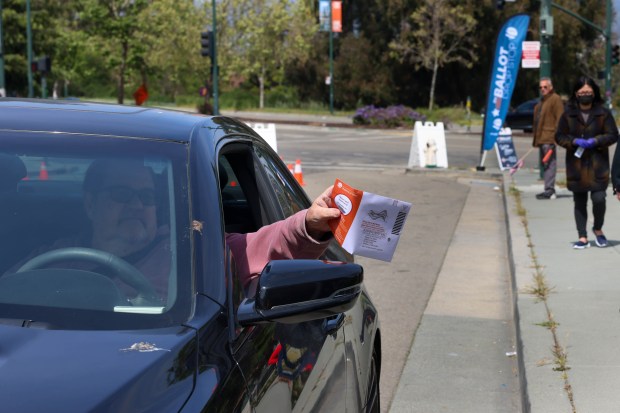 A voter in his vehicle drops off his ballots at the Alameda County Court House during a special Election Day in Oakland, Calif., on Tuesday, April 15, 2025. Oakland voters marked their ballots for the next Oakland Mayor, city council, and sales tax measure races. (Ray Chavez/Bay Area News Group)
SEIU 1021 and IFPTE Local 21, respectively, spent $200,000 and $150,000 to fund signature-gathering for the new June tax initiative. Union representatives did not respond to an interview request.
Both labor groups, plus the police and fire unions, are currently bargaining with city leaders over new multi-year contracts. The outcome of those negotiations could heavily influence Oakland’s public finances years down the line.
The city faces lingering budget deficits through the end of the decade that are structural in nature, which means fixed costs — namely pensions and salary benefits — outpace revenues, regardless of economic trends.
The rising costs track across all city staff, but especially the Oakland Police Department, which was on track to blow past its overtime budget by nearly $17 million amid a decline in officer staffing before Interim Chief James Beere placed a cap on discretionary overtime spending last year.
Economic outlooks for both Oakland and the Bay Area as a whole had appeared bleak over the next year, even before the United States’ and Israel’s war with Iran made financial predictions more uncertain.
Revenues from most taxes — including for retail sales and business licenses — have nosedived since the COVID-19 pandemic.
The council, meanwhile, has declared that an “extreme fiscal necessity” requires the city to bypass provisions in existing tax measures in order to tap the revenue.
The special financial status has led the city to access tax revenue even when it foregoes promises made to voters in earlier elections, such as a parcel tax approved in 2024 that required a minimum of 700 sworn police officers in the city. There were just 613 officers on the force as of last week.
“The city will need to consider additional, more aggressive fiscal policies to increase funding to responsible levels to ensure the city will be able to meet its obligations,” the city’s financial forecast states.
The fiscal necessity status has helped Oakland balance its books the past few years. Steadily, though, the city is also spending less on its own.
New data released last month show the city has a staff vacancy rate of nearly 20%, with over 1,000 fewer staffers now than in the 2018-19 fiscal year, which preceded the pandemic.
The cost-cutting helped the city balance its books last year, with help from tax revenue generated by the Pacific Gas and Electric Co.’s purchase of a $908 million office tower near Lake Merritt.
So far this fiscal year, the city is spending according to the budget. It is a positive sign going into the June election, where officials hope to be rewarded by voters for the upward progress.
“In terms of our revenues and expenditures, we’re exactly where we thought we would be,” Brad Johnson, the city’s finance director, said in a meeting last month.
Shomik Mukherjee is a reporter covering Oakland. Call or text him at 510-905-5495 or email him at shomik@bayareanewsgroup.com.