
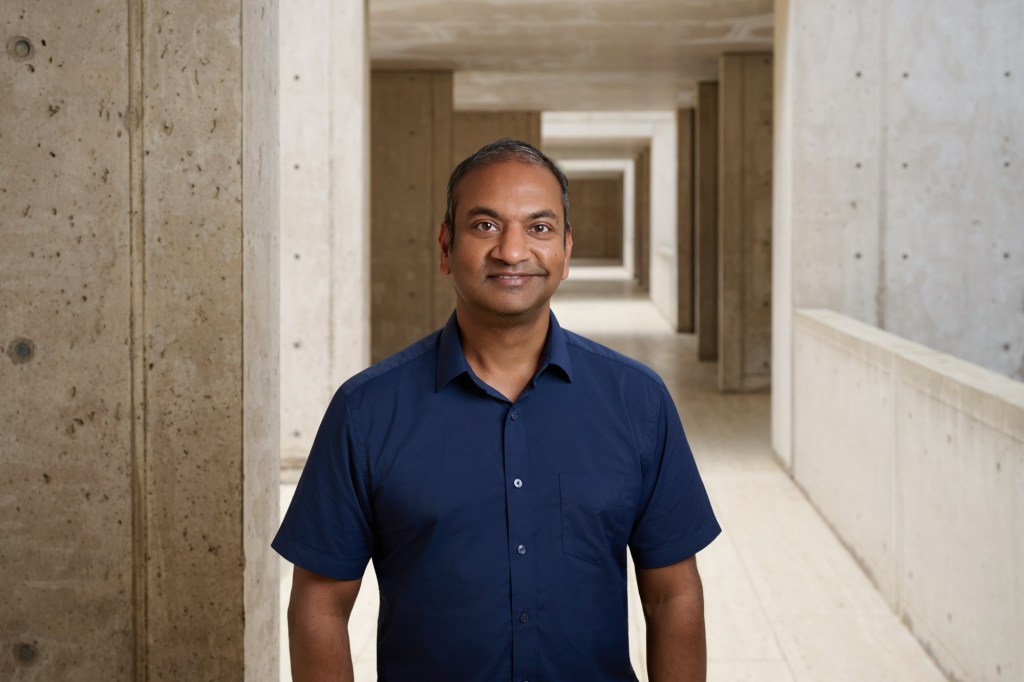
Salk Institute neuroscientist Sreekanth “Shrek” Chalasani coined the term “sonogenetics” in 2015. Now, a little more than a decade later, he finds himself leading a team awarded $41.3 million to turn his idea into therapy that could someday treat everything from Parkinson’s disease to irregular heart rhythms.
Chalasani, and a growing number of researchers worldwide, have found that certain proteins can be made to behave like The Clapper, that 1980s-era device sold on after-midnight infomercials. While that gizmo promised that just two sharp cracks from a pair of human hands could turn any electronic device on or off, sonogenetics requires significantly more finesse.
This method verges outside the range of human hearing, using ultrasound waves, the same type of technology commonly used to image babies during prenatal visits and heart structures in cardiology studies, to control cells with precision.
Scientists have shown in lab experiments that they can pass snippets of genetic code into cells that cause them to make proteins that are sensitive to ultrasound. These proteins embed themselves in cell walls and, when they are exposed to key frequencies, they pop open, allowing compounds such as calcium or chloride to enter.
These chemicals have well-known signaling properties.
An infusion of calcium, for example, can activate a cell, and chloride can tamp down cell activity. Chalasani’s lab at Salk in La Jolla has shown, first in nematodes and then in mice, how this combination of proteins and sound can allow activation and deactivation of individual cells to treat conditions without surgery.
Today, some diseases are treated by using electricity to stimulate cells, whether it is a pacemaker shocking heart muscle tissue back into a healthy rhythm or deep brain stimulation electrodes using continuous pulses of current to reduce the debilitating symptoms of Parkinson’s disease.
Both of these examples are invasive. They involve the implantation of medical devices inside the body and, for deep-brain stimulation, drilling a hole through each patient’s skull. But sonogenetics offers the possibility of noninvasive stimulation.
“In our method, we wouldn’t have any surgery, we would take our protein, express it in target cells, and then use ultrasound to control those cells from outside the body,” Chalasani said.
There are other ways to get similar effects. Proteins have also been shown to respond to light, a stimulation pathway called “optogenetics.” But using sound has a powerful ability to penetrate tissue.
“Unlike light, ultrasound can go through the skin and bone,” Chalasani said.
In mice, researchers have already been stimulating mice with ultrasound.
“We have shown that we can manipulate neurons in the brain of a mouse, and we can affect cardiac muscle, so we can make a pacemaker for the heart,” he said. “And we can show that we can affect insulin production in mice.”
Using grant funds, a team of researchers will search for ways to make similar gains in human subjects with the goal of having specific methods ready for preliminary human trials in four to five years.
It is an extremely ambitious goal. A key challenge will be finding ways to get only targeted cells to express proteins and to do so deep inside complex organs.
Salk is not going it alone. Seven organizations are part of the sonogenetics effort.
Nobel laureate Ardem Patapoutian at Scripps Research will lead a team that will help with the discovery and engineering of ultrasound-sensitive proteins. Nigel Calcutt at UC San Diego will lead a team charged with determining how to validate the clinical effectiveness of the sonogenetics approach, and Ghassan Kassab at California Medical Institute will lead a team that will also work on validation. Teams at Duke University, the Massachusetts Institute of Technology, St. Boniface Hospital Research and the University of Manitoba and startup SonoNeu are also key participants.
Funding comes from the federal government’s Advanced Research Projects Agency for Health (ARPA-H), a $1 billion Congressional initiative signed into law by former President Joe Biden that pursues “leap forward” projects with potential to revolutionize medicine. San Diego-area researchers have fared well in the heavy competition for these funds. In January, UC San Diego bioengineer Shaochen Chen was among researchers nationwide tapped to explore creating a bioprinted human liver as part of an ARPA-H initiative. And in 2025, UCSD researchers were awarded $25 million to develop biomarkers capable of anticipating tumor evolution and predicting how malignancies will respond to treatment.