
Following the return of the Artemis II astronauts’ and their circumnavigation around the moon, San Diegans can keep their eyes on the sky this week for a series of events focused on astronomy and the importance of dark skies.
International Dark Sky Week — from April 13 to 20 — is an annual event that celebrates the nighttime hours, when the world is dark and quiet, nocturnal critters emerge and stars become visible. It aligns with the Lyrids meteor shower and the new moon, which brings the darkest skies.
The week’s events in San Diego, organized by Dark Sky San Diego County, include stargazing parties and educational programming across the county. But the week also focuses on the effects of light pollution on communities and animals. For years, local advocates have been pushing for better lighting practices to reduce strain on wildlife as well as to help improve quality of life for residents.
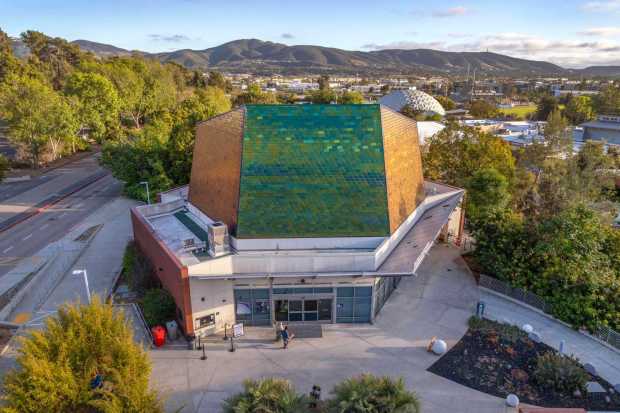 Exterior view of the Palomar College Planetarium with its main entrance below in this view looking south. In the distance is the school’s landmark dome that houses the school’s gymnasium. (Charlie Neuman / For The San Diego Union-Tribune)
“It’s not just about the stars; it’s about health,” said Cathy Handzel, one of the lead advocates for Dark Sky San Diego County, a local chapter of the international organization that calls for improved lighting to preserve the night sky. “It’s about reducing glare for better visibility.”
Dark Sky advocates in San Diego are pushing communities to pursue different lighting options, including altering the direction of lights — so they aren’t shining directly up into the sky or into a neighbor’s window — reducing their intensity and temperature and adding shielding to contain the light.
“Dark Sky isn’t about eliminating lights, it’s about doing lighting correctly,” said Eddie Lain, a volunteer advocate from Dark Sky San Diego County.
The week’s events come just after the Artemis II mission concluded with its return landing off the San Diego coast on Friday. During its 10-day excursion, the four-person crew traveled farther from Earth than any other humans — as well as witnessed a rare solar eclipse from deep space and observed a 600-mile-wide crater on the moon’s surface.
 Early Friday evening, visitors at the San Diego Air & Space Museum in Balboa Park watched a live stream of NASA’s feed of the splashdown as the four-person crew of Artemis II splashed down off the coast of California. (Nelvin C. Cepeda / The San Diego Union-Tribune)
San Diegans may not be able to see such lunar features and celestial events up close, but for local amateur astronomers, the ability to see the stars from afar brings them closer to the vastly unknown universe.
“You never get tired of looking at celestial objects,” said Kinchen Searcy, star party coordinator for the San Diego Astronomy Association, who has been a member of the group for 25 years. “You can see new stars and galaxies…. And pursue a level of astronomy, which is a fun thing to do.”
The San Diego Astronomy Association is one of several groups partnering with Dark Sky San Diego County for this week’s events. It will be hosting star gazing at West Sycamore, part of Mission Trails Regional Park in Scripps Ranch, on Friday, April 17.
Searcy says that various factors go into ideal conditions for stargazing, including weather and the brightness of the moon, as well as light pollution from local cities.
Robert Quimby, an astronomy professor at San Diego State University and director of the Mount Laguna Observatory, said light pollution can be hard to ignore.
“It’s less of an issue in the mountains because we’re farther away from the city, but you can clearly see where the cities are,” he said. “At the observatory… you can point yourself towards the San Diego-Tijuana area, and you’ll see this dome of light that covers where the … region is.”
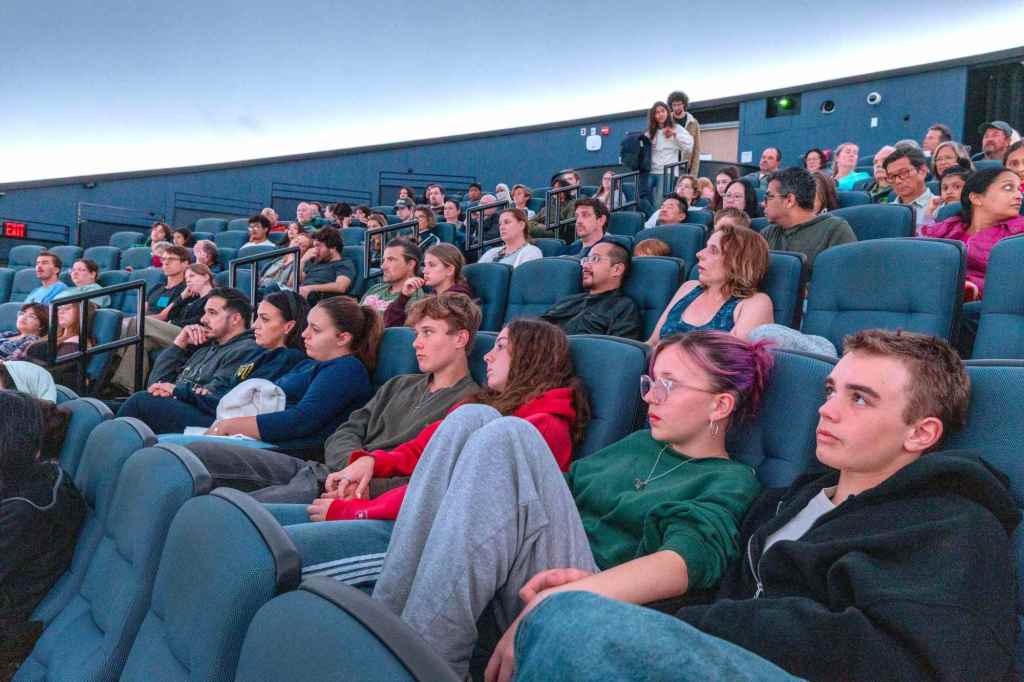
 Waiting for the start of the 7:00 p.m. show at the Palomar College Planetarium are Julian Chan and his wife Maria with their daughter Judy, her husband Peter and their son Edison, 12. They’re watching a live broadcast of the astronauts exiting the Artemis 2 spacecraft after its splashdown. (Charlie Neuman / For The San Diego Union-Tribune)
Light pollution also has significant consequences for wildlife, such as migrating birds, that rely on the dark of night for safe passage.
More than 80% of North America’s migrating birds do so at night, according to the San Diego Bird Alliance, and on Wednesday night alone, more than 1.1 million birds crossed over San Diego County.
“The light impact of a city like San Diego really gets on the radar, figuratively, of a bird,” said Andrew Meyer, director of conversation at the San Diego Bird Alliance.
The organization is currently holding its Lights Out, San Diego! campaign, encouraging people to turn off their lights from 11 p.m. to 6 a.m. to help the spring migratory birds in flight.
Birds migrate using a learned route, Meyer explained, including using physical sight of the coast. Bright lights can disorient them and make their surroundings look different. The lights can affect local resident birds, too, especially young birds in ground nesting areas, since the artificial light can make them more visible to predators.
Efforts are underway across the county to make communities more light-friendly for wildlife and residents.
Lain is part of the Valley Center Community Planning Group and is working to get the community officially designated as a Dark Sky Community, registered under the International Dark Sky organization.
International Dark Sky Places include communities, parks, reserves or urban areas that must adhere to a set of standards over a range of factors, including night sky quality, land management and nighttime public access.
Some areas of San Diego County are already Dark Sky havens, including Borrego Springs and Julian, which are both official Dark Sky Communities.
The community of Fallbrook is also working on an application for the Dark Sky Community designation, and the Mount Laguna Recreation Area is pushing to become a designated Dark Sky Park. Mission Trails Regional Park Foundation is aiming to be California’s first Urban Night Sky Place.
Handzel said urban areas, such as the city of San Diego, can do more to combat light pollution, too. She wants to see better lighting in her City Heights neighborhood, where she says lights — especially at roundabouts and busy thoroughfares such as along University Avenue — can blind drivers.
“There is so much more that can be done,” she said.
The city of San Diego is revamping nearly 40,000 of its streetlights to make them more climate-friendly, and officials say the city is incorporating light-sensitive concerns into its streetlight operations.
In an effort to provide more neutral lighting color, the city engineer issued a directive last year changing the City’s standard streetlight color to 3000 Kelvin Correlated Color Temperature (CCT) — a softer white streetlight color compared to the former 4000 Kelvin CCT, adopted in 2017.
Since 2017, 25% of the city’s streetlights have been converted to the more environmentally-conscious LED lights, though most of those feature the harsher color of 4000 Kelvin CCT, said city spokesperson Anthony Santacroce. He said roughly 80% of the city’s streetlights will be converted to 3000K LEDs over the next few years.
Individually, advocates encourage San Diegans to turn off their outdoor lights at night or put them on a motion-sensor timer, and talk with their landlords or Home Owners Associations about improving lighting around a property. Dark Sky International also offers a home outdoor lighting assessment.
And to celebrate International Dark Sky Week, San Diegans can find a dark place to spot constellations such as the Big Dipper and Orion’s belt, and Orion’s nebula, a stellar nursery where stars form, just below it.
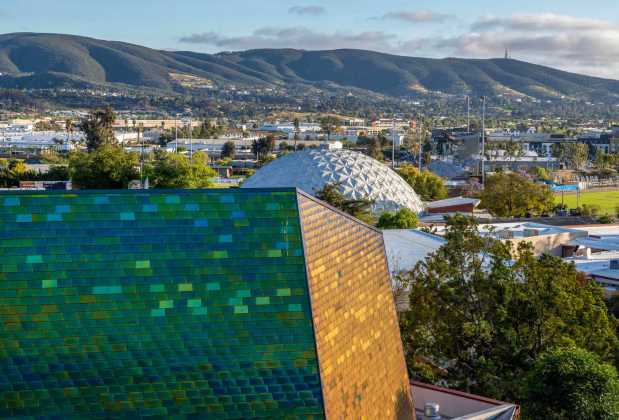 Exterior view of the Palomar College Planetarium (foreground) with the school’s landmark dome shown in the distance that houses the school’s gymnasium in this view looking south. (Charlie Neuman / For The San Diego Union-Tribune)
Venus and Jupiter should also be visible, said Scott Kardel, associate professor of astronomy and the assistant planetarium director at Palomar College.
Kardel hopes San Diegans can attend the Dark Sky events this week, such as the star party and dark sky symposium at the Santa Ysabel Nature Center on Saturday, April 18, to learn from the researchers and take a look through a telescope to admire the sky.
But it’s also an effort that San Diegans can pursue on their own.
“I hope that even the people that don’t (go to an event) can find some time to try to appreciate what the night sky is and the amazing beauty of the universe,” he said.