
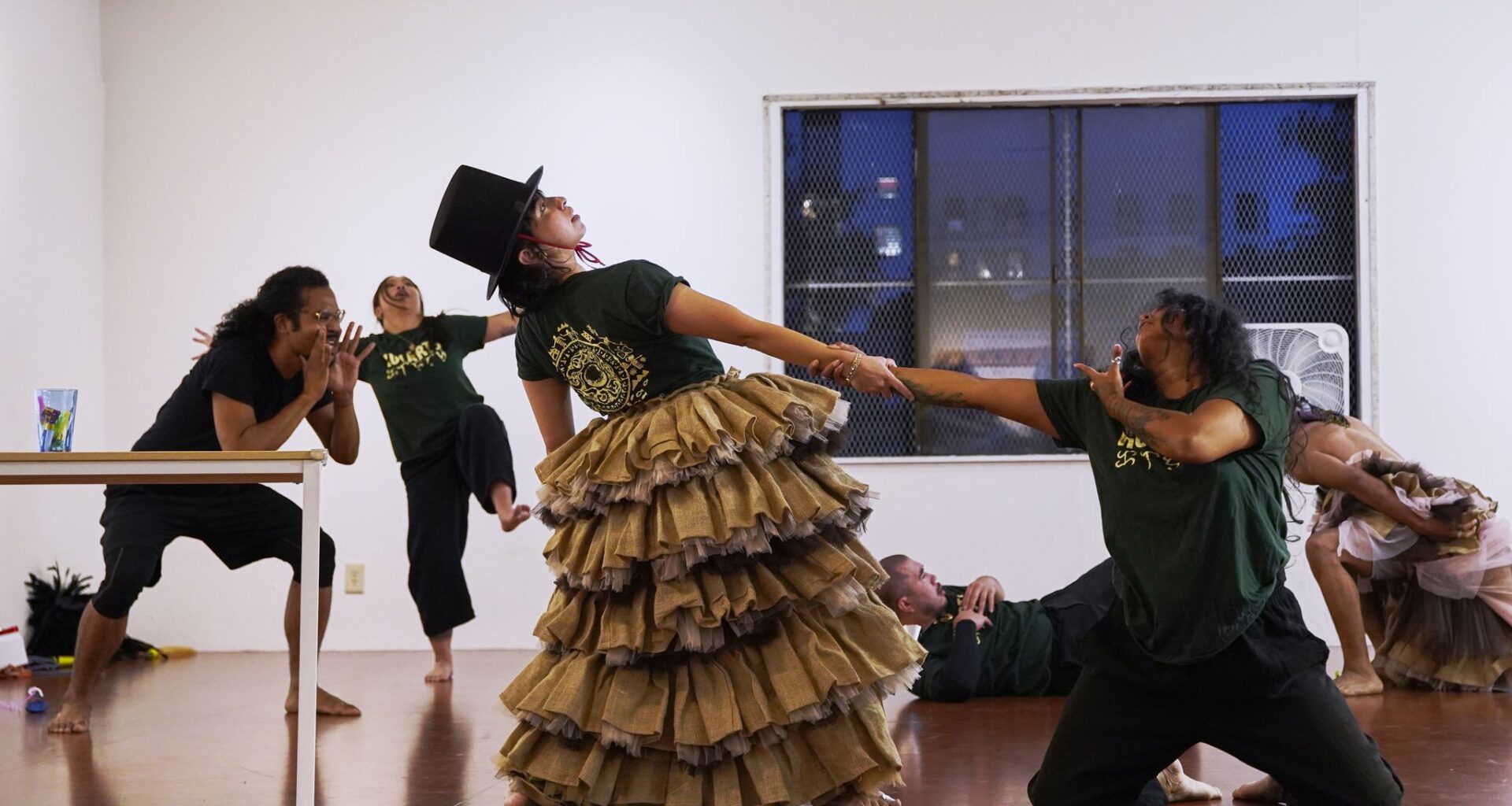
Kularts dancers rehearse “Burden of Proof” in San Francisco on Thursday, April 9, 2026.
Giselle Garza Lerma/S.F. Chronicle
Lounging on a table, the mom in a pointy birthday hat was hoisted in the air — a modern-day Cleopatra getting carried by servants. She waved to her well-wishers like a beauty queen in a parade.
This, “Burden of Proof” implies, is what life always could have been like for Leonora Perez.
“Burden of Proof”: Directed and choreographed by “Manai” Alleluia Panis. 7 p.m. Friday-Saturday, April 17-18; 3 p.m. Sunday, April 19. Through April 26. Bindlestiff Studio, 185 Sixth St., S.F. www.kularts-sf.org
Instead, during Kularts’ recent rehearsal in a Mission District studio, mysterious figures in top hats and ruffly tiered skirts, played by Jess DeFranco and Francis Eric Cabrera Aquino, entered the scene. As horrifying words echoed from computer speakers — “They said she poisoned them” — Dre “Poko” Devis as the mom and all the dancers decelerated. They looked like nightmare figures trying to claw out of a pit of hell in slow motion.
Article continues below this ad
The multimedia work of dance theater, which opens Friday, April 17, at Bindlestiff Studio, isn’t just an exploration of the real-life 1975 case in which two Filipina nurses were wrongfully convicted of poisoning and conspiring to poison patients at a Michigan VA hospital. “Manai” Alleluia Panis’ world premiere is also an act of healing.
Writer, performer and academic Jason Magabo Perez is the son of Leonora Perez, who along with fellow nurse, Filipina Narciso, had her case dismissed on appeal in 1978. The evidence against them was circumstantial, and their prosecution was racist, complete with slurs uttered during trial.
Kularts co-founder Alleluia Panis gives feedback during “Burden of Proof” rehearsal in San Francisco on Thursday, April 9, 2026.
Giselle Garza Lerma/S.F. Chronicle
When Perez saw a work-in-progress showing of Panis’ piece, he told the Chronicle, “I felt a big weight lift — that I didn’t have to hold the story myself.”
San Francisco Chronicle Logo
Make us a Preferred Source to get more of our news when you search.
Add Preferred Source
Panis and Perez first met in the mid-aughts, when Perez was a student at the now-defunct New College of California in the Mission District. They’ve collaborated many times since, including on Perez’s 2011 autobiographical project “You Will Gonna Go Crazy,” which also touched on his mom’s life, who’s now 81 and lives near him in San Diego.
Article continues below this ad
That shared history is part of how Panis earned Perez’s trust.
Additionally, “Jay knows that I’m not going to push,” Panis said. “I’m not going to say, ‘I want to talk to your mom or your dad or your siblings.’ It was just like, ‘Whatever you want to offer, I will accept.’”
For his part, Perez said, “I don’t trust everybody with the story.” He recalled a bad experience with a documentary filmmaker whose both-sidesism, he felt, “ultimately insinuated that my mother and the other nurse were guilty.”
In lightly fictionalizing the Perez family story for “Burden of Proof,” she explored why the exonerated women didn’t return to the Philippines after their treatment by the American legal system and why they eventually returned to nursing.
“She was a model immigrant. She had a degree. She was a professional,” Panis pointed out of the elder Perez. “If she went back to the Philippines, they’re going to look at her as a huge failure — like, you won the lottery, and you basically effed it up.”
Article continues below this ad
As for continuing as nurses, Panis said, “That really is indicative of their innocence.”
Kularts dancers rehearse “Burden of Proof” in San Francisco on Thursday, April 9, 2026.
Giselle Garza Lerma/S.F. Chronicle
“Burden of Proof” isn’t Panis’ first project about Filipina nurses. The co-founder of 41-year-old Filipino arts company Kularts (originally called Kulintang Arts, Inc.) also mounted “Nursing These Wounds” in 2021.
Her longstanding interest is in digging deeper into the usual reasons proffered as to why so many Filipinos go into nursing (in 2022, they made up 19.3% of California’s nurse workforce, according to the California Board of Registered Nursing) and why the Philippines exports so many nurses around the globe.
One stereotype: “Their cultural value is caring for others and yada, yada, yada.”
Article continues below this ad
Another: “It’s good money.”
Panis believes the Filipino value of Kapwa — shared identity — is underrepresented in those narratives. She defined it in part as “I see the other in you, and you see the other in me.”
“Burden of Proof” also traces the ripple effects on Perez’s descendants.
“This story was supposed to (finish) once the judge said, ‘We’re dropping the case,’ … but it doesn’t,” Perez said.
Kularts dancers rehearse “Burden of Proof” in San Francisco on Thursday, April 9, 2026.
Giselle Garza Lerma/S.F. Chronicle
Panis sees the younger Perez as bearing a special burden. To his parents, she explained, his success in life is “proving to the American society that they are good people.”
Article continues below this ad
Back in rehearsal, the character of the son (Johan Raymundo Casal) kept gazing in confusion and horror at hands he’d curved into claws. He beat them against invisible walls. He tried to make weapons out of them, but they wouldn’t work. Then, with the aid of drugs and the top-hatted figure, they unfurled into wings.
The snippets of text recorded as part of the soundscape come from writings from the elder Perez’s diary — “It was a horrible day” — and some of her son’s work as well. But for the younger Perez, what’s most powerful about the piece are its nonverbal components.
“The English language was always going to fail the story,” he said, noting his own dissertation was about why existing forms failed to tell his mother’s story.
“When my mother was indicted, when she was interrogated, she was translating in her imagination from two different native languages, Ilokano and Tagalog.” English and the American imagination, he said, “don’t deserve” this story.
To articulate what Panis and her dancers are accomplishing, he borrowed a phrase from a mentor of his, the retired Black studies scholar George Lipsitz.
Now, he said, “We are not braving through the hurts of history alone.”