
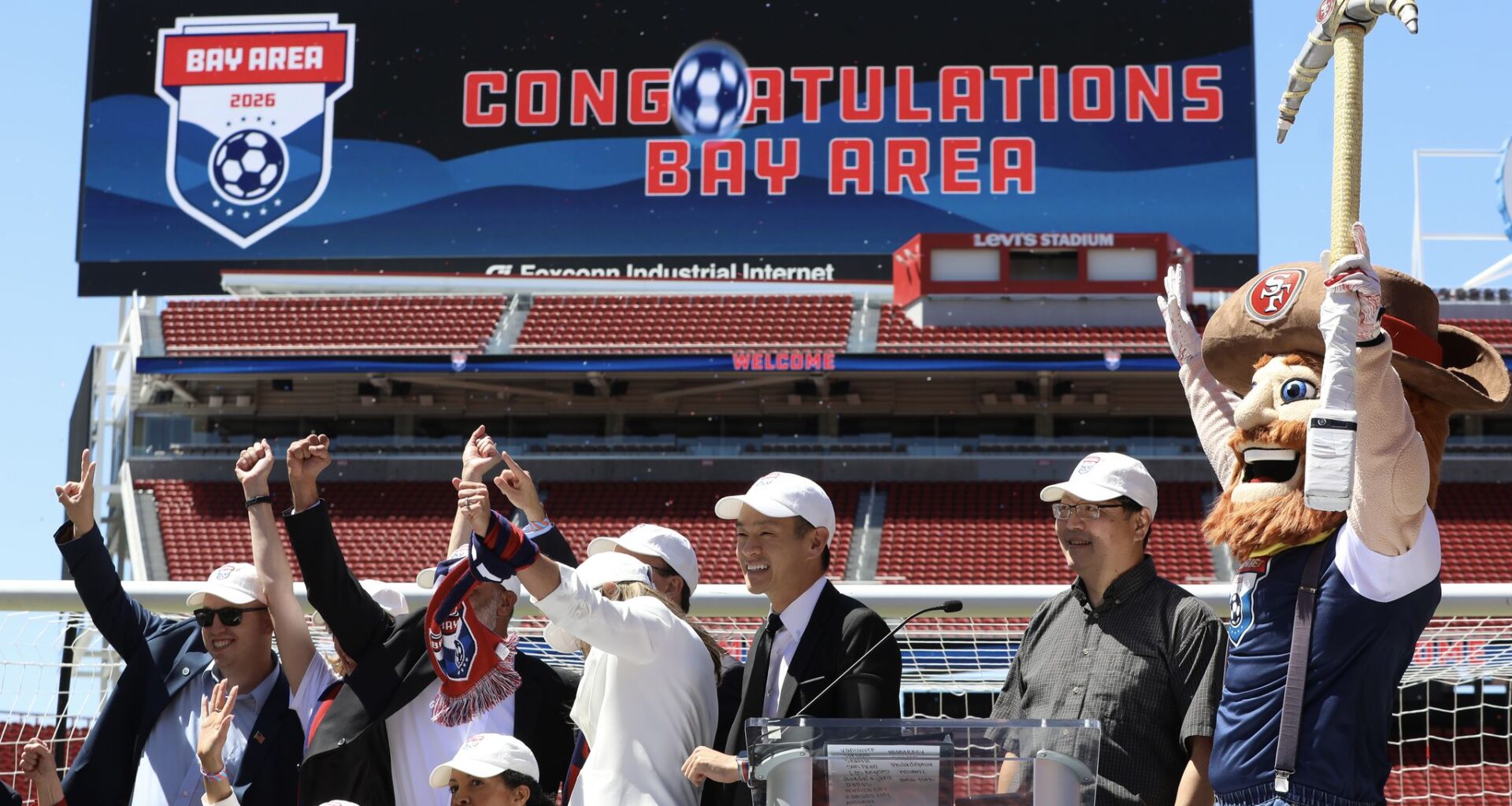
Officials celebrate onstage following the announcement that San Francisco will be a host city during FIFA World Cup 2026 at Levi’s Stadium on Thursday, June 16, 2022, in Santa Clara, Calif.
Yalonda M. James/The Chronicle
Two federal agencies will spend nearly $60 million to underwrite World Cup matches at Levi’s Stadium, as part of a $1 billion infusion the Trump administration has directed to U.S. cities hosting soccer’s marquee event.
The grants, announced recently by the Federal Emergency Management Agency and the Federal Transit Administration, are intended to boost security and support mass transit for the six World Cup matches in Santa Clara, records show.
The announcements offer new insight into how tens of millions of dollars in costs for the tournament will be covered.
Article continues below this ad
The Bay Area matches are the responsibility of the city of Santa Clara, along with the San Francisco 49ers and the Bay Area Host Committee, a fund-raising non-profit set up by the team. The 49ers manage the publicly owned stadium where the matches will be played in June and July.
Since FIFA, soccer’s international governing body, chose Santa Clara as a World Cup venue, city officials have been secretive about the project’s finances, refusing to make public basic documents about what the deal requires and how much it will cost. The issues are fraught in Santa Clara, because a local ordinance (Measure J) forbids the use of taxpayer funds to subsidize stadium events.
In a City Council briefing last year, City Manager Jovan Grogan said staging the matches at Levi’s Stadium would cost about $50 million, while rent paid by FIFA will bring in approximately $13 million. The Bay Area Host Committee pledged to raise the money to make up the multi-million dollar shortfall.
San Francisco Chronicle Logo
Make us a Preferred Source to get more of our news when you search.
Add Preferred Source
To quell financial concerns raised by critics, the 49ers later promised to cover any deficit if the host committee’s fundraising falls short.
Article continues below this ad
Grogan’s $50 million estimate is lower than what other World Cup cities say they will spend. New Jersey’s payout will reach $300 million, according to a local member of Congress, while Toronto officials have estimated their World Cup expenses at about $279 million in U.S. dollars.
Grogan has said the $50 million figure represents only Santa Clara’s share of World Cup costs, and the overall cost would be higher. The World Cup is a regional event, and “the Bay Area Host Committee is going to bear costs throughout the Bay Area,” he told the council, without providing an estimate for the region.
City spokesperson David Knight, in an email Monday to the Chronicle, didn’t respond to a question about overall costs of the tournament. Knight did say the federal funds would be earmarked for public safety, security and emergency preparedness tied to the World Cup.
Zaileen Janmohamed, the host committee’s president, has refused to disclose the committee’s fundraising goal. Big corporate donors were hard to find in the early going, sources familiar with the effort said. But spokesperson Mitch Germann called the private fundraising effort a great success, saying the committee was “on track to deliver a memorable event.”
Lobbying for public funds was also an early focus. Over the past two years, records show, the 49ers and the host committee have spent a combined $200,000 lobbying Gov. Newsom and the state legislature for World Cup funds.
Article continues below this ad
So far, the payoff has been modest: last year, the governor split $10 million between Los Angeles and the Bay Area for World Cup security. The host committee had hoped for $40 million.
The committee has also spent $100,000 to lobby the White House as part of a consortium of World Cup cities that together have pumped more than $750,000 into the effort. It has paid big dividends.
President Donald Trump has become a World Cup booster, predicting huge economic benefits from hosting the tournament. He created a White House Task Force for the World Cup and promised $1 billion in federal subsidies, some of it built into his “One Big Beautiful Bill” spending measure last year.
Then, last month, the first payouts were announced. FEMA said it would distribute $625 million to World Cup cities to pay for protecting “players, staff, attendees, venues, and critical infrastructure” from “potential terrorist attacks,” according to a FEMA fact sheet.
The money will pay for training officers, upgrading cybersecurity defense and increasing police and emergency response not only at stadiums but also at hotels and transportation hubs used by fans. The Bay Area’s share for six matches is $51.1 million — with stadium safety and security as the top priority, according to Germann, followed by “team hotels, base camps and venue specific training sites.”
Article continues below this ad
The federal money will be distributed by the host committee via grants to local city governments and organizations, Germann wrote in an email. The committee is required to reimburse the city of Santa Clara for costs associated with hosting the event, according to their agreement.
“I’m glad they have a revenue source to pay the cost of the World Cup and meet their obligations,” Mayor Lisa Gillmor said Monday. “We don’t have a choice with Measure J — we have to have every dollar reimbursed. No money for these operations can come from our general fund.”
The City Council will hold a special meeting Tuesday night, and among the agenda items is a “status report on 2026 major events invoicing and reimbursements.” That discussion is expected to include the Super Bowl and World Cup.
Los Angeles, which will host eight Cup matches, was granted about $58 million, nearly $7 million more than the Bay Area. New York and New Jersey received $66 million for security at MetLife Stadium in New Jersey, site of eight matches, including the World Cup final.
Meanwhile, the Federal Transit Administration said it would steer more than $100 million to expand transit service to World Cup stadiums. The goal is to provide a “seamless travel experience” for soccer fans, Transportation Secretary Sean Duffy said in a statement.
Article continues below this ad
The Bay Area’s share of $8.8 million will be administered by the region’s San Francisco-based Metropolitan Transportation Commission. The Santa Clara Valley Transportation Authority, the primary transit service for Levi’s Stadium events, is advocating “a large majority of these funds be allocated to VTA,” according to a spokesperson.
Those funds would be used to support the cost of additional trains, buses and operators for the World Cup.