
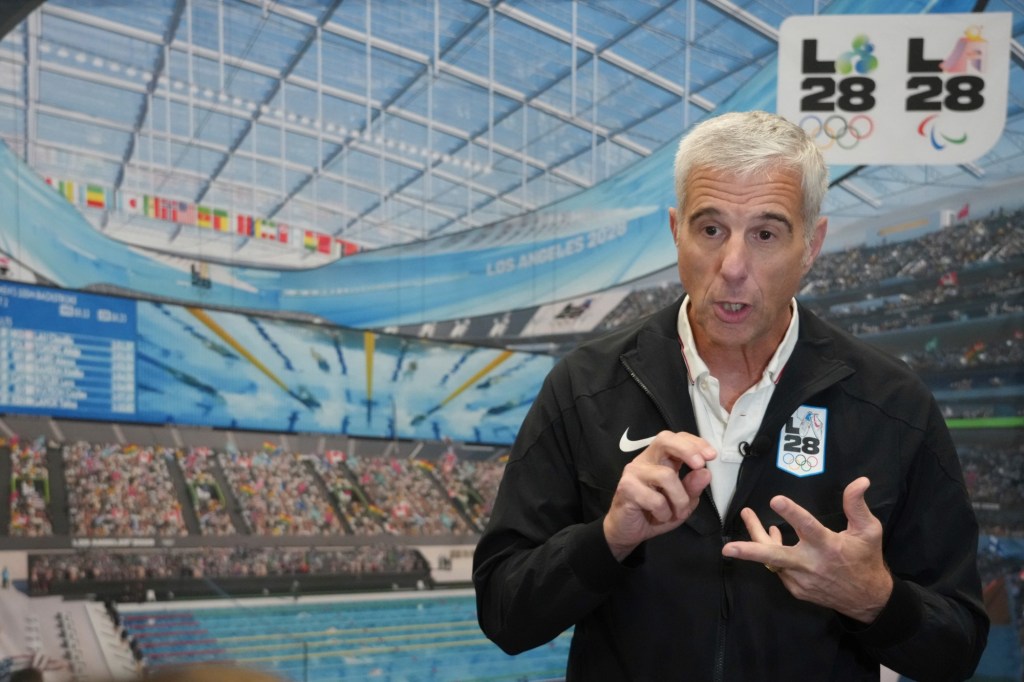
LSO ANGELES — Months of the Los Angeles City Council’s frustration with LA28 boiled over during a committee meeting Monday morning with one council member saying he doesn’t trust the local organizing committee for the 2028 Olympic and Paralympic Games and its board of directors. And council members maintained they had been misled on ticketing and accused LA28 of trying to make an “end run” around city requirements for hiring local businesses for the Games.
Council members directed pointed criticism toward LA28 officials for a lack of transparency on the organization’s finances, its failure to reach an enhanced services agreement with the city, repeatedly disregarding to city council members’ concerns about the funding, planning and implementation of the Games and their security, and a ticket surcharge during the nearly two hour meeting of the council’s ad hoc committee on the Olympic and Paralympic Games.
“You don’t understand you’re not a nonprofit,” council member Hugo Soto-Martínez, referring to the LA 28’s status as an 0rganization exempt From income tax, told LA 28 CEO Reynold Hoover. “We are. The city of LA is the financial backstop to everything that you are doing, and I don’t think that has resinated or permeated to you or to this whole board that I just frankly don’t trust. When we have all these Maga Republicans sitting on that board, you’re not coming here, giving us confidence that you’re doing the right thing for the city of LA.”Hoover did not respond.
Council member Katy Young Yaroslavsky grilled Hoover on ticketing, saying that LA 28 had previously misled the council and pressing him on how much of a 24 percent surcharge on tickets is going back to LA 28.
“We had a lot of conversation about putting $1 a ticket tax on the ballot this June, and we declined to do that after having a conversation with you all about how important it was that you keep the tickets affordable,” Young Yaroslavsky said. “The tickets are not affordable. The 24 percent surcharge is not affordable, and $1 which would have actually helped us do some of the things that we know we need to do to get ourselves ready in the city the Olympics feels like a drop in the bucket compared to 24 pecent surcharge when we’re talking even about a $28 ticket, of which there were hardly any left when it was when I got lucky enough to get in there, there was hardly anything that was affordable, and then you had the 24% surcharge. I’m thinking, why didn’t we do the dollar tax? And it’s not too late, colleagues, for us to do that, because there’s going to be a secondary market for all of these tickets. And so I want to know what percentage of that 24 percent is coming back to LA 28 because I feel like we were misled when we were having conversations about that ticket tax.”
“I don’t know,” Hoover said, adding that he would have to get back to the council member.
But much of the meeting centered on council members criticism of LA 28 for what the council described as a lack of guarantees that businesses in the city will receive contracts with LA 28 for Games related services.
“What’s materializingin this plan is it feels like a lack of honest commitment with measurable goals, with dollars,” council member Monica Rodriquez said.
LA 28 has committed to awarding 75 percent of Games related contracts to local businesses and 25 percent to small businesses. But “local” includes a five-county area in Southern California while the council want LA 28 to prioritize businesses with the city.
“Basically, what she laid out and defended is a system where no LA, you could have a scenario where no LA business does any business with LA28 out of the over $4 billion, not in a verifiable way,” council president Marqueece Harris-Dawson told Hoover and LA28 chief operating officer John Harper. “I mean, you just said, ‘Well, I don’t want to have a tier, because I want competition, and then I don’t even want them to be required to have certification, because that might be difficult.’ What that can add up to, to someone just reading the plan, is you don’t do any business with anybody in LA. And I know that’s not your intent, but that’s what you have written down. That’s what you’ve defended this morning.”
Hoover in an opening statement stressed what he called the ability of the Olympics to bring people together and the success of LA28’s ticket sales so far. But he spent most of the meeting defending LA28’s proposals regarding hiring local and small businesses, saying the organization has a responsibility to deliver fiscally responsible Games.
“Here’s the thing,” he said. “One of our responsibilities is to deliver a fiscally responsible gains for the city of Los Angeles and for us as an organization. In order to do that, I need to have competition in pricing.
“If I focus solely, first and foremost, on the city of LA, for city small business, then I am artificially reducing the pool of competition, placing greater risk on the city taxpayers and placing greater risk on the backstop of the city of LA, because prices will go up when there’s no competition.”
Council member Bob Blumenfield pushed back.
“You’re talking about the logical extreme of that. And I don’t think that (a city official) was saying focus solely on LA businesses. We all know that that’s ridiculous extreme. The question is whether or not there is a, you know, a priority, an extra point, or some, some form you there are ways to do that without, without jumping to that extreme of we’re losing our competition.”
“LA is big city. It’s not, it’s not like we’re talking about Santa Monica or something, you know, or single district, and LA is a country state that’s right, right? “
Harris-Dawson said the lack of specificity in the term “local” struck him recently as his wife was ordering Olympic tickets.
“And we realize, even though, as I’ve told both of you, I live a mile from So Fi (Stadium) far another about three and a half miles from Exposition Park I was in line with somebody from Barstow, California,” Harris Dawson said. “Someone was very little at risk. They’re not within 100 miles of any of the activities, their city, their county. They’re not putting anything on the line, and so I’m just, I just want to communicate to you all that five county cthing hit differently and just over the process of buying tickets, I can’t imagine how it would feel if I were a business owner and I’m competing to do business down the street or around the corner with somebody in Barstow or mean to pick up Barstow as a place, but the point is, there are people included in the five county area that have a lot less at stake than LA City. And I won’t even go further, I don’t even work for these people. But those people are even different than Long Beach and Inglewood and Pasadena, because at least they have at least their hosting events.
“So the idea that we we lump all those together, and as the procurement plan that we have in front of us now does without special attention to the city of LA, and I would even argue, again, special attention for venue cities or people live near venues which I’ve heard la mentioned, I think this is the mark. And then again, not ever knowing. You know, we’ve been at this for nine months or so, at least, not knowing what the spend is, or what the range of the spend is, or, you know what a minimum spend might be, at least as a starting place…
“But my point is the you know, the reason the Olympics are in LA is because people of La have invested to build a city up so that it is at a stage where you could come and have a living and not have to build a single building. The people of Los Angeles did that, and in order to do that, we have a greater tax burden, we have a greater regulatory burden, and we have greater property costs. So businesses might charge a little bit more. So if you just go for a straight we want the cheapest person in the five county area. I can tell you already, you’re going to be using a bunch of businesses where the land is cheap and there’s no regulation, because the county, the counties that you didn’t go all the way to the Nevada border.”
Monday’s meeting came more than six months after an Enhanced City Resources Master Agreement was supposed to be completed. LA28 officials remain in negotiations with city officials over which expenses beyond “normal and customary” city services LA28 will compensate the city for.
Rodriguez in a letter to Hoover last week, first reported by the Southern California News Group, criticized LA28 for what she described as a lack of “financial transparency” and its failure to reach an agreement with the city that protects hundreds of millions of dollars in city funds used for Games-related services.
“With just 830 days remaining until the 2028 Summer Olympics and Paralympics, the City of Los Angeles still lacks clear, enforceable protections over hundreds of millions of dollars in public exposure,” Rodriguez wrote to LA28 CEO Reynold Hoover in a letter obtained by the Southern California News Group. “This is not a minor gap; it is a critical failure that must be fixed now.”
“Bankruptcy cannot be the legacy of these Games,” Rodriguez wrote later in the letter.