
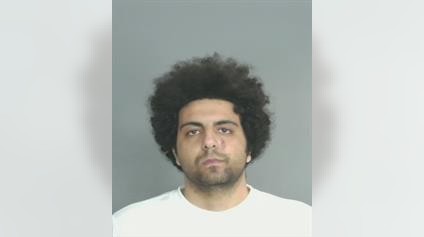
The ambush and fatal stabbings of two Chapman University alumni at their apartment near Angel Stadium was the result of either a fit of insanity by an admitted killer or a long-planned but botched murder plot driven by workplace anger, an Orange County Superior Court jury was told on Tuesday, April 14.
Ramy Fahim, 30, admitted last week to being responsible for the special circumstances murder of Griffin Robert Cuomo and Jonathan Andrew Bahm, both 23, at the Stadium House Apartments across from Angel Stadium on Katella Avenue in April 2022.
Jurors hearing the case in a Santa Ana courtroom are now left to decide whether Fahim was insane at the time of the killings.
Fahim — whose mother is a former high-ranking official in the Egyptian government — was born in Cairo but spent time during his childhood and teenage years in Chicago and Rome before getting degrees from USC and Columbia. Around his college years, Fahim was also involuntarily hospitalized for the first — but not last — time, diagnosed with schizophrenia, and began taking an anti-psychotic medication.
In late 2021, Fahim moved from Florida to Southern California to work for Pence Wealth Management. His mother was a friend of one of the firm’s owners, according to court filings, and as a favor Fahim was hired so that he could renew his Visa and stay in the United States.
It was at the wealth management firm that Fahim met Griffin Cuomo, a marketing and media assistant who was responsible for giving Fahim assignments. The two got along at first, jurors were told, with Cuomo at one point taking Fahim to a Los Angeles Rams game. But their work relationship soon turned antagonistic, the prosecution and defense both acknowledged, turning the mood at their shared office tense.
Fahim appeared to be frustrated at the level of work Cuomo assigned him, the attorneys said, and claimed Cuomo was micro-managing him. Cuomo and other employees were concerned by Fahim’s bizarre and erratic behavior — along with his poor personal hygiene — and unsuccessfully tried to get the leaders of the firm to fire him.
On the night of April 18, 2022, Fahim gained entry to the Angel Stadium-adjacent apartment building where Cuomo lived with his friend and fellow Chapman University graduate, Jonathan Andrew Bahm. He spent more than ten hours at the complex overnight and into the next morning, drawing concern from other residents and at one point the suspicion of a security guard. Around 6 a.m. on April 19, Fahim made his way to the fifth floor of the complex and waited outside Cuomo and Bahm’s apartment.
As soon as Cuomo opened the door to leave for work, Fahim slashed his throat, according to both the prosecution and defense. Cuomo was driven back into his apartment, where Fahim stabbed him more than 40 times with what the prosecutor described as a “hunting dagger.”
Bahm saw Fahim attacking Cuomo, locked himself in a bathroom and called 911. But Fahim forced himself into the bathroom and killed Bahm, also stabbing him more than 40 times. On a recording of the 911 call played for jurors on Tuesday, a slightly frantic Bahm’s attempts to describe the man attacking his roommate abruptly turn into bloodcurdling screams.
Fahim, after killing Cuomo and Bahm, waited for police to arrive. The officers found the bloody knife in a pocket of the hoodie Fahim was wearing. Speaking to an Irvine detective, Fahim acknowledged killing Cuomo and Bahm, but blamed it on his schizophrenia, claiming that voices in his head had told him to carry out the slayings.
Fahim’s attorney, Marlin G. Stapleton, spoke at length before jurors about Fahim’s “bizarre” behavior around coworkers and during the police interview. After his arrest, officers carried out a search of Fahim’s electronic devices.
“It leads to madness,” the defense attorney said, referencing writings found on Fahim’s computer. “That is the best word I can use to describe it.”
Among the notes Fahim had written over more than a year were musings about how serial killers pick their victims, where to bury a body and whether someone can scream with their throat slit, Stapleton told jurors. Investigators also found disturbing messages Fahim had written to family.
“He was telling his mother that he was going to kill Griffin, he talks about God and Moses and how he won’t get in trouble for it,” Stapleton said.
Senior Deputy District Attorney Jeff Moore acknowledged that Fahim was schizophrenic, but argued that the killings were driven by Fahim’s anger at his workplace dispute with Cuomo, not his mental illness. Ten days before the killings, the prosecutor told jurors, Fahim had written that if he got caught he would blame it on his schizophrenia.
“He foresaw this day, he knew that it was potentially possible that one day he could find himself in a courtroom sitting in that chair before a group of people like you,” Moore told the jurors. “He needed a reason. He needed an out. And his out was blaming it on schizophrenia.”
Fahim had planned to kill Cuomo, to cut off his head, to bury the head somewhere in nature and to leave his body in a dumpster to be taken to a landfill, the prosecutor said. Fahim had scouted out Cuomo’s apartment complex several times, had driven out to isolated spots where he could have buried Cuomo’s head and had left a tarp and a shovel in his car.
“He personally wanted to kill someone and it came to be Griffin (Cuomo),” the prosecutor told jurors, saying that Fahim’s writings showed he was “obsessed with murder and death.”
But Moore said Fahim apparently didn’t know that Cuomo had a roommate, and Bahm’s witnessing the attack on Cuomo “blew up” Fahim’s plan. Once Bahm called 911, the prosecutor told jurors, Fahim knew he had no chance of escaping the apartment complex.
Four mental health experts are expected to testify in the trial — two chosen by the prosecution who are expected to argue Fahim was sane and two chosen by the defense who are expected to argue he was insane.
A sanity phase of a criminal trial is the rare instance in a criminal case where the burden of proof is on the defense rather than the prosecution. But the burden of proof for the defense is lower than the standard prosecutors are required to prove for a guilty verdict. Jurors will have to decide whether it is more likely than not that Fahim was insane at the time of the killing, rather than the “beyond a reasonable doubt” standard required for a criminal conviction.
If jurors do decide that Fahim was insane at the time of the killings, he would likely be sent to a state hospital for mental health treatment. If they decide he was sane, Fahim would face up to life in state prison without the possibility of parole.