
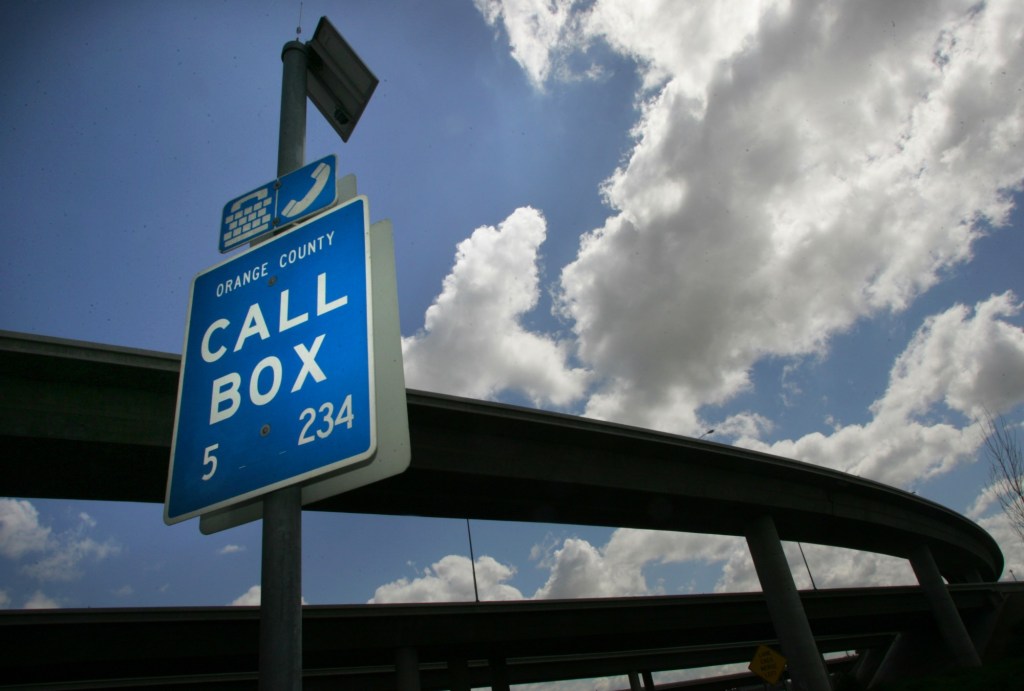
When a tire blows out or the engine overheats, fewer than one person a day in the last year has gotten out of their car on the side of the freeway and trudged to a call box.
Most people whip out their cellphones to call for help.
With the decline in usage and the availability of the 5-1-1 motorist assistance program, the Orange County Transportation Authority board gave its blessing this week to remove the remaining 175 call boxes along local freeways by June 2027.
Some might even be surprised to know that call boxes were still around.
The emergency phones along freeways started popping up in Los Angeles in the 1960s, but it was years before they were seen much elsewhere. It wasn’t until a $4.6 million contract was awarded in 1987 that a 1,000-box network debuted in Orange County.
Within a year, 11,000 calls were being logged a month, and a noticeable decrease was reported in the need for California Highway Patrol officers to stop and help motorists — the then-Orange County Transportation Commission’s executive director, Stan Oftelie, was quoted as saying, “The call boxes are just a tremendous success. What did those people do before those call boxes were there? How much freeway delay time were we sacrificing before we had them?”
At their height in the early 1990s, 1,200 call boxes were spaced about every quarter-mile on local freeways, and some 135 calls a day were logged in OC, according to OCTA officials.
In 2008, 7,306 people used a call box in OC and the next year — when one transportation official compared the waning use of call boxes to photo labs or cassette tapes — more call boxes were going to be removed to spread them to about every mile on public freeways. A 2015 article in The Orange County Register about the OCTA looking at removing even more of the boxes reported about 205 calls a month.
That is about how many calls were logged in the last fiscal year, OCTA authorities said.
Los Angeles-area transportation leaders are also looking at phasing out the last of their already-reduced stock of call boxes. Inland Empire counties have discontinued their programs, OCTA CEO Darrell Johnson said.
A dollar is tacked onto registration fees in Orange County to pay for the call boxes and other motorist assistance programs — the county also has its Freeway Service Patrol that contracts tow trucks to make rounds on local freeways to help motorists with disabled vehicles and is part of the nationwide 5-1-1 system. About $2.9 million is raised from the fee a year, officials said.
“We have coverage which we didn’t have in certain places before,” Johnson said. “While not every single situation can be accommodated, we note that even with the current boxes out there, they can’t accommodate each one. There are some gaps, but we think they are minor.”
More than 6,000 people called 5-1-1 for help in the last fiscal year, according to Eric Carpenter, a spokesperson for the OCTA. And officials said they will be promoting more awareness of the system.
“The need for safe and efficient roadside service hasn’t gone away, but technology has changed,” Carpenter said in an email. “We’re aligning the program with how people actually request help today and using the $1 fee more efficiently to support faster, safer service through 511 and freeway service patrols.”
OCTA officials estimated each call to the county’s call boxes costs about $1,337, while the 5-1-1 system costs about $7.11 per call.
As of last year, 98% of adults in the country report having cellphones, and most are smartphones, according to the Pew Research Center, which adds that a similarly high level of usage is seen across all ages and communities.
Travelers can call 5-1-1 and also visit SoCall511 to get traffic, transit and rideshare information as well as roadside assistance while on freeways.
OCTA officials said 98% of the calls from the remaining call boxes are for cars having mechanical problems, to report debris on the roadway or following a crash; the other 2% were for fire or medical needs.
The program of patrolling tow trucks should also help cover those needs, officials said.
And a charged-up cellphone is always a good idea.