
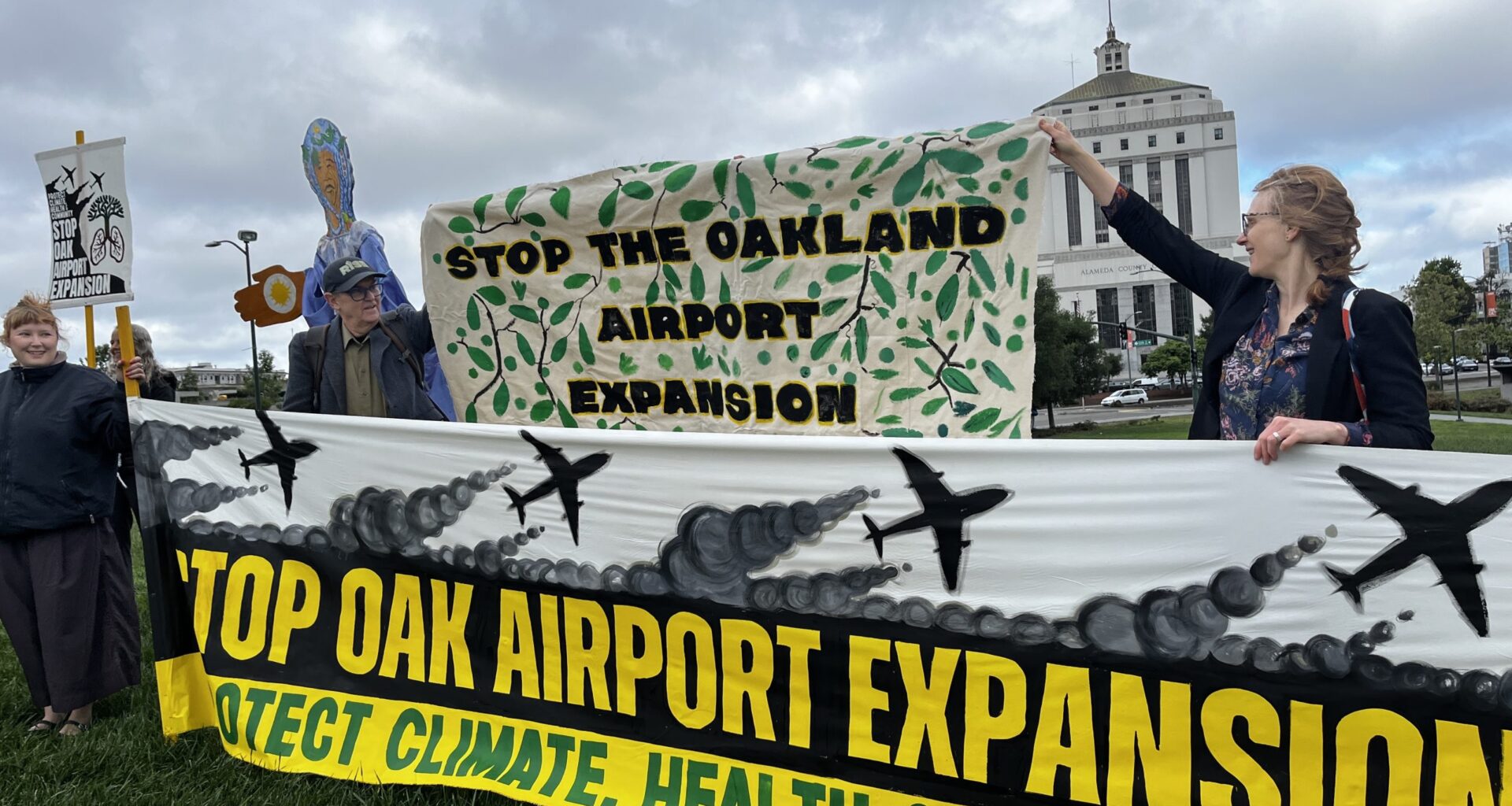
A small crowd of activists gathered near the Lake Merritt amphitheater on Tuesday, saying they want to remind Oakland residents what’s at stake in an ongoing legal battle to stop the expansion of the airport.
Attorneys for Communities for a Better Environment and other environmental groups want an Alameda County judge to force the Port of Oakland to redo an analysis it performed on the potential impacts of a major construction project at the airport. The project, which has been in the works for years, would modernize terminals and add new gates for planes.
The port, which operates the airport, argues expansion is necessary to meet demand for air travel in the East Bay and that it will create jobs. But environmental advocates claim it will lead to more air pollution.
“We have a right to clean air, water, and soil,” said Adele Watts, a program director with Communities for a Better Environment, a nonprofit advocacy organization. “16 new gates are going to cause an abundance of additional air pollution.”
Communities for a Better Environment and the Stop OAK Expansion Coalition sued the port in December 2024 for allegedly not adhering to the California Environmental Quality Act, a state law that requires government agencies to consider the environmental impacts of development projects. According to the lawsuits, the port didn’t conduct an adequate health assessment to understand how expanding the airport might impact the health of residents living nearby. A Southern California public-interest law firm called Advocates for the Environment filed its own suit, too.
An Alameda County Superior Court judge heard arguments from the plaintiffs and attorneys representing the Port today at the Rene C. Davidson Courthouse. The judge took the arguments under submission and will issue rulings on the three related cases at a later date.
A major sticking point for the environmental groups is that the Alameda County Public Health Department asked the port for a more thorough report on potential health impacts during the public comment period for the draft environmental impact report. The port didn’t follow this advice, noting that such an assessment would produce “inconclusive results or similar conclusions” compared to the evaluation they had conducted.
Janina Turner, the environmental justice co-director for the HOPE Collaborative, said at Tuesday’s rally that residents in East Oakland have suffered from generations of environmental injustice. The area has high rates of asthma hospitalization for children, among other public health issues.
“We will be arguing that the port needs to go back to square one and conduct a new final environmental health impact report, that this time includes the health study that the health department has requested,” Turner said.
Justin Berton, the Port’s communications director, said in a statement that the Port’s Board of Commissioners certified the environmental impact report for the modernization and development project “following a comprehensive review by staff.”
The final report “was based on substantial evidence and expert analysis, and the Port looks forward to defending the EIR and the project in public hearings,” Berton said.
Last March, the port struck a deal with the city of Alameda and a separate group of residents who had threatened a lawsuit over the expansion project. As part of this agreement, the port is required to take steps to minimize noise and air pollution over Bay Farm Island, a neighborhood of Alameda that is next to the airport.
This settlement upset some advocates fighting the expansion project, who argued it would result in more concentrated pollution from air and ground traffic in lower-income areas of Oakland and disproportionately impact people of color. In the past, other advocates have noted that the airport’s argument for adding more gates to the airport is at odds with the decline in passengers flowing through OAK since the pandemic.
Dean Wallraff, an attorney for Advocates for the Environment, which is also involved in the litigation, said the aviation industry contributes a huge percentage of carbon dioxide emissions that contribute to global warming. He argued that the airport violated CEQA by failing to state what the net increase in greenhouse gas emissions will be from the expansion project, and offered no mitigations.
“This is something the airport should be paying for, not the world at large,” Wallraff said.
“*” indicates required fields