
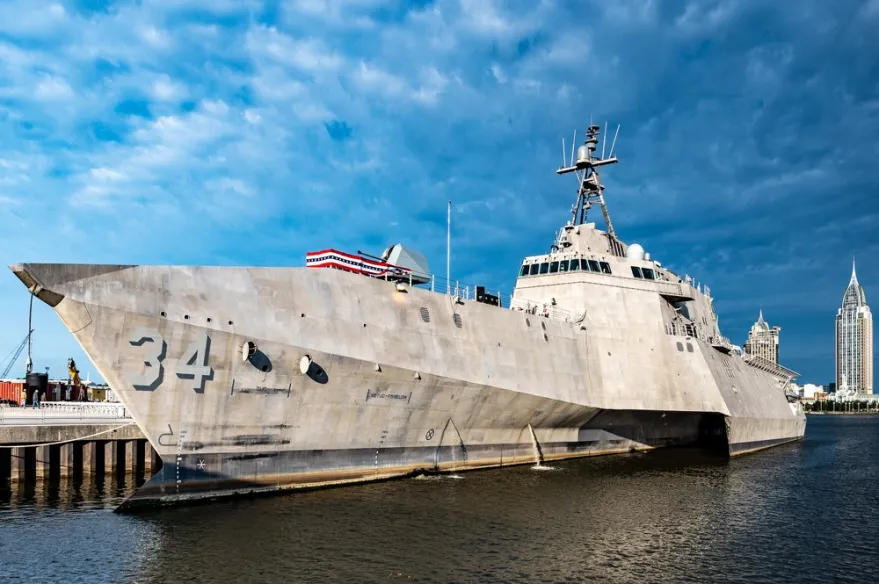
The USS Augusta, a nearly new Independence-class littoral combat ship, will undergo a $33.5 million overhaul at a San Diego shipyard that will partly focus on determining if it has developed the sort of hull cracks that have plagued other vessels of its design.
Workers also will take a look at the Augusta’s propulsion system, another area in which many littoral combat ships, or LCS, have experienced problems, drawing ongoing criticism from Congress and the defense industry.
Such flaws have made early-life reviews common among LCS, something that is not broadly true among the Navy’s much larger and far more sophisticated Burke-class destroyers.
The Augusta has been homeported in San Diego since 2023, the same year it was commissioned. It has yet to reach the point where it could depart on its first major deployment.
The Defense Department announced last week that the roughly $500 million ship will enter the BAE Systems shipyard in Barrio Logan and go into a dry dock, which is done to give workers a chance to examine, clean, paint and, if necessary, make repairs.
This kind of inspection led to the discovery of structural problems in many earlier Independence-class ships, some of which involved costly hull cracks, according to a 2022 report by the U.S. Government Accountability Office.
Cracks can also reduce how fast these lightly-armed ships can move, which runs counter to their purpose. They are meant to be fast, versatile vessels that can dart into shallow, near-shore waters to detect and destroy mines, hunt and hassle submarines, and place special forces ashore.