
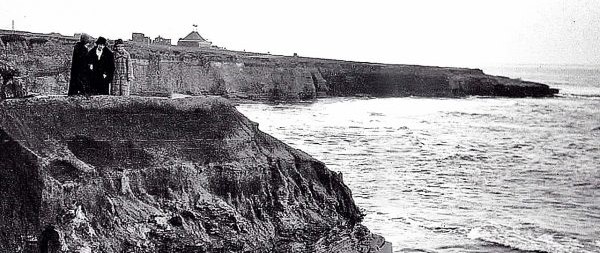
This is the first of two parts.
“Opening of new Kraft Building” read the banner headline of The Beach News on Saturday, Jan. 29, 1927. The “beautiful modern drug store” had just opened on the southeast corner of Newport Avenue and Bacon Street in Ocean Beach.
With “five stores” on the ground floor, “suites of offices” and “modern apartments” on the second floor, the “splendid structure” was lauded as “magnificent and new” and deemed “worthy of the highest commendation.”
In fact, “in its solidity, immensity and general appearance, the new Kraft Building stands without a peer in the beach sections of San Diego.”
Evidently they liked it.
The above is reported as a time-frame reference — nine months short of a century ago.
An adjacent story in The Beach News, also above the fold, advertised the next-day opening of Azure Vista, “Point Loma’s newest residential district.”
“The noted author” John Steven McGroarty was to officiate at “a grand function arranged by the John P. Mills Organization Inc., selling agents for the owners of the property.” There would be “a fine orchestra in attendance before and after a free hot lunch to be served in a tented pavilion on the tract, located on Sunset Cliffs Boulevard near Hill Street.”
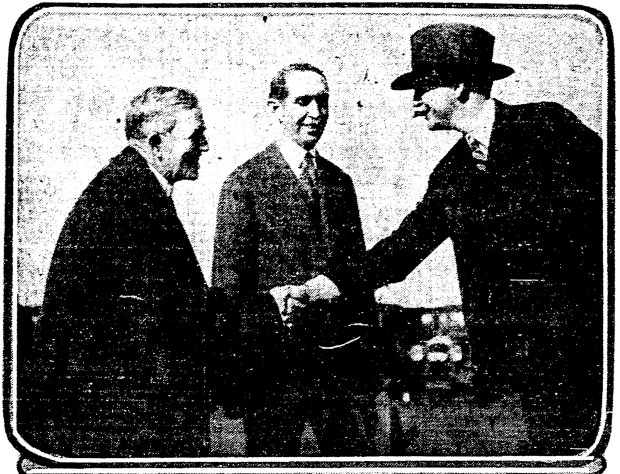 Author John Steven McGroarty and developers Jesse Shreve and John P. Mills attend the opening of Azure Vista in January 1927. (Ocean Beach Historical Society)
You frequently hear that there is no such thing as a free lunch, yet such was clearly to be had in Azure Vista, and the public was invited. Folks were urged to “be there, and take a friend with you.”
A giddy optimism reigned on the Point in 1927.
If you’re not familiar with Azure Vista, we refer to the neighborhood west of Cornish Drive and south of Hill Street, above Sunset Cliffs Boulevard. It is a gently sloping hillside overlooking the ocean.
Azure Vista was by no means unique as a new subdivision at that time in Point Loma. The partnership of Pantages, Mills & Shreve happened to be developing 15 subdivisions on the Point more or less contemporaneously with Azure Vista.
Most notably, Point Loma Heights and Azure Vista-adjacent Sunset Cliffs and Riviera Villas were large tracts with good-size lots, wide streets, alleys, smooth sidewalks and all utilities.
Most of Sunset Cliffs and Riviera Villas had been purchased from the estate of sporting goods magnate Albert Spalding, along with the shoreline park that he loved so much. We’ve mentioned old Al in these pages several times.
The 65 acres of Azure Vista were acquired on the cheap from what Mills referred to as “the Theosophical homestead.”
Advertised restrictions were part of the package in most if not all of those subdivisions. Spanish Revival, Mediterranean-style villas were what Pantages, Mills & Shreve envisioned. Large white stucco homes and red tile roofs with minimum building expenditures were expected. Fifteen to 20 of what are referred to as the area’s old Spanish Houses were effectively model homes, giving prospective homeowners an idea of what was expected and what to shoot for.
Ah, the best-laid plans.
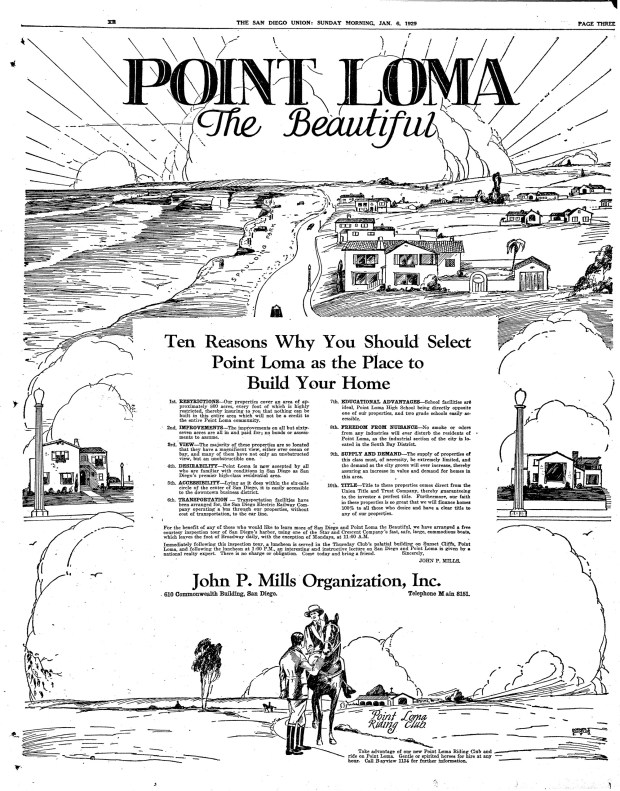 The John P. Mills Organization took out a full-page ad for its Point Loma subdivisions in the San Diego Union on Jan. 6, 1929. (Ocean Beach Historical Society)
Vacant lots
Here we will bounce forward 3½ decades and consider the concept of vacant lots. I realize, children of the ‘80s and ‘90s, that you have no frame of reference here. Much like an intricately folded paper street map from the gas station or a nice cold bottle of Delaware Punch from Al’s Market, the vacant lot is but a dim memory.
Picture, if you will, a parcel of land in a suburban environment with nothing built on it! You may just have to trust me on this one, but honestly, such was once a thing — a thing highly valued by the kids of the early 1960s.
We often would walk or ride bikes — here I mean the kind of bike you actually had to pedal — to Azure Vista. Why? Because AV at that time was largely made up of vacant lots! Practically wide-open spaces. Some of the blocks were all vacant lots on one side of the street from Cornish Drive down to Cordova Street!
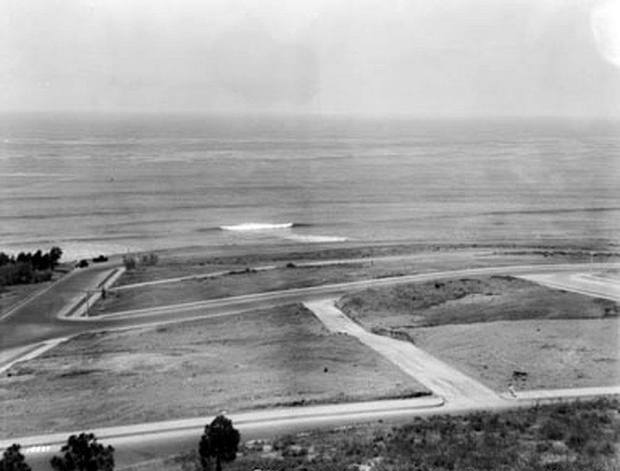 Vacant lots occupy the area toward the bottom of Ladera Street in Azure Vista in 1929. (Ocean Beach Historical Society)
What did we do on those vacant lots? Wouldn’t you like to know! No, of course we flew kites, made forts, had huge pickle-weed wars, the usual stuff. But here’s the thing — some of those lots were not completely vacant. There were trees and bushes, sure, but in some cases there were concrete walkways going … nowhere. Or steps going to a walkway that went … nowhere.
To an 8-year-old anthropologist, it seemed to be the remains of an ancient civilization! Had something been there? Had people lived there? Where did they go? Why did they leave? What the heck? It was a real mystery.
And another thing, some of our textbooks at Sunset View Elementary School were stamped very boldly on the inside cover: AZURE VISTA SCHOOL. Why would they change the name of the school? Perspiring second-grade minds wanted to know. I wouldn’t connect those dots for many semesters.
‘Super-subdivision’
The big sales kickoff mentioned above was in early 1927. Azure Vista sidewalks are dated in spring and summer 1928. In September ‘28, John P. Mills was still ballyhooing the 300 contiguous acres of his three westside subdivisions and their uniform excellence.
In the Community Development section of the Sunday San Diego Union, the developer referred to a “super-subdivision” of “large residential homogeneity … with nothing mediocre in between them.” A “city within a city,” he suggested, invoking the example of Coral Gables, Fla.
Mills released figures showing that his firm had spent $3 million-plus over a three-year period on infrastructure for its subdivisions. Not pocket change a century ago. He declared that his developments gave San Diego “a wonderful oceanfront dwelling district, just far enough off the main highways,” and forecast that “in the years to come, the most fastidious people in America” would flock to Azure Vista and Sunset Cliffs.
Yet it appears that only four homes were built in Azure Vista in the next 14 years. Then came the Second World War.
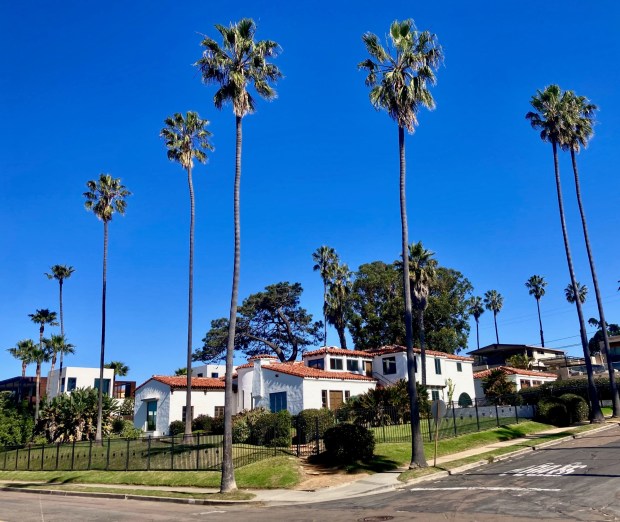 This home on Sunset Cliffs Boulevard was one of the few built in Azure Vista before World War II. (Eric DuVall)
The U.S. economy had slowed by the middle of 1929, and the great stock market crash in October of that year tamped the lid down tight. Hard times had returned exponentially. Enveloped in their own scandals of excess, Pantages, Mills and Shreve were bankrupted. What a debacle!
Mills left town penniless. Dreams of ocean-view lots and Mediterranean-style villas were relegated to the round file. Folks who had purchased lots — and there were many — couldn’t make their mortgage payments, to say nothing of their property taxes.
As a consequence, the next dozen years were unexpectedly peaceful in the large, nearly empty new subdivisions. The wide streets, free of porch lights and vehicle traffic, were quiet and dark at night. Spooky dark.
The common good
In this space, we’ve recently discussed how San Diego’s balmy climate and typically calm seas made it a natural and excellent location for aviation innovation, both military and commercial. Reuben Fleet’s Consolidated Aircraft Corp., along with smaller competitors Ryan, Rohr and Solar, had been flying along famously with their military contracts before the United States entered WWII.
Overnight, San Diego’s population doubled. Not really — I’m erring on the side of hyperbole. But with a population in the neighborhood of 200,000 in 1940, San Diego expected to reach 300,000 in 1960, not 1941, which is what happened.
Defense-related war and aircraft industry jobs were to be had in San Diego, and people showed up from all over the country and from foreign lands. “Housing crunch” does not remotely approach describing the complete housing crisis that backwater San Diego found itself in that year. Where were all these new neighbors supposed to live?
Huge government contracts meant plenty of defense capital was floating around, but the city and county were banking none of it. The dire municipal situation was documented in a couple of national publications, if you can believe that. In the Saturday Evening Post, San Diego was described as “a town of many troubles.” Adequate potable water was a big issue, but let’s consider sewage:
“The city engineer’s big worry is sewage disposal. The facilities were adequate for a city of 200,000 people, plus a normal growth of 55,000 new citizens in a decade. The increase has overtaxed the mains and, to make matters worse, the Navy demanded a metropolitan sewage service to prevent pollution of the bay. Until the present emergency arose, San Diego had taken the pay-as-you-go vow and had voted down every bond issue proposed since 1932. But in the past six months, they have saddled themselves with almost $7,000,000 in new bonded debt.”
It got worse. San Diego never had a housing authority, nor did it want one. The federal government went ahead and took matters into its own hands. It unilaterally “leased” thousands of acres of San Diego property for Lanham Act federal housing projects and military bases such as Camp Pendleton, Camp Callan and more, effectively removing that acreage from the local property tax rolls.
Yet the additional necessary infrastructure, including water and power, new roads and, of course, dramatically increased police and fire protection fell to the overburdened local municipalities.
As Carey McWilliams reported in The New Republic in June 1941: “Most of the new construction in San Diego, for housing and plant, is federally owned and is therefore tax-exempt. Since city and county revenue is derived almost exclusively from local property taxes, the tax base will not support levies for an amount sufficient to finance these new expenditures. While the increased population pays a considerable sum by way of sales tax, this revenue goes to the state and not to the local community.”
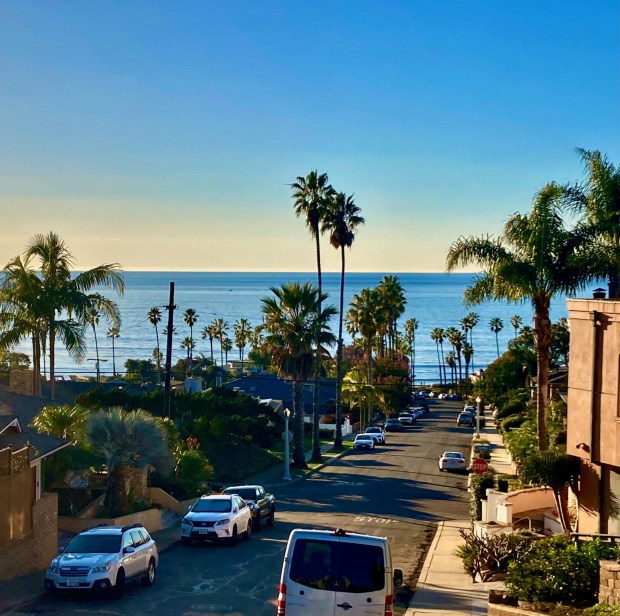 A view down Monaco Street in the Azure Vista subdivision in January this year. (Eric DuVall)
The largest federal housing project in San Diego County, Linda Vista, was also the largest in the nation. Some 4,800 units were erected along the hills and canyons of Kearny Mesa in less than a year. A completely new neighborhood created from scratch.
Linda Vista was the first federal project in San Diego and garnered plenty of publicity, but did you realize there were 24 others?
The Independence project across Barnett Avenue from the Marine base replaced the Ryan airfield at Dutch Flats. Cyane, Los Altos and Bayview Terrace in Pacific Beach and the Presidio project in Old Town San Diego, where Heritage Park is now, were a few others.
Frontier Housing in what is now the Midway District was the last project built in San Diego and the second-largest next to Linda Vista. Riverlawn was a project of apartments and barracks-type rooming houses adjacent to Frontier.
The Warren project near Point Loma High School was developed along the north side of Voltaire Street, where Stump’s market is today.
And then there was Azure Vista.
As an existing subdivision — 99% of it vacant — Azure Vista offered hundreds of buildable vacant lots populated only by red ants, quail and Groucho Marx bugs. Los Altos in PB seems to have been a similar situation, in which the feds just moved into an existing neighborhood.
In Azure Vista, they simply built around the few existing homes. The lonely folks out there were lonely no more. Some 400 of what were termed “demountable” units — mostly modular, portable duplex bungalows — were quickly constructed on the seaside slope of Azure Vista.
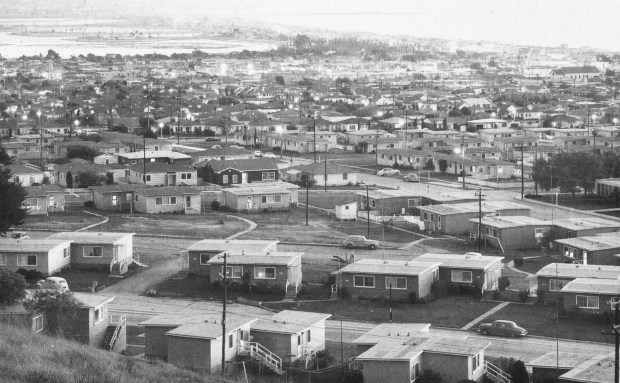 These “demountable” duplex bungalows in Los Altos Terrace, a Pacific Beach federal housing project, were similar to most of the units built in Azure Vista in Point Loma. (San Diego History Center)
With the exception of Linda Vista, Independence and possibly one or two others, San Diego’s federal wartime projects were, in theory, designed to be temporary.
Most of the property in Azure Vista was in receivership, and the feds, in this case the Defense Homes Corp., just relieved the city of those encumbrances, along with the underlying assets — the land itself.
In the few cases when a property owner owned a parcel outright and was up to date on property taxes, the DHC bought the property for approximately half of the “current assessed value.” The supposed arrangement was that the owner would be able to buy back the property for the same price … after the crisis was over. And sharks would fly.
Part 2 will be published in the May edition. Eric DuVall is president of the Ocean Beach Historical Society. Membership in OBHS, a 501(c)(3) nonprofit, is $25 annually. Visit obhistory.org.