
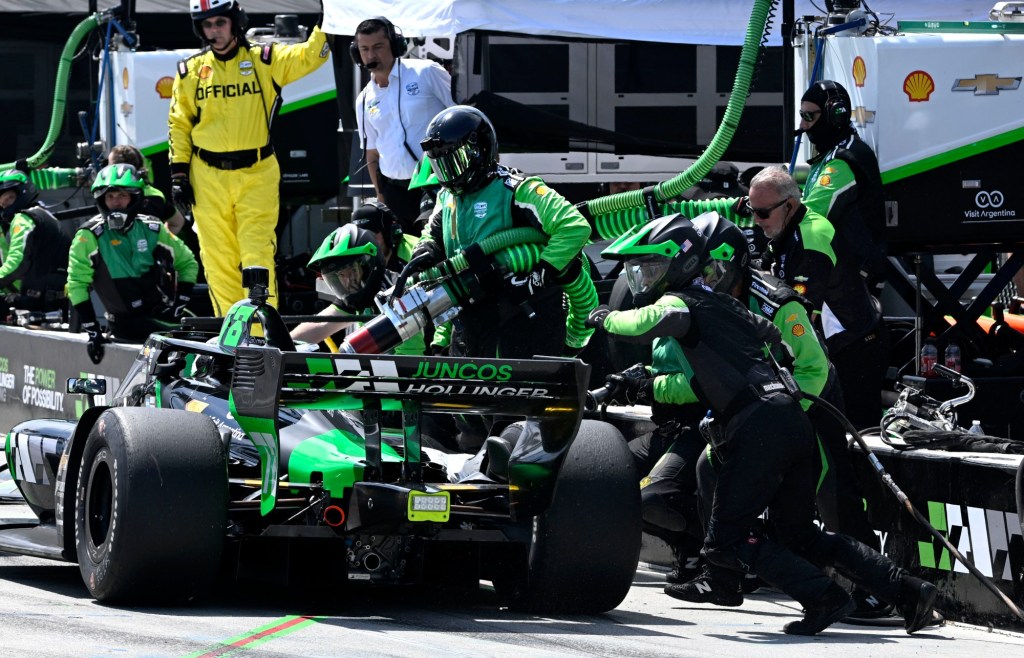
Those who work and live in Long Beach have prepared themselves for a weekend of revving engines and car exhaust fumes rising from downtown Long Beach.
That’s because, starting Friday, April 16, the Grand Prix of Long Beach will take over the streets of downtown for a three-day race, with teams from IndyCar, the International Motor Sports Association, Formula DRIFT and more all competing in one of the nation’s most prestigious motorsports events.
Each year, the streets of downtown Long Beach are transformed into a 1.97 mile race track, attracting close to 200,000 spectators to view the cars flying by. With the thrill of watching cars speeding by at 180 mph, however, comes a significant increase in carbon emissions.
This may seem contradictory to Long Beach’s Climate Action & Adaptation Plan, which lays out how the city can reduce greenhouse gas emissions, but many of the series participating in the Grand Prix actually use renewable and sustainable fuels.
And, they’re not stopping there. The sport of auto racing is going green — as much as it can.
Renewable Fuels
In recent years, IndyCar and IMSA have switched to largely renewable fuels. While teams purchase their own fuel, both series require their teams to use a specific type to ensure fairness in racing. The fuel that powers these race cars is not like what drivers fill their tank with at the pump. Each type of fuel is developed in a lab, often blending ethanol or methanol and other chemicals for a fuel that is efficient and preserves the life span of the vehicle.
Historically, the fuel has been fossil-based gasoline. But now, fuel companies are finding innovative ways to create a fuel that is better for the environment.
In 2023, for example, IndyCar made history as the first motorsport in North America to transition to 100% renewable race fuel. The new fuel, developed by Shell, has reduced the series’ greenhouse gas emissions by 40%. In the last three years, an IndyCar spokesperson said, those two-seater, open-air vehicles have been powered by sugarcane waste.
“This innovation is a great example of how fuels technology is pivotal in helping reduce emissions in the sport,” says the January 2024 edition of the Shell TechXplorer Digest, “and building credibility for low-carbon fuels as emissions-reducing products that can be deployed today for transitional and harder-to-abate fleets.”
IndyCar did not stop at using renewable fuel for their race cars. It also uses exclusively renewable diesel fuel for the trucks that transport vehicles, equipment and, yes, fuel back and forth across the country. This has reduce emissions from those trucks by up to 85%, according to IndyCar.
IMSA, meanwhile, has also taken steps to require the use of a more renewable fuel in its cars. There are two classes of vehicles – the Grand Touring Prototype, or GTP, and the Grand Touring Daytona, also known as GTD – both of which will compete during the Acura Grand Prix of Long Beach.
GTP cars use an 80% renewable fuel developed by VP Racing Fuels, called R80. Eighty percent of the fuel is made from second-generation biowaste and the other 20% is traditional fossil-based ethanol. These cars have also been developed with a hybrid technology, using 10% less fuel than before.
IMSA generated this fuel through a partnership with the Environmental Protection Agency and Department of Energy, according to IMSA President John Doonan, and the series hopes to work toward a 100% renewable fuel in the future.
GTD cars, on the other hand, use IMSA 100, also developed by VP Racing, which is 10% ethanol and 90% petroleum-based fuel.
Endurance racing, Doonan said, is a “showcase for the auto industry” and he views it as an opportunity to show the fuel industries what can be done.
“We get to show the performance in a really cool environment,” he said, “but also be very responsible in the communities in which we are racing and to the environment as a whole.”
Formula DRIFT, whose cars reach high speeds before turning and braking suddenly (or “drifting”), does not use a series-sanctioned fuel. But Formula DRIFT Competition Director Kevin Wells said many of the racers use Ignite E85. This fuel, formulated by Ignite Racing Fuel, is 85% renewable, consisting of ethanol derived from corn.
At this time, however, the series itself does not have any environmental goals.
“It’s not necessarily better for the competitors because the fuel doesn’t actually become cheaper,” Wells said. “Sometimes it becomes more expensive than if they could just go buy it down the street. So it hasn’t currently aligned to where that’s something that would benefit the series at this point.”
Prioritizing Sustainability
IndyCar and IMSA, on the other hand, have outlined plans and other strategic efforts to reduce their carbon footprint.
IndyCar has set a goal of reducing race operations emissions by 50% by 2030.
“Through various partnerships, initiatives and innovations, INDYCAR aims to minimize its environmental impact while fostering a more inclusive and diverse racing community,” says the “2026 INDYCAR Media Guide & Record Book.” “To track this progress, INDYCAR works closely with NTT DATA, the Official Technology Partner of the NTT INDYCAR SERIES. In 2025, NTT DATA, in partnership with INDYCAR, developed an AI-powered emissions management platform that will provide INDYCAR and its partners with data-driven insights into the carbon footprint of race operations and logistics throughout the season.”
This information, however, is not publicly available.
Another effort made by IndyCar to reduce the negative impacts auto racing can have on the environment was creating the Firehawk Indy 500 race tires. These tires, launched in 2023, are produced by Firestone and are created from hard-to-recycle plastics and palm oil waste residue, according to IndyCar’s media guide.
Each year, IndyCar works to improve the tires. This year, for example, it will incorporate Bridgestone’s ENLITEN Technology, which includes renewable soybean oil instead of petroleum-based oils, recycled steel for bead wire that anchors a race tire to a wheel and recycled carbon black to reinforce material recovered from end-of-life tires.
“Use of these materials helps improve resource efficiency and increased material circularity while meeting the rigorous performance demands of North America’s premier open-wheel racing series,” IndyCar said in a February press release. “Efforts are also ongoing to advance end-of-life recycling initiatives for race tires, moving from energy generation to material circularity. Nearly 100% of the tires used in the NTT INDYCAR SERIES and INDY NXT by Firestone are recycled into new uses beyond the racetrack — including playground and sports surfaces, flooring and other rubber products.”
IMSA has also focused on tires when it comes to sustainability. It has launched Michelin’s new GTP tire globally — the Michelin Pilot Sport Endurance. The tire is made of 50% recycled and renewable material.
Both IndyCar and IMSA GTP regulations this year require the double-stinting of race tires, meaning that racers are required to run two stints before replacing their tires, reducing the sets of tires used during a season.
IMSA has even launched a new sustainability award for GTP racers this year — the IMSA Michelin Sustainability and Racing Award. The award, according to a January press release, factors in three elements equally: the number of tires used, the amount of fuel and electricity used, and the finishing time. A “Sustainability Score” is created based on these factors and lower is better.
An award recipient is picked for each race throughout the series. At the end of the season, the team with the lowest cumulative Sustainability Score will be recognized as the season champion.
“IMSA and Michelin have always represented the pinnacle of innovation and competition in sports car racing,” Doonan said in a written statement, “and the debut of the IMSA Michelin Sustainability in Racing Award elevates that legacy in a meaningful new way.
“A key pillar of our partnership with Michelin is a shared, long-standing commitment to advancing technologies and practices that reduce environmental impact while preserving the spirit of endurance racing,” he added. “This award celebrates the teams and manufacturers who are leading the charge toward a more sustainable future for our sport, and we’re proud to showcase their efforts on one of motorsports’ biggest stages.”
All of these efforts align with the environmental priorities of the Grand Prix of Long Beach, according to spokesperson Chris Esslinger.
“The Acura Grand Prix of Long Beach, in conjunction with our racing partners, vendors and sponsors, is working toward a sustainable future for professional racing because we believe motorsports can continue to evolve in ways that are exciting and responsible,” he said in a written statement. “As a temporary street circuit set in the heart of our community, we have a responsibility to look for meaningful ways to reduce our environmental impact, support innovation and help move the sport forward.
“Sustainability,” Esslinger added, “is about ensuring that racing remains strong, relevant and inspiring for generations to come.”