
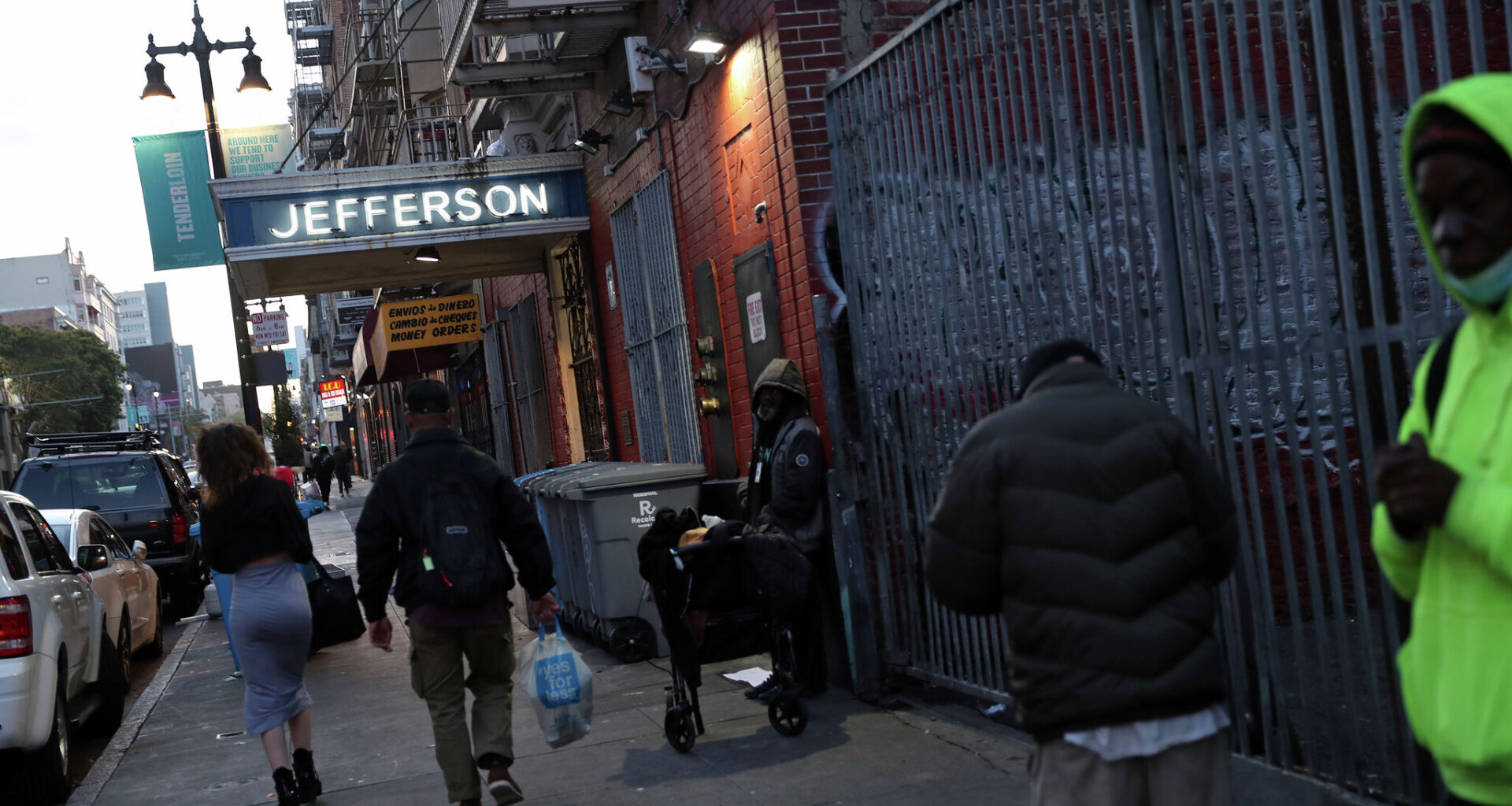
The Jefferson Hotel on Eddy Street in San Francisco is among the city’s 150 permanent supportive housing sites. The city is considering closing some supportive housing sites, but has not made decisions about which ones to shutter.
Scott Strazzante/The Chronicle
San Francisco plans to close several supportive housing sites, long treated as a foundation of its response to chronic homelessness, according to multiple homeless service providers.
The mayor’s office did not confirm the potential closures but says it wants to improve services and outcomes within its homeless housing network.
Housing providers and homeless advocates expressed concerns about the plan, which they worry could mean a sweeping reset of the city’s homelessness strategy as the city faces huge budget deficits for the foreseeable future.
Article continues below this ad
San Francisco has more than 9,000 units of permanent supportive housing across more than 150 buildings citywide. These feature on-site support services and include new construction, acquired apartment buildings and hotels, and master-leased single-room-occupancy hotels, also known as SROs.
Much remains uncertain about the plan, including how many buildings may close, what services will replace them, where residents will be rehoused and timing. It comes amid a loss of shelter beds that has alarmed homeless advocates, though officials say they’re adding more service-rich beds. The city has also confirmed that it plans to shutter a short-term housing facility for young adults next month.
San Francisco Chronicle Logo
Make us a Preferred Source to get more of our news when you search.
Add Preferred Source
Emily Cohen, a spokesperson for the city homelessness department, told the Chronicle that the department is “evaluating permanent supportive housing buildings in order to rightsize the portfolio,” but added that they had not yet identified specific buildings and that conversations are ongoing. Cohen directed the Chronicle to the mayor’s office for further comment.
Charles Lutvak, a spokesperson for Mayor Daniel Lurie, would not comment directly on any potential changes. He said in a statement that permanent supportive housing is key to helping people get off the streets but “we need to make it work better — the city is spending $300 million a year while we face hundreds of millions in federal cuts, and still a quarter of overdose deaths happen at these sites.”
Article continues below this ad
Tabitha Allen, co-chair of the Supportive Housing Provider Network, (SHPN), said Kunal Modi, the mayor’s chief of health and human services, last month told a group of housing providers that by the end of April the city would release a list of proposed buildings to be shuttered. Modi added that the city hoped to finalize the list by the summer but emphasized that taking the buildings offline would be a long-term process that would likely span more than a year, Allen said.
Lutvak declined to make Modi available for an interview and declined to confirm Modi’s comments to the group of housing providers.
Lauren Hall, director of housing provider DISH SF and co-chair of SHPN, said Wednesday that Modi’s “quite aggressive” timeline had since been pushed back amid backlash.
“We are concerned about losing any units … but understand that there are resource constraints that the mayor’s office is trying to address,” Hall said, adding that she expects to help city officials assess the criteria for shuttering buildings next month.
Hall said that ongoing conversations include refocusing properties to make them more “effective” through programming changes and finding other funding mechanisms that could prevent some closures.
Article continues below this ad
Some providers told the Chronicle that they believe city officials are most concerned about the portfolio of aging SROs, which critics have long complained have deteriorating conditions, scant oversight, ineffective services and are expensive to operate.
A 2022 Chronicle investigation detailed these issues and found that the city was spending hundreds of millions of dollars on housing that set its most vulnerable residents up to fail. Supportive housing is meant to provide residents with enough stability to move on to more independent housing though there is little churn and few other affordable housing options for residents to move to when ready.
Advocates caution the push needs to be for better alternatives, not less long-term housing, and providers have said the city’s homeless housing system lacks flexibility and a bridge for clients to permanent affordable housing, which is limited in San Francisco’s expensive rental market.
“We do not want to see communities destabilized,” Hall said, adding that buildings with serious capital needs should only be taken offline as new programs are opened that tenants can be moved into.
The Lurie administration has previously discussed plans to close some permanent supportive housing sites, but Modi’s recent comments signal that decisions are advancing.
Article continues below this ad
At a September panel on addiction recovery, Modi said that the city planned over the coming year to rethink “the whole portfolio of permanent supportive housing units in the city.”
Modi said that city leaders would consider a handful of options for each building, including the city ceasing to fund the building, converting it to a different use or relocating tenants from buildings in “capital disrepair.”
Still, some city officials and housing providers say they remain in the dark about how it could play out.
After hearing from concerned housing providers, Supervisor Chyanne Chen on Tuesday called for a budget hearing on the city’s homelessness and supportive housing systems.
“I think that this conversation is an important one that needs to be had in a public setting,” Chen said.
Article continues below this ad
Sharky Laguana, a member of the city’s Homelessness Oversight Commission, said he had not heard any specifics but given budget restraints, he would support looking at how the city allocates homeless funding.
“We have to think very carefully about how we make the system we currently have more sustainable,” he said, “and better able to deliver better services to more people.”