
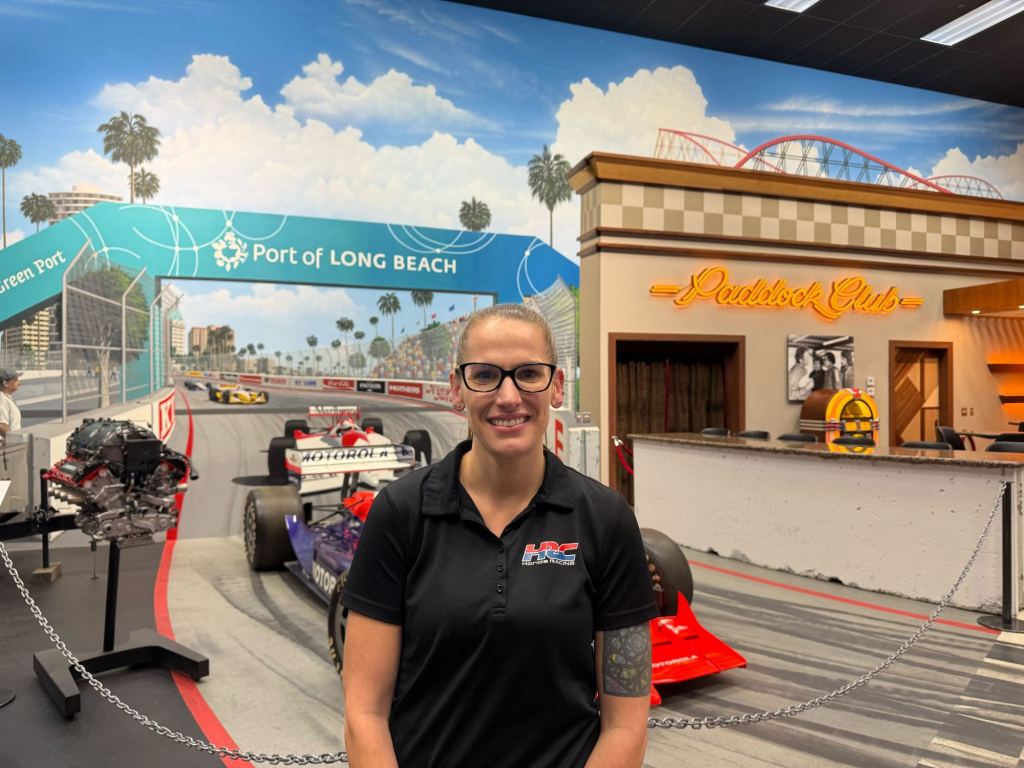
Behind the fast cars, the photo finishes, the overall excitement at the race track, there’s a whole world of people who test and troubleshoot, invent and innovate — who make the cars, and therefore the race, exciting.
And if there is a project involving electronics at Honda Racing Corporation, Hannah Westbrook is most likely involved.
Take, for example, IndyCar’s still relatively new hybrid system, unveiled in the middle of the 2024 season.
Women in Motorsports
Throughout the Acura Grand Prix of Long Beach, we’re highlighting women in the motorsports world, from drivers to engineers to storytellers and more. Read the first story here in this year’s Women in Motorsports series.
The new hybrid unit was developed in partnership with Chevrolet/Ilmor and Honda, with the team over at Honda tasked with producing the energy storage system. Put more simply, the hybrid system essentially collects energy that would otherwise be wasted during braking, and in turn, can be reused by the driver.
It was a fast-paced project — this is the motorsports world, after all — coming together in just a few months, said Westbrook, a principal engineer at Honda Racing who was recently named assistant manager of the electrical systems group, a team that tackles wiring, harnesses and system integration.
“There were a lot of moving pieces,” Westbrook, 35, said, “a lot of design work, a lot of integration between our electrical assistance group and the electrical design group.
“It was one of those things that was kind of high-pressure, high-involvement,” she added, “took a lot of different people coming together to make it work.”
They didn’t have too many shots to get it right.
But when they powered it up for the first time, it worked. And it’s the system still used as IndyCar roars into Long Beach for the Grand Prix this weekend.
It’s that sort of project — that tangible impact made on motorsports (and, in this case, IndyCar) — that fuels Westbrook’s passion for her job.
The Santa Clarita resident didn’t come from a family of racing fanatics.
But her father is an electrical engineer, and she grew up tinkering with oscilloscopes (a tool that visualizes electrical signals) and other test equipment. She tagged along with her dad on a trip to the Red Bull Racing facility in England and was hooked.
From there, Westbrook, who was born in England but grew up in the Boston area, studied electrical engineering at the University of Pittsburgh, where she got involved with Formula SAE, a competition that challenges students to design, build and test small racing cars.
That really honed her passion for the marriage of electronics and race cars, Westbrook said, and led to a nine-year stint at MoTeC USA, an automotive electronics company based in North Carolina. A few years ago, she went back to England to receive a master’s degree in advanced motorsports mechatronics at Cranfield University.
And then she landed at Honda Racing in California.
“One of the main things that I love about being here is there’s always something new and some kind of innovation that we’re working on,” Westbrook said. “I really don’t feel like we’re ever kind of just stagnant. It’s always, ‘OK, what can we do next? How do we push the limits next?’”
That means her days are just as fluid as her projects.
Westbrook doesn’t spend a lot of time at the racetrack anymore in her current role. She’s more shop-based, ready to respond to questions, analyze data or send different sensors or harnesses to the track if needed.
Along with the electrical systems work, Westbrook is also in charge of the hardware design group. That involves designing and ordering circuit boards and making sure projects are done on time.
And it’s not just for IndyCar. Westbrook’s projects also include LMDh prototype race cars and other internal testing.
Westbrook spends most of her time in Honda Racing’s electronics lab, juggling meetings with hands-on work. She sits in on meetings about the company’s priorities and direction — and then pivots to crimping wires and creating harnesses.
She’s also a mom to two kids. Proof, she said, one doesn’t have to choose between motherhood and motorsports.
It wasn’t always easy in her line of work, Westbrook said.
Back in those early days, when she was in North Carolina, a MoTeC client needed someone to come tune an engine. Westbrook was picked to go out, but the client said, “I don’t want her. She’s a girl,” she recalled.
This was 2013 — “so quite a while ago,” she said, “but really not that long ago as well.”
But Westbrook had a supportive boss who told the client: “You get her, or you get nobody.”
The client relented, and by the end of the day, his mind was made up: In the future, he only wanted to work with Westbrook.
What started as a bad experience turned positive, Westbrook said, as it showed people’s minds can be changed. And that’s her advice for other women in the motorsports industry: Put the work in, don’t give up and if someone says no, don’t stop trying.
There’s a lot of work that goes on in the background to make a race happen, Westbrook said.
“From the forward-facing things, you see a lot on the racetrack and the cars going around,” she said, “and there’s so much that goes on behind the scenes in terms of the testing and the validation that we do, from all the kinds of problems that we run into and the kind of solutions we find for those.”
It’s not just finishing a project and calling it a day, she said.
There’s a constant support system to ensure the current technology is working.
All the while, juggling new projects and new systems. In other words, asking, “What’s next?”