
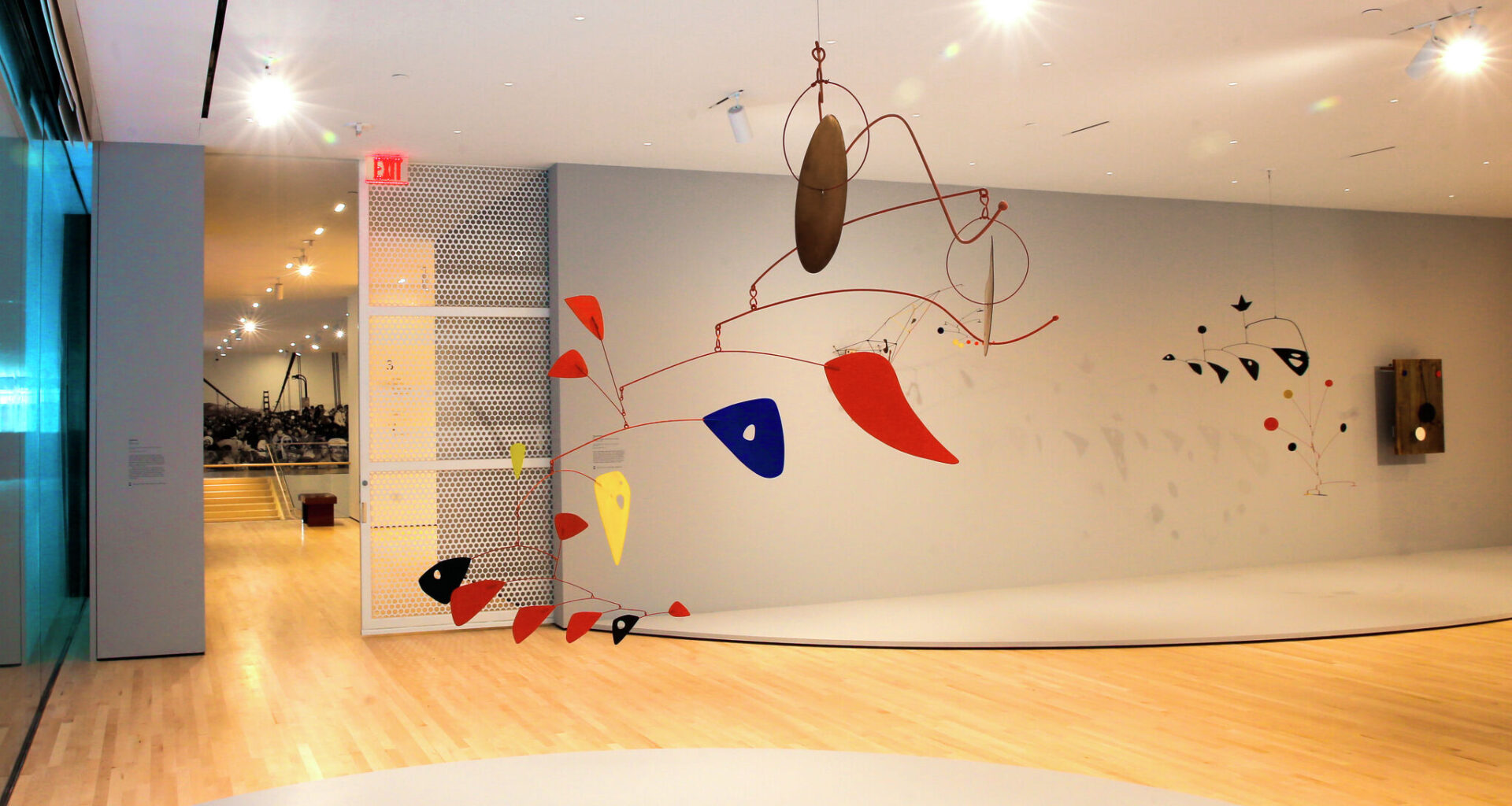
Alexander Calder works on view in “Reimagined: The Fisher Collection at 10” at the San Francisco Museum of Modern Art.
Don Ross/San Francisco Museum of Modern Art
Art is to be admired, not exhaled upon.
But unfortunately, the never-ending list of how entitled people behave badly in museums has a new entry.
“Ahab,” center, and other works by Alexander Calder and Pablo Picasso are seen in the Calder-Picasso exhibit at the de Young Museum in 2021.
Lea Suzuki/The Chronicle
“Reimagined: The Fisher Collection at 10” at the San Francisco Museum of Modern Art offers plenty of opportunities to revisit favorite works by Andy Warhol, Cy Twombly, Joan Mitchell and others that are part of the long-term loan by the family of Gap founders Donald and Doris Fisher. The collection includes more than 1,100 postwar and contemporary artworks by 185 artists.
Article continues below this ad
Among the featured pieces in the 89-year loan are several mobiles by sculptor Alexander Calder. With a move to the fifth floor, hanging works such as “Eighteen Numbered Black” (1953), “Double Gong” (1953) and “Fish” (1951) now have more room to breathe.
Speaking of breath, as I was leaving the celebration, I got into a discussion with a guest about how she preferred to experience the exquisite modern beauty of those masterworks that float in the air.
San Francisco Chronicle Logo
Make us a Preferred Source to get more of our news when you search.
Add Preferred Source
“I like to blow (on) the Calders,” the woman cheerily informed me.
I was stunned by this admission. For years, there have been signs posted at the museum telling people not to do this. While constructed of metal and wire, Calder’s hanging works are extremely fragile. And if their beauty is not enough to compel you to protect them by following the posted rules, they are also extremely valuable, with some works selling for as much as $15 million at auction. Blowing on or otherwise forcing air on the many armed, hanging works risks tangling them. And in a post-COVID world, isn’t the idea of blowing on (and potentially spitting on) anything, let alone a culturally significant work of art, taboo? Not to yuck your yum, lady, but this is a kink best left unexplored.
Article continues below this ad
When I told the woman about the signs, she protested that Calder designed the mobiles to move. Well yes, I tried to explain, but they’re designed to move with gentle, natural air currents, not strong blasts or fanning. She remained unconvinced. It was shocking to me that a person past middle age who was connected enough to the art world as to be invited to this party had gone through life blowing on Calders like birthday cakes.
“I’m going to go ask the Fishers if I can blow (on) them!” The woman announced, sweeping off grandly toward SFMOMA Chair Bob Fisher, son of Doris and Donald.
I did not stick around to find out whether she asked any of the Fishers in attendance her question but am going to assume they told her, “No.”
Ma’am, if you’re reading, this next advice is for you.
Don’t blow on art. This applies not only to hanging works by Calder, but also Ruth Asawa, Ernesto Neto, Cathy Lu and others. In fact, don’t blow on art of any kind: not paintings, not sculptures, not textiles. It’s a good rule of thumb to go into art spaces with the cultural assumption that you will be expected to keep your breath to yourself.
Article continues below this ad
But in the privacy of your own home, huff and puff on your art like the Big Bad Wolf; I won’t stop you.
Blow, blow, thou winter wind. Blow, Gabrielle, blow. The answer my friend, is blowin’ in the wind. But I repeat, don’t blow on the art.
In response to a Chronicle query, SFMOMA conservators offered a more technical version of that same maxim:
“Blowing on the sculptures will inadvertently transfer fluids onto artworks and can affect their surfaces, so we definitely want to discourage this behavior,” they said in a statement.
They also pointed out that Calder’s kinetic sculptures are designed “to slowly move in space, responding to their environment. The ones on view at SFMOMA are affected by the circulation of air from our HVAC systems.”
Article continues below this ad
Instead of blowing on them, “we recommend our visitors slow down and experience their subtle movements. They’ll be rewarded for their patience.”
While we are on the subject of best museum visitor practices, here are a few other behavioral expectations to be aware of before your next visit. These rules aren’t there to stifle your freedom; they exist to keep the art safe and to help everyone have a pleasant visit. When you know better, you can do better.
Works by Alexander Calder on view at the San Francisco Museum of Modern Art.
Michael Macor/The Chronicle
Mind the lines and barriers
I thought this one was common sense, but after my experience with Miss “Waiting to Exhale,” I’ve learned to assume nothing. If you see a line on the floor or a rope barrier in front of a piece of art, don’t cross it. You could potentially hurt yourself or the art.
Article continues below this ad
Obey posted signage
If museum staff cares enough to post a sign, they want you to not only read them, but obey their instructions. The people who make the rules about best visitor practices are simply trying to give everyone a chance to have a positive experience.
Phone etiquette
Smartphones are as much an aspect of museum-going as they are every other part of life. But even though selfies with art are now the norm, that doesn’t give you free rein to turn the museum into your own influencer house. If you want to take pictures of the art and there are no rules against it, go ahead. But if you want to take pictures of yourself with the art, be mindful of the people around you. If others are waiting to see the work, take a few shots, then come back later if you’re not satisfied. If you can wait until an exhibition is less crowded, that’s always extra credit. And please, don’t bring your own ring light, as I once saw someone do at a museum before the guard asked them to put it away.
Remember, this isn’t your living room
Enjoy the art, experience the art, fall in love with the art. But remember, you’re not on your couch scrolling through images alone. Remember that other people are at museums and they deserve an opportunity to enjoy the work as much as you do. If someone lets you know your behavior is disrupting them, don’t take it as a rebuke but as a lesson about how to be a better art aficionado.
If there’s an issue, get a staff member
If you see someone violating rules and potentially endangering a work of art, alert a security guard. Don’t try to be a hero; upsetting an offender could make the situation worse.
And if you see a woman on the fifth floor of SFMOMA blowing on the Calders, please send her this column.