
City officials have said this can be helpful to follow a suspect’s vehicle movements between nearby jurisdictions. In recent months, though, some Bay Area cities have amended their controls around data sharing after discoveries that their records had been accessed by out-of-state-agencies, including to aid in federal immigration enforcement activities in violation of local Sanctuary policies.
More than two dozen municipalities across the U.S. — including Santa Cruz and Los Altos Hills — have terminated contracts with Flock altogether. Others, like Oakland and San Francisco, have doubled down on their contracts, lauding the technology’s benefits to aid in investigations and even curb dangerous vehicle collisions.
But the San José residents represented in the suit say that the city’s more than 470 cameras have created a system of “mass surveillance.” Plaintiff Zhaocheng Anthony said in court documents that the system “reminds him of the Chinese surveillance state.”
“Pervasively tracking a person’s movements and then storing them in a government database … creates precisely the type of suffocating atmosphere of surveillance the Framers adopted the Fourth Amendment to prevent,” the suit reads. “Police no longer need to identify suspects in advance to place them under surveillance; they just surveil everyone instead.”
The residents say that Flock can create “vehicle journey maps” that can be traced to a driver, allowing the city to track residents’ routines, habits and outings, especially to sensitive locations like health care clinics, places of worship and protests.
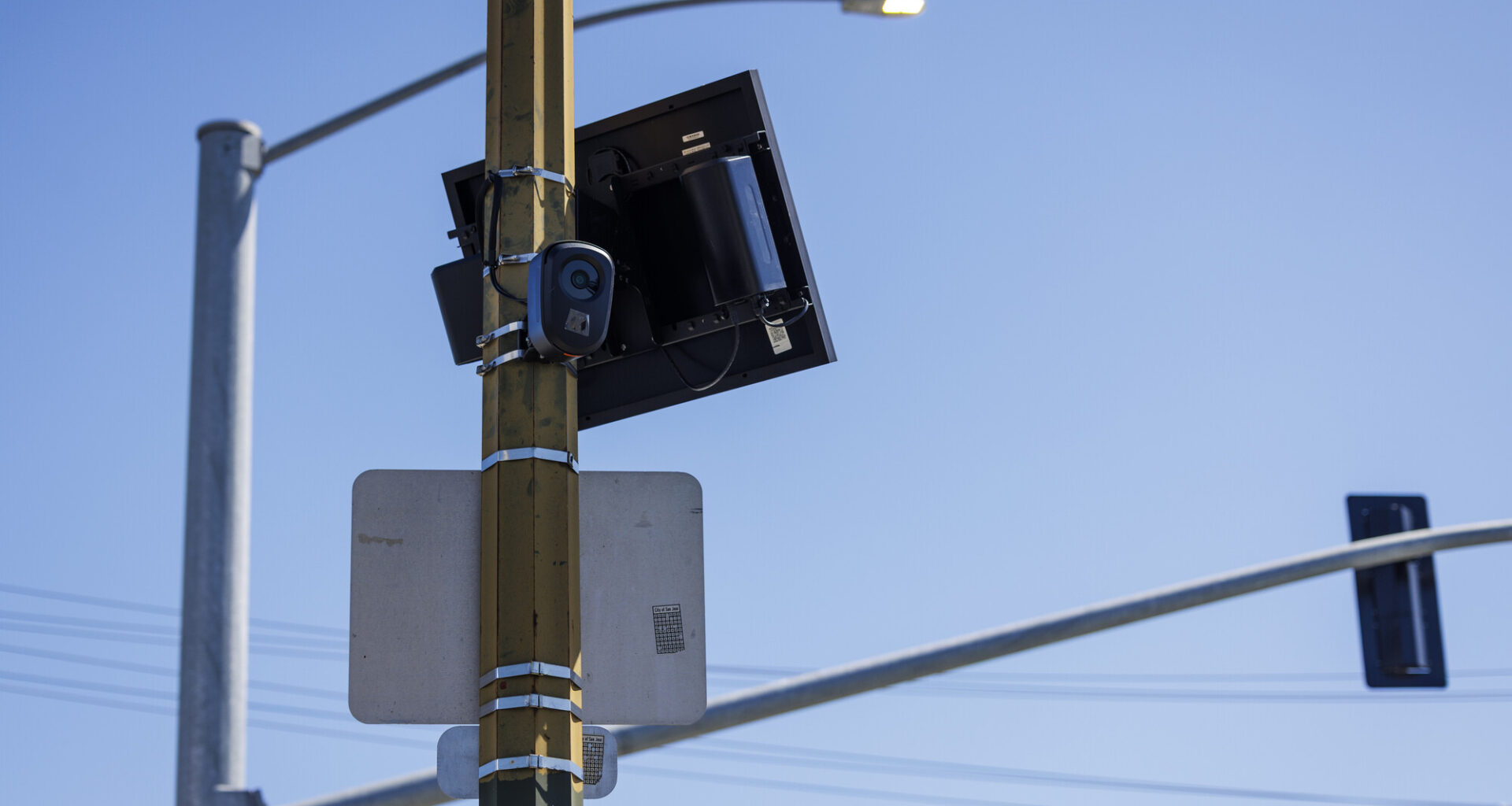
 San José Mayor Matt Mahan helps to install a Flock Safety brand automated license plate reader on April 23, 2024. The city and Mahan are now being sued by civil liberties groups over the technology’s uses. (Joseph Geha/KQED)
In March, San José’s city council put restrictions on where the city can position cameras, including near reproductive health care facilities and places of worship; reduced the default data retention period from one year to 30 days; and added new documentation and authentication requirements for agencies requesting sharing access.
“The San Jose Police Department has robust, transparent policies in place to ensure that the information is not misused in any way, including policies that prohibit direct access to the data to private entities, out-of-state law enforcement agencies, or federal agencies,” City Attorney Susana Alcala Wood said in a statement. “Access to our ALPR system is tightly controlled and limited to authorized SJPD personnel only.”
SJPD said it conducted a review of internal and external searches in 2025, and found that “all searches were in compliance with department policy and California law.”