
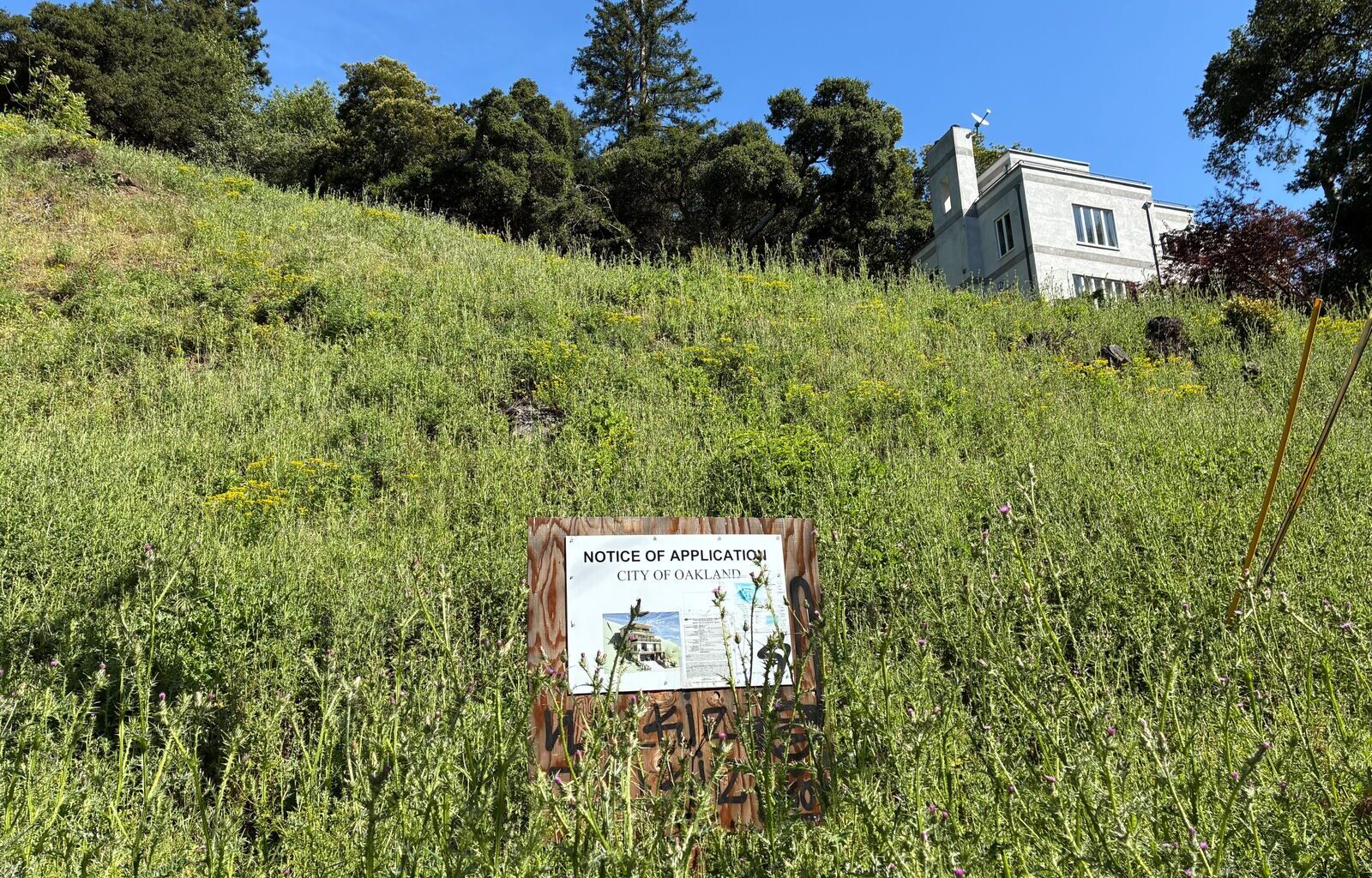
The weedy Claremont Avenue hillside lot looks like any other undeveloped land in Oakland.
But as recently as six years ago, the property was blanketed by the city’s namesake oak trees.
Property owners Matthew Bernard and Lynn Warner may face close to $1 million in fines for chopping down 38 trees there between 2021 and 2022 despite multiple warnings from city staff, police, and neighbors that they needed permits.
The City Council, however, can’t decide whether to enforce or reduce those fines. The council took up the matter for a second time on Tuesday.
In an initial vote during a hot debate, the council tied, with Zac Unger, Charlene Wang, Janani Ramachandran, and Kevin Jenkins supporting the full fine of $915,135. Councilmembers Carroll Fife, Ken Houston and Rowena Brown voted no, with Noel Gallo excused.
Mayor Barbara Lee declined to break the tie.
The no-voters later tried to approve a smaller fine of around $417,000, representing only the trees that were outside of the exact area the couple might develop a house on. That motion failed, with four officials unwilling to reduce the full amount, so the council decided to revisit the matter on May 5.
After the meeting, Councilmember Janani Ramachandran, who represents the district where the property is located, reprimanded her colleagues in a press release, calling the Claremont cuttings “the most egregious tree removal violation case in the city’s history.”
Letting them off the hook “sets a dangerous precedent,” she wrote.
38 felled trees and conflicts with neighbors
 District 4 Councilmember Janani Ramachandran urged her colleagues to approve the nearly $1 million fine for the tree-cutting in her district. Credit: Estefany Gonzalez/The Oaklandside
Bernard and Warner, who live in Emeryville, bought the Claremont Avenue property in 2019, with plans to build a home for their family there, according to the couple.
Immediately, neighbors were suspicious, said Warner on Tuesday. Bernard is an immigrant from Nigeria, and Warner said the couple faced racist comments and discrimination from surrounding homeowners, who called the police whenever they were on the property and threatened to call ICE. Bernard ended up seeking a restraining order against two neighbors, which a judge denied, according to the San Francisco Chronicle.
The couple’s first clash with the city came in 2021, when Oakland tree division staff responded to complaints that Bernard had removed eight trees. According to the city, a staff member warned the property owner that he needed a permit, but Bernard ignored the guidance and continued toppling trees on numerous occasions.
The city continued issuing verbal warnings and written notices of violation in the coming months, according to staff.
Under Oakland’s Protected Tree Ordinance, property owners need permits to remove all trees of a certain size except for most eucalyptus and Monterey pine trees, which are considered invasive and fire hazards. The law cites the numerous ecological and health benefits of trees, including the shade, oxygen, and wildlife habitats they provide.
The majority of the Claremont Avenue trees were coast live oaks, plus a few big leaf maples and others. The fines for the 38 trees, based on estimated size and international standards, range from $750 to $94,100. The property owners would also be responsible for covering investigation and enforcement costs.
In May 2022, city staff responded to continued complaints and visited the property to find Bernard and workers from a private company in the process of cutting down a final three trees. They told the workers to stop because they had no permit. Bernard, according to the city, told them to continue. By the time police arrived, they’d all left.
Some of the trees were on neighboring properties, including a lot owned by Oakland, according to the city.
At Tuesday’s meeting, Bernard disputed the city’s chain of events, claiming a number of the initial trees had fallen themselves.
“We did everything in our willpower to follow the law from day one,” he said. “They portrayed me like some random guy who just picked up a chainsaw and started chopping trees. It’s not true.”
Bernard did apply for a tree removal permit in June 2021, after 30 trees had reportedly already been cut. He then withdrew the application and submitted another through a private tree company. The city rejected that application for incomplete information.
In March 2025, the property owners applied for building permits to build a single-family home on the lot.
Today, the lot is vacant. There’s a sign noticing the planned development of the four-story home is near the bottom of the sun-drenched hillside.
Straightforward law or inequitable enforcement?
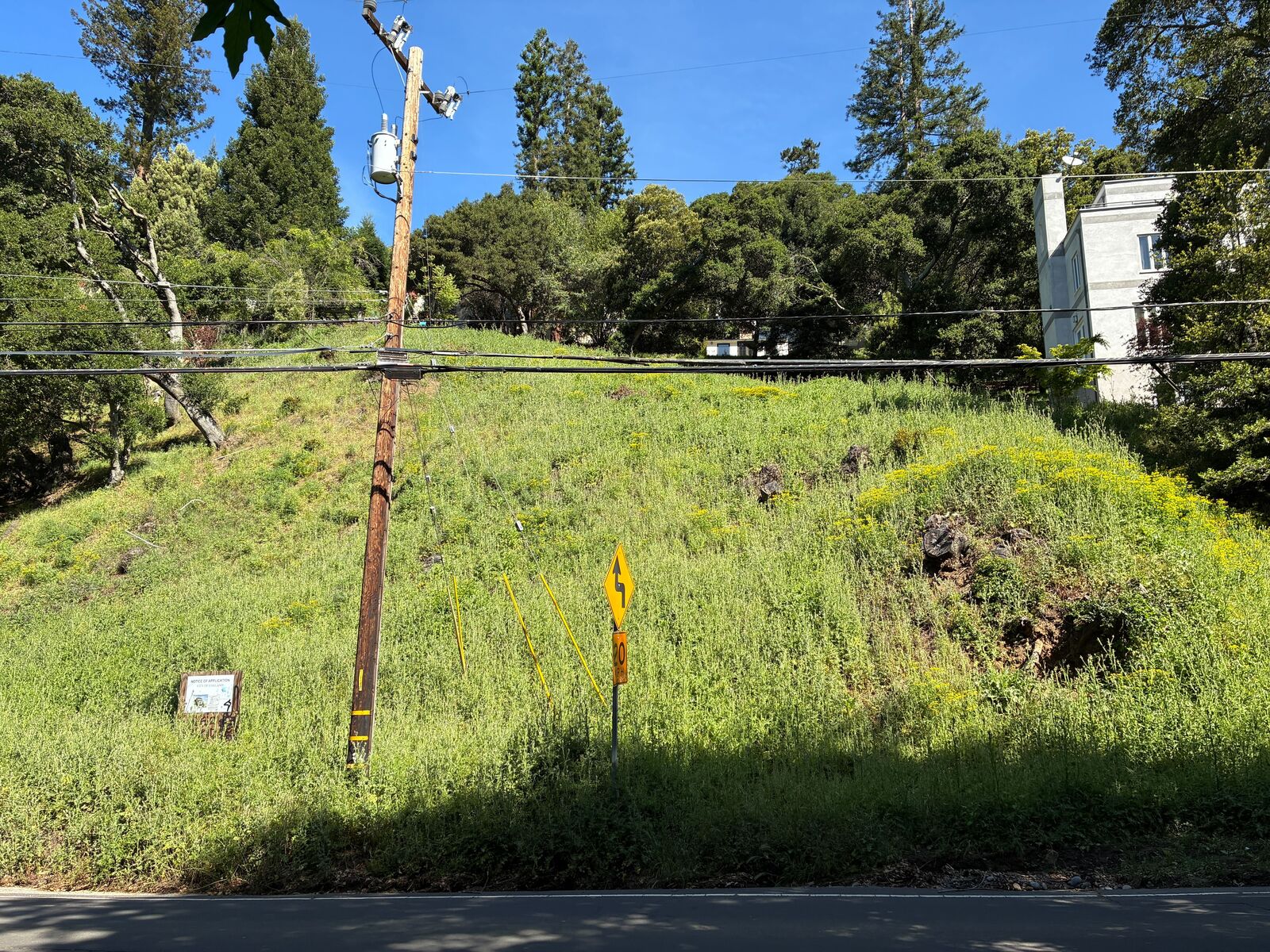 Property owners want to build a single-family home on the Claremont Avenue lot that used to be covered in oak trees. Credit: Darwin BondGraham
Councilmembers held an increasingly impassioned discussion over the enforcement of city law, Oakland’s racial history, and the value of biodiversity at the multi-hour meeting.
Ramachandran was the most fervent supporter of fining the property owners. She said she spent hours talking with all parties and poring over documents.
“I’m a hard no on anything but the maximum penalty,” she said. “If we’re going to put laws on the book to protect our earth, to provide better urban canopy, to continue to nurture our land, we need those laws respected…Otherwise we continue to be a laughing stock of a city.”
Ramachandran also criticized the city for waiting years — until Bernard and Warner submitted a development application — to issue the fines.
Unger agreed that the city needs to enforce its rules.
“I’m all for rewriting laws we don’t agree with — that’s literally our job,” he said, but allowing people to break the laws that currently exist has consequences.
The council is “thumbing our nose” at Cal Fire’s large investment in tree-planting in Oakland, Unger said.
Several environmental advocates and tree-planting volunteers spoke in support of penalizing the landowners. Some neighbors spoke too, including one who claimed Bernard threatened him with his “deep-pocketed” friends and connections to Russia. (According to the San Francisco Chronicle, Bernard is a mathematician and tech founder who has a teaching position at the Moscow Institute of Physics and Technology.)
Other councilmembers warned that issuing a nearly $1 million fine and putting a lien on the property if it wasn’t paid, could result in a lose-lose outcome. The owners would be hit with an unaffordable fee and a weedy, fire-prone property would be left undeveloped and unsightly.
“He shouldn’t have cut those trees down, and he knew better too,” said Houston. “But a million dollars on a property we still want him to develop?”
He pointed out that the city would have likely let Bernard and Warner remove a number of trees to develop if they’d gone through the legal process.
At one point, Houston tried to get Bernard to come up to the microphone and admit that what he did was wrong.
“Let the truth set you free,” the councilmember said. Bernard appeared to decline the invitation.
Fife said she was concerned about the inequitable levying of fines against property owners of color.
“I’m extremely confused why a Black man should be the first to experience consequences for a thing white people have been doing for decades,” she said. “The fact is, the hills was built up for white people, which nobody else had access to.”
Properties around Claremont Avenue typically had deeds restricting ownership to white people well into the 20th century. To this day, Black people represent about 5% of the population in the census tract around Bernard and Warner’s land.
Fife later posted a historical ad for what would become the Rockridge neighborhood on Instagram. From the early 1900s, it advertised that “no negroes, no Chinese, no Japanese” could build there.
(The racial breakdown of property owners who’ve received fines for cutting trees in Oakland so far is unclear.)
Several officials said they’d be interested in amending the city’s tree ordinance to make it more equitable or to require city staff to act quicker on violations.
“*” indicates required fields