
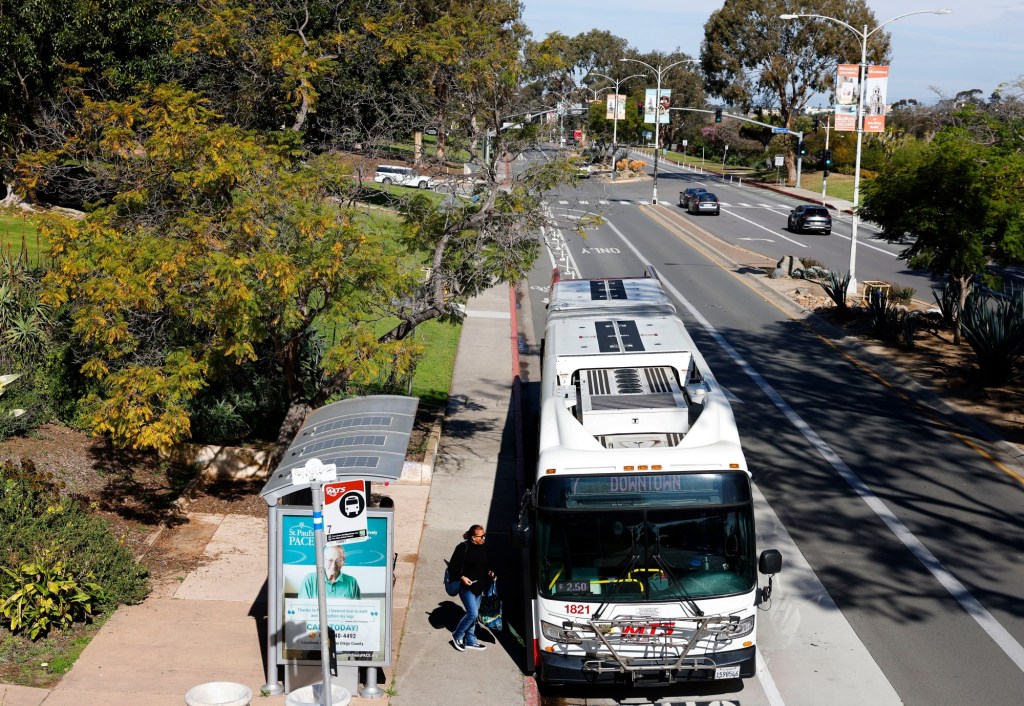
Fares to ride local buses and trains would rise 30% under fare increase packages approved Thursday by the county’s two transit agencies, the Metropolitan Transit System and the North County Transit District.
It would be the first fare hike in 17 years for monthly passes on local buses, the San Diego Trolley and the Sprinter. The cost of a pass would jump from $72 to $85 this fall and then to $95 in fall 2027 — up nearly 31%.
And it would be the first increase in seven years for one-way fares, which would rise from $2.50 to $3 this fall and then to $3.25 in fall 2027. That’s a 30% hike, far steeper than the last increase in 2019 from $2.25 to $2.50.
Discounted fares for seniors, passengers with disabilities and people on Medicare would rise less sharply, from $1.25 to $1.50 for one-way fares and from $23 to $30 for monthly passes.
The fare hike package is scheduled for approval next month by the Transportation Committee of the county’s regional planning agency, the San Diego Association of Governments.
Leaders of both transit agencies said the fare increases were needed to solve budget challenges. The MTS hikes are projected to boost annual revenue $14.2 million, while the NCTD hikes would raise $1.2 million.
The MTS board voted 7-4 to approve the fare increase package after a contentious public hearing Thursday morning.
Supporters said fare increases were preferable to the option of cutting transit service and were a necessary move to help MTS ease long-term financial challenges, including a projected $100 million annual deficit in fiscal 2030.
Opponents said MTS shouldn’t be balancing its budget on the backs of people who can least afford an increase. They also said MTS had not fully explored other possible ways to solve its financial problems, such as seeking more state aid, charging premium rates for special events and price-bundling with Padres tickets.
San Diego City Councilmember Stephen Whitburn, chair of the MTS board, said the agency would have to make painfully deep cuts to service without a fare hike.
“I don’t want to vote to increase fares, but I don’t want to vote to cut service — and it’s one or the other,” Whitburn said.
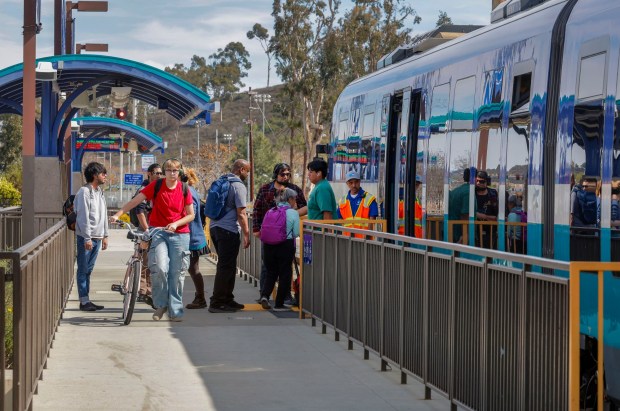 Passengers get on and off a Sprinter train at the Palomar College Station. (Charlie Neuman / For The San Diego Union-Tribune)
Whitburn said he was also persuaded by a survey of transit riders that showed they would rather pay a bit more than see transit service cut.
“Given the choice between increasing fares or cutting their service, they would rather we increase fares because the service is that important to them,” he said. “And without the service, the fares don’t matter much anyway.”
But San Diego Councilmember Sean Elo-Rivera, who cast one of “no” votes on the board, called those arguments bogus.
“I don’t think that survey is a mandate — I think it’s a false choice,” Elo-Rivera said. “Did we ask them if they’d rather pay more or have the wealthiest San Diegans pay their fair share?”
Elo-Rivera said it’s wrong to jack fares up on the most vulnerable San Diegans, some of whom wake early to clean office buildings, while high-paid workers in those offices commute on roads that are heavily subsidized by taxpayers.
“A fare hike is a flat, regressive charge collected from the people who have the least ability to pay for that,” Elo-Rivera said.
Elo-Rivera was joined in opposition by San Diego Councilmember Henry Foster, National City Councilmember Marcus Bush and Chula Vista Councilmember Cesar Fernandez.
The rest of the board said they didn’t feel they had a real choice.
“Unfortunately, there is no good option,” Santee Councilmember Ronn Hall said. “We have to keep the doors open. We have to avoid bankruptcy.”
Coronado Councilmember Carrie Downey said her reasoning was based on how long it’s been since the last increase, stressing that everyone must deal with inflation.
“We don’t like to tell people ‘you have to pay more money’ — nobody does,” she said. “But we have to do it. We haven’t done it in one area in 17 years. The public has to understand that just like their costs went up, so have ours.”
Circulate San Diego, a transit advocacy group, said opting for service cuts instead of a fare hike would start a downward spiral.
“Raising fares is never ideal, but when we are forced to choose between raising fares and cutting service, we must make the tough choice to raise fares,” said Aria Grossman, Circulate’s policy manager. “The success of the system depends on people using it.”
Leaders from other local nonprofits said the hike would fall hard on residents across the city but particularly in City Heights, where many residents can’t afford cars.
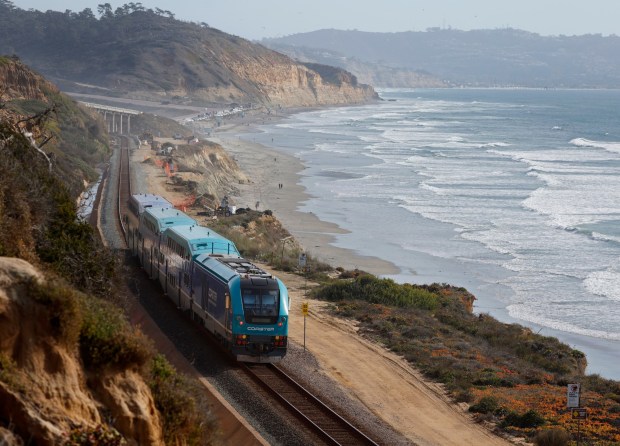 A Coaster train runs along the Del Mar bluffs on Tuesday, March 6, 2025. (K.C. Alfred / The San Diego Union-Tribune)
Later on Thursday, the NCTD board voted unanimously to approve the same fare package. NCTD faces deficits of more than $20 million in both fiscal 2029 and fiscal 2030.
NCTD’s package would also eliminate zoned fares on the Coaster commuter rail line. Those fares now charge passengers more for longer trips. Instead, all riders would start paying the same one-way fare, which would rise from $6.50 to $7 in fall 2027.
In addition, a special monthly pass that can be used only on Sprinter trains and Breeze buses in North County would rise in price from $59 to $65 this fall and to $70 in fall 2027.
The hikes for one-way fares would put the San Diego region at a higher price point than comparable transit agencies.
One-way fares are currently $3 in Dallas and San Francisco, $2.80 in Portland, Ore., $2.75 in Denver and $2.50 in Sacramento and Salt Lake City.
For both MTS and NCTD, the discounts for seniors, disabled passengers and those on Medicare would be phased. One-way fares would climb from $1.25 to $1.50 this fall and not increase in 2027. Monthly passes would rise from $23 to $28 this fall and then to $30 in fall 2027.
MTS would leave popular discounts like fare-capping and two-hour free transfers in place. Fare-capping means passengers don’t need to buy monthly passes, because the system automatically stops charging them one-way fares when their spending reaches the cost of a monthly pass.
SANDAG’s Transportation Committee is scheduled to consider the fare hike packages on May 15.
An equity analysis must be completed, but officials said that’s unlikely to be a problem because the fare hikes don’t discriminate against any particular groups.
The Transportation Committee could potentially take a final approval vote at its June 12 meeting.