
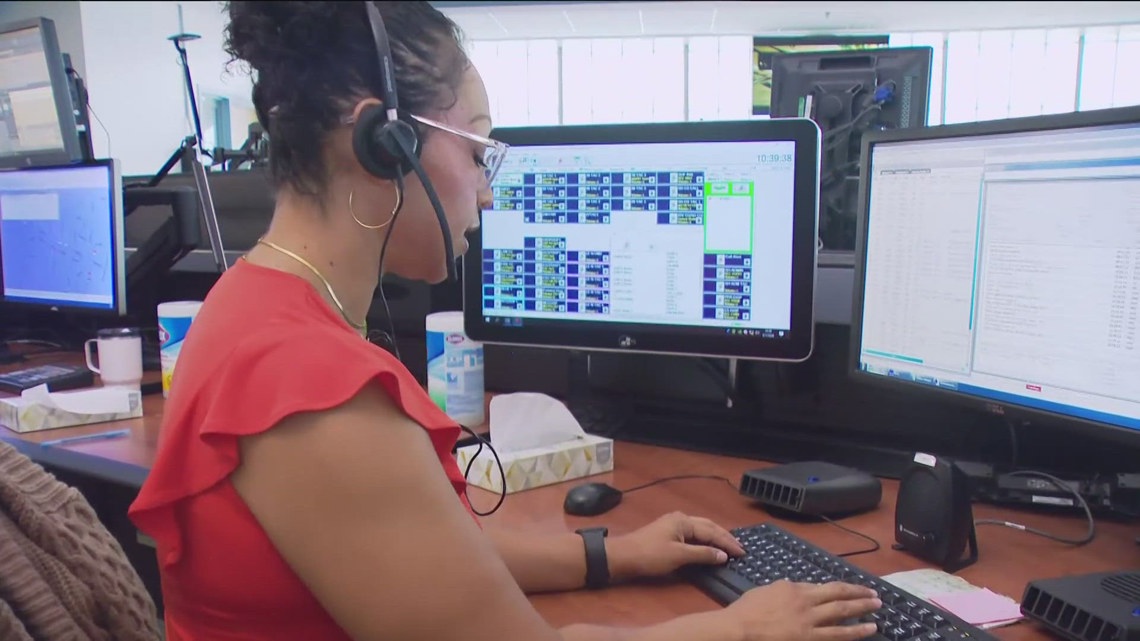
Inside the San Diego County Sheriff’s dispatch center, the “unsung heroes” guiding people through their worst moments.
SAN DIEGO — They are the calm voice on the other end of a crisis—emergency dispatchers who help save lives every single day.
During National Public Safety Telecommunicators Week, CBS 8 got a rare, behind-the-scenes look inside the San Diego County Sheriff’s Communications Center, where every second counts and every word matters. Inside the communications center, dispatchers are the first to answer when someone calls for help. They gather critical information, calm callers, and coordinate responses—all in real time.

This story continues below.
“These are the voices behind the scenes during your worst moments,” said Captain Nathan Rowley with the San Diego County Sheriff’s Office.
Rowley says becoming one of those voices is no easy task. The training process is long and demanding, often taking up to two years before a dispatcher is fully qualified.
“It is a very long training program, it’s a very hard training program,” Rowley said. “Most people don’t actually get to the point where they get to these seats.”
Trainees must learn how to manage emergency calls, monitor radio traffic, and process life-or-death information all at once.
“When you call 911 or a non-emergency line, these are actually the people picking up the call,” Rowley said.
Dispatchers are often referred to as the “forgotten first responders,” but their role is critical from the very first moment of an emergency.
“They’re the first ones dealing with these incidents when people need them most,” Rowley said. “They’re already being the calm voice when the bad thing is happening.”
The job requires intense focus, speed, and the ability to multitask under pressure.
“They need to be able to work in a fast-paced environment,” said supervising dispatcher Ariana Hill-Battey. “They need to have a lot of patience, be able to multitask and really assess information as it’s coming in.”
Accuracy is crucial. Even a small mistake can have serious consequences.
“If you mess up an address and you send somebody to the wrong place, that is a key thing to mess up,” Hill-Battey said.
For those who make it through the rigorous training, the job offers a strong sense of purpose.
“I do like the process of helping people,” said dispatcher Jennyfers Rosa.
“You are the first responders really taking the calls,” added dispatcher Alina Tannone.
It’s also a team effort, built on trust between dispatchers and deputies in the field.
“You just feel like you’re part of a team,” Rosa said. “The people on the other side of the radio really do count on you to be that calm voice.”
It’s a demanding job where no two calls are the same and where every second can make a difference.
If you’re interested in becoming a dispatcher, you can find more information on how to apply at joinsdsheriff.net/civilian-careers/dispatcher.