
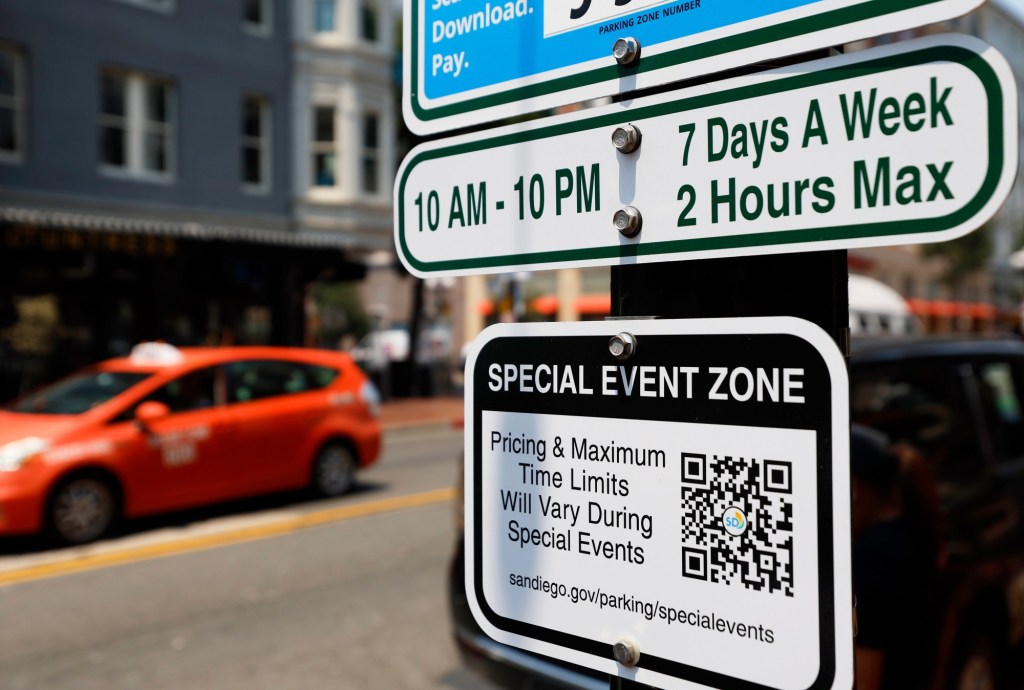
A city leader’s proposal to slash by half the cost to park at downtown meters during San Diego Padres games was met with resistance from colleagues who said they might be more amenable to adjust the special event policy when more data is available.
On Thursday, San Diego’s Economic Development and Intergovernmental Relations Committee rejected Councilmember Raul Campillo’s 5/5/5 proposal, which sought to reduce the hourly special event rate to $5, shorten the enforcement window to five hours and limit the enforcement zone to five blocks, or roughly a quarter-mile radius, around Petco Park.
Instead, the committee agreed to let the council member’s office continue working with the city attorney’s office to bring a revised special event parking package to the full City Council for consideration at a later date.
“I’m disappointed that my colleagues weren’t ready to endorse my 5/5/5 plan as proposed today, but I am thankful they agree that changes do need to be made,” Campillo said in a statement.
A spokesperson for Campillo’s office said a revised proposal would be presented in a couple of months.
The committee’s action, which leaves the door open for continued discussion, comes eight months after the city of San Diego implemented a special event parking zone for downtown. Meters in the zone, which covers a 200-square-block area surrounding Petco Park, now charge $10 per hour during a six-hour period that extends before, during and after Padres games. The special event rate is four times as much as the standard meter rate of $2.50 per hour, and was designed to boost revenue amid budgetary woes and increase meter turnover.
The city budget adopted for fiscal year 2026 estimated that the special event parking program would generate $6.3 million in revenue, although the projection has since been revised to $1.7 million given the September start date and an adjusted zone size. Annually, the program is expected to generate $2 million in revenue, according to a report from the Office of the Independent Budget Analyst. Campillo’s proposal would reduce estimated net revenue by $1.3 million, the report states.
Campillo characterized the current policy as a painful experiment, one that comes at the expense of minimum-wage workers and small businesses, and also discourages investor interest in downtown.
“We’ve passed the financial burden on to residents and workers and attractions that bring economic activity and cultural vitality to our city,” Campillo said at the committee meeting. “We understand that demand pricing is the right way to move forward, and we need to manage that congestion, but the current version in place is too blunt. It’s too aggressive. So I’m asking that we do something more pragmatic and something more responsive to the message of our constituents and the workers who live and work here. It makes downtown smarter and our policy more targeted and the results fundamentally more fair.”
Representatives from downtown associations and hospitality groups joined with business owners and residents in decrying the current program, which they said is not only overly broad in scope but unsafe and altering consumer behavior to the detriment of downtown’s growth.
“We already have problems attracting quality employees because of the parking downtown that they don’t want to pay, and this just exacerbates that issue. We’ve had two employees assaulted on their way home from the bar at 3:30 in the morning because they’ve had to park so far away to avoid the rates,” said Heather Kline, the controller for hospitality group Good Time Design. Good Time Design’s downtown San Diego venues include Moonshine Flats and Patrick’s Gaslamp Pub. “Our guest counts are down 20% over last year. And when we ask people, they tell us that downtown is disgusting. They don’t want to come downtown, and they definitely aren’t going to pay $10 an hour to park.”
Justine Murray, vice president of government affairs for the Downtown San Diego Partnership, told the committee that the $10-per-hour rate has morphed from a parking management tool to a de facto entrance fee to downtown.
“It sends a message that downtown is simply too expensive,” she said. “When San Diegans and tourists are facing a $10-per-hour parking fee … they’re forced to choose between attending a special event and supporting a nearby business. That means fewer meals before the game, fewer drinks after, and fewer visits to local shops and cafes. People might still be coming to the event itself, but they’re not staying and they’re not spending. And, over time, that impacts small businesses, jobs and San Diego’s workforce.”
Councilmembers Jennifer Campbell and Kent Lee did not support Campillo’s suggested special event parking proposal because they said there was a lack of sufficient data to support the proposed $5-per-hour rate and the quarter-mile radius. But they signaled a desire to make changes to the current program.
“I do agree that there is a concern when it comes to utilization by visitors, diners, shoppers, et cetera. If I’m fair, I will note that I avoid going into downtown during special events, because I’m going to assume that parking is more challenging during that time period,” Lee said. “Ultimately, that’s why coming up with clear and coherent policies that are backed from a data standpoint are really important.”
Campbell, who said she agreed that the geographic area for the special event zone needed to be adjusted, said she wanted to see a year’s worth of data. She also asked for detailed maps that illustrate where cars are parking and what businesses are impacted.
The committee took no action on an initial motion from Campillo and a substitute motion from Campbell, which both failed to secure a second. Campillo’s second motion to work with the city attorney’s office and return to the full City Council with a new special event parking rate proposal at a future date passed 3-0. Councilmember Henry Foster was absent.