
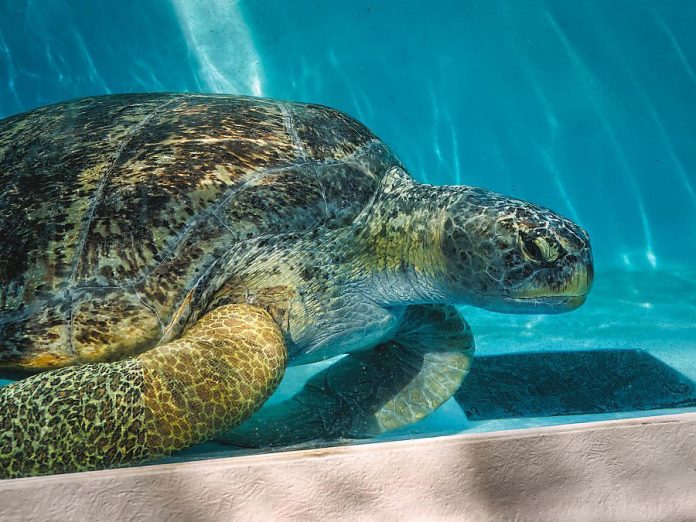
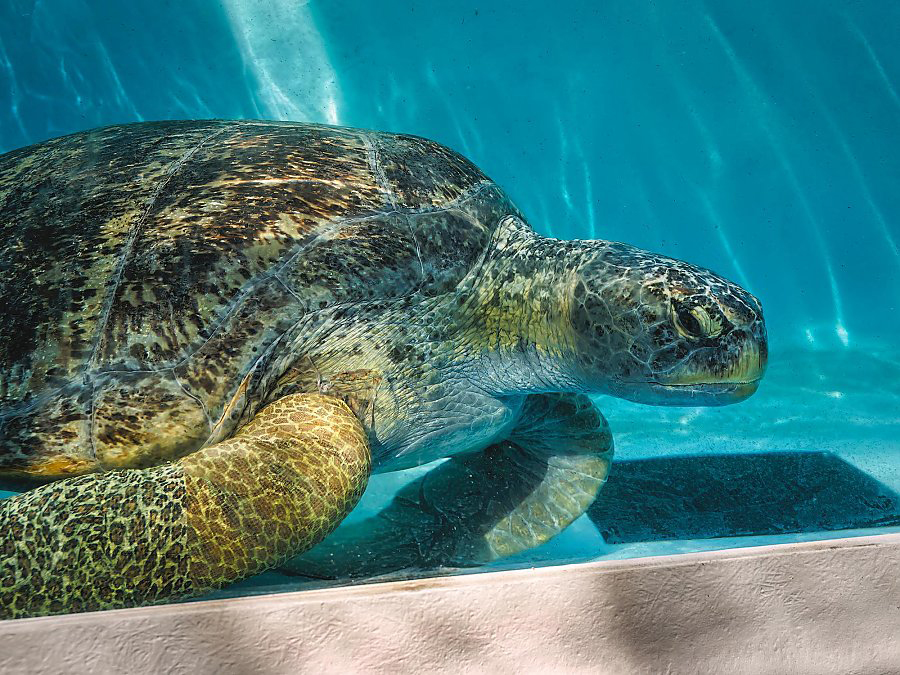
 Meatloaf in her recovery tank at Aquarium of the Pacific. Photo by Robin Riggs
Aquarium of the Pacific officials say a 250-pound sea turtle they have dubbed “Meatloaf” is now in the intensive care tank at the facility after the massive creature was found injured in the St. Gabriel River.
Meatloaf was found trapped in fishing line and rope and tethered to debris in the San Gabriel River, said Aquarium Vet Dr. Jerry Adams last week.
It was rescued by National Oceanic and Atmospheric Administration personnel and the U.S. Fish and Wildlife Service and then transferred to the aquarium for medical evaluation and care because of their “expertise in treating and releasing stranded and injured sea turtles.”
Adams said the Aquarium is part of a massive “sea turtle stranding network,” a network of organizations that work together to decide which provider gets alerted when a sea turtle is found in need of care along the California coast.
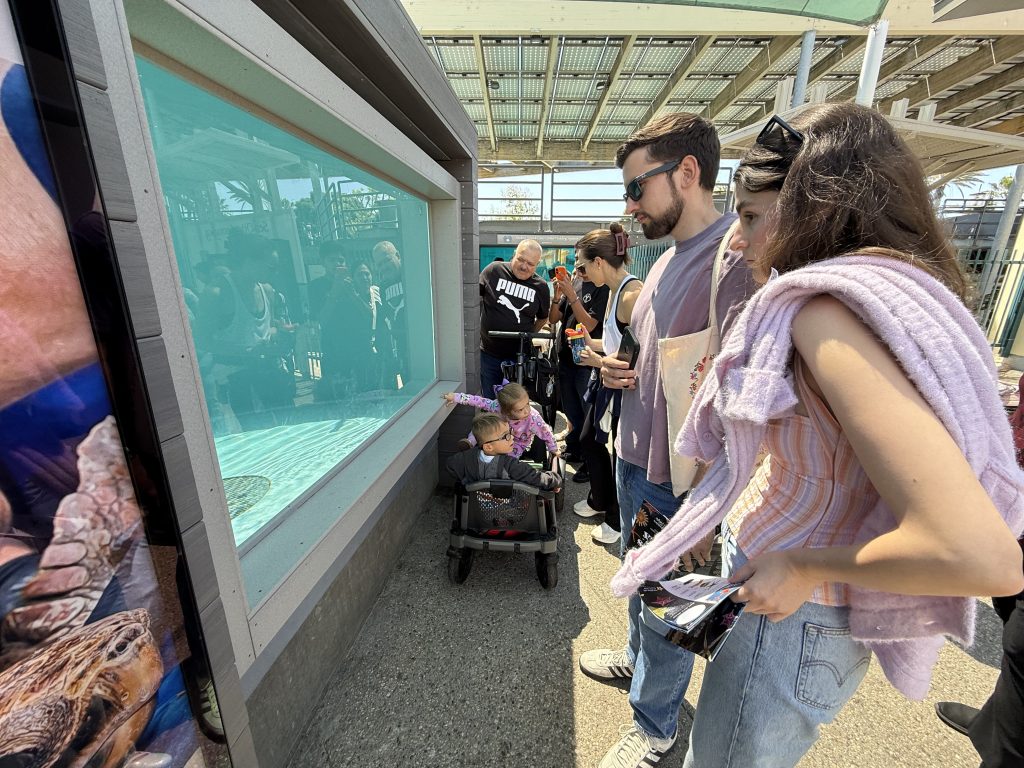 Meatloaf attracts crowds as she recuperates at the Aquarium. Photo by David N. Young
“They’ll call us and ask us to go out and evaluate and decide if it needs human care,” he said. Dr. Adams heads up the Aquarium’s Veterinary Services unit. Sea turtles found in Orange or L.A. counties are sent to the Aquarium of the Pacific.
Any injured sea turtle found further south is cared for by SeaWorld, he said.
“Meatloaf” has been attended to and is resting comfortably within a special area of the Aquarium.
She has suddenly become a prime attraction at the Aquarium, as visitors can walk up directly to the massive 4,000-gallon water tank that has become the sea turtle’s intensive care unit as vets continue to care for her and try to save her right flipper.
In an interview with ENE, Adams said, “The entangled line severely damaged a front flipper, cutting off its blood supply.”
“We have been doing all we can, including surgery, to try and save the flipper,” he said.
“We are treating it with antibiotics,” said Adams, and “It is showing some early promising signs of healing.”
In addition, Dr. Adams said Meatloaf the sea turtle receives medical treatment in ways not unlike a human. “We take X-Rays to check for pneumonia and collect blood samples for laboratory analysis to assess infection, organ function and hydration status,” he said.
Turtles are red-blooded like humans but are cold-blooded, he said.
“They are considered air breathers,” he said, “but they’re considered cold-blooded, they’re poikilotherms, meaning they are the same temperature as the environment around them. They don’t generate their own body heat, so if they want to get warm, they have to go to warmer water,” the Aquarium’s Chief Vet told ENE.
He said Aquarium staff regularly weigh the turtle, track its body condition, and monitor its nutrition and adjust its diet during rehabilitation.
Green sea turtles are herbivores, meaning they mostly eat plants and algae, “but I think they will eat whatever they can find,” he said.
While Meatloaf is a large turtle, he said most Green Sea Turtles in the area average closer to 100 pounds.
Dr. Adams said Meatloaf is healing nicely, and he thinks that when Meatloaf is released back into the Pacific, she could survive with only three flippers if necessary.
“Meatloaf’s overall progress has been great,” said Adams. “She’s going to do well while the prognosis is still questionable on the flipper. “Sea turtles primarily use their flippers for swimming so they can forage and migrate, then they use them to haul themselves out of the ocean to migrate and lay eggs,” said Adams.
“There are sea turtles that can live with one missing flipper,” he said, if necessary. “They adapt to missing limbs.”
Adams said he expects Meatloaf to go the way of “Porkchop,” the Aquarium’s most recent rescue, and to be returned to the Pacific within six or twelve months. Porkchop has been spotted reunited with other sea turtles, he added. “One rescue is never the last,” he added.
On its website, the Aquarium is asking for the public’s help to fund the specialized medical care needed for Meatloaf to recover and be deemed ready to be released back into the wild.Donations to the Sea Turtle Rehabilitation Program support expert care, critical surgeries, and rehabilitation for Meatloaf and future rescued turtles.
For more info, or to assist, visit aquariumofpacific.org.