
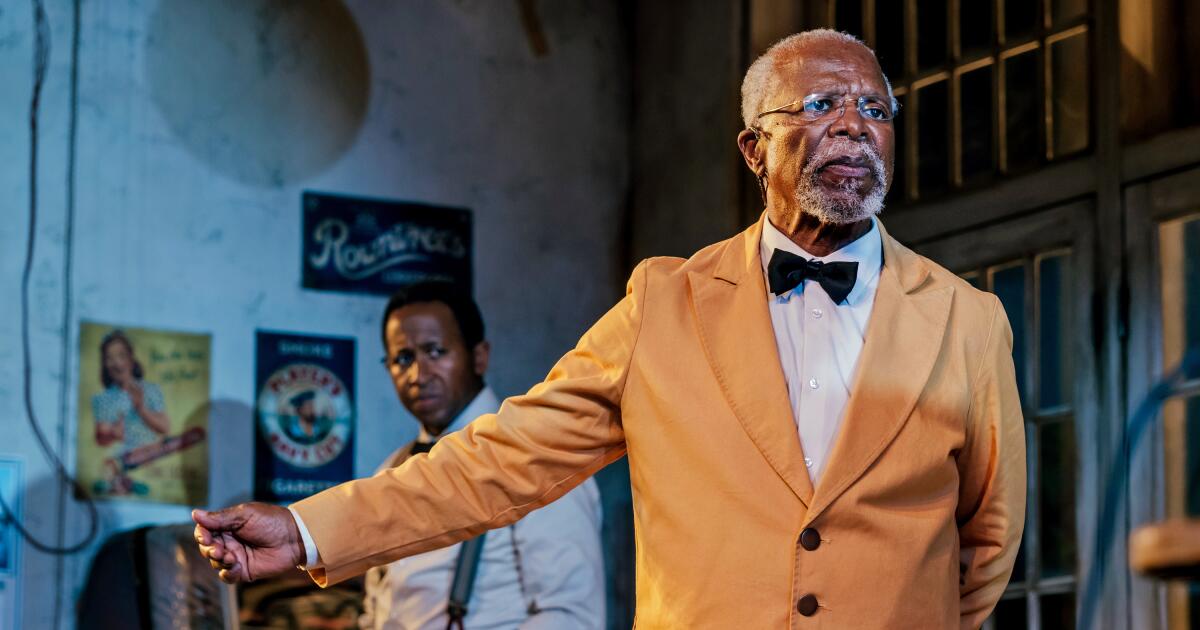
The historical situation of “‘Master Harold’ … and the Boys,” Athol Fugard’s apartheid-era classic from 1982, has changed. South Africa’s system of racial segregation that institutionalized white supremacy was dismantled in 1994.
Fugard, who died last year, played a role in bringing international attention to the injustices of his homeland through plays that chronicled the human toll of such corrosive governmental policies. The power of his work resides not in ideological argument or moral screed but in the observation of characters struggling to maintain their humanity in an inhuman system.
Precisely for this reason, “‘Master Harold’ … and the Boys” has lost none of its emotional validity, as the exquisite new production that opened at the Geffen Playhouse on Thursday reveals. The revival stars Tony winner John Kani (“The Island,” “Sizwe Banzi Is Dead”), a treasured collaborative partner of Fugard’s and one of the best living interpreters of his work. His performance alone makes this an unmissable event, but that’s not the only reason you should see it.
At a time when many of us are struggling to see a future that isn’t just a fulfillment of the worst impulses of the corrupt, exploitative, anti-democratic present, Fugard offers a vision of perseverance and resistance. “‘Master Harold’ … and the Boys” makes no empty promises, but it reminds us that hope is contingent on us retaining our souls.
Emily Mann and Geffen Playhouse artistic director Tarell Alvin McCraney have joined forces to direct. The combination is an effective one. McCraney has a way of drawing the best from actors in tight combustible spaces and Mann has a long history with Fugard. When she was artistic director of the McCarter Theatre, she made the Princeton venue one of his American homes. (I saw the relationship up close several decades ago from my vantage at the theater’s literary office.)
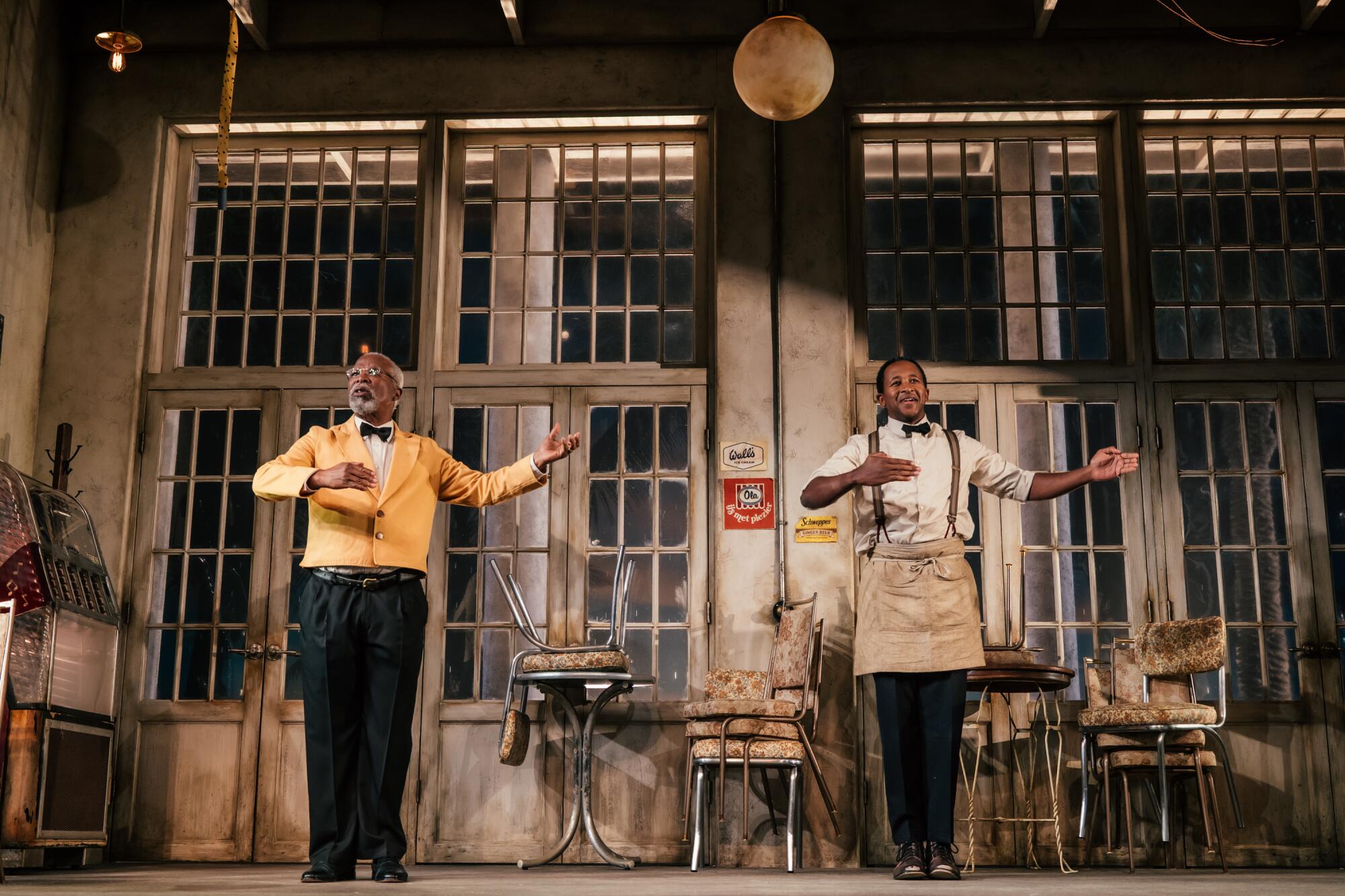
John Kani, left, and Nyasha Hatendi in “‘Master Harold’ … and the Boys” at Geffen Playhouse.
(Jeff Lorch)
Set in the St. George’s Park Tearoom in Port Elizabeth on a rainy day in 1950, the play concentrates on the relationships of three characters: Hally (Ben Beatty), a callow 17-year-old white schoolboy whose mother owns the cafe, and Sam (Kani) and Willie (Nyasha Hatendi), two Black men employed as servants there.
When the play begins, Willie is practicing his moves for an upcoming ballroom dance contest he has entered with his girlfriend, Hilda. Sam has been giving him pointers, but Willie is still rough around the edges. Sam points out his volatile friend’s technical and temperamental flaws, but he doesn’t give up on him, just as he doesn’t give up on Hally, who arrives at the tearoom after school in a storm of vulnerability and arrogance.
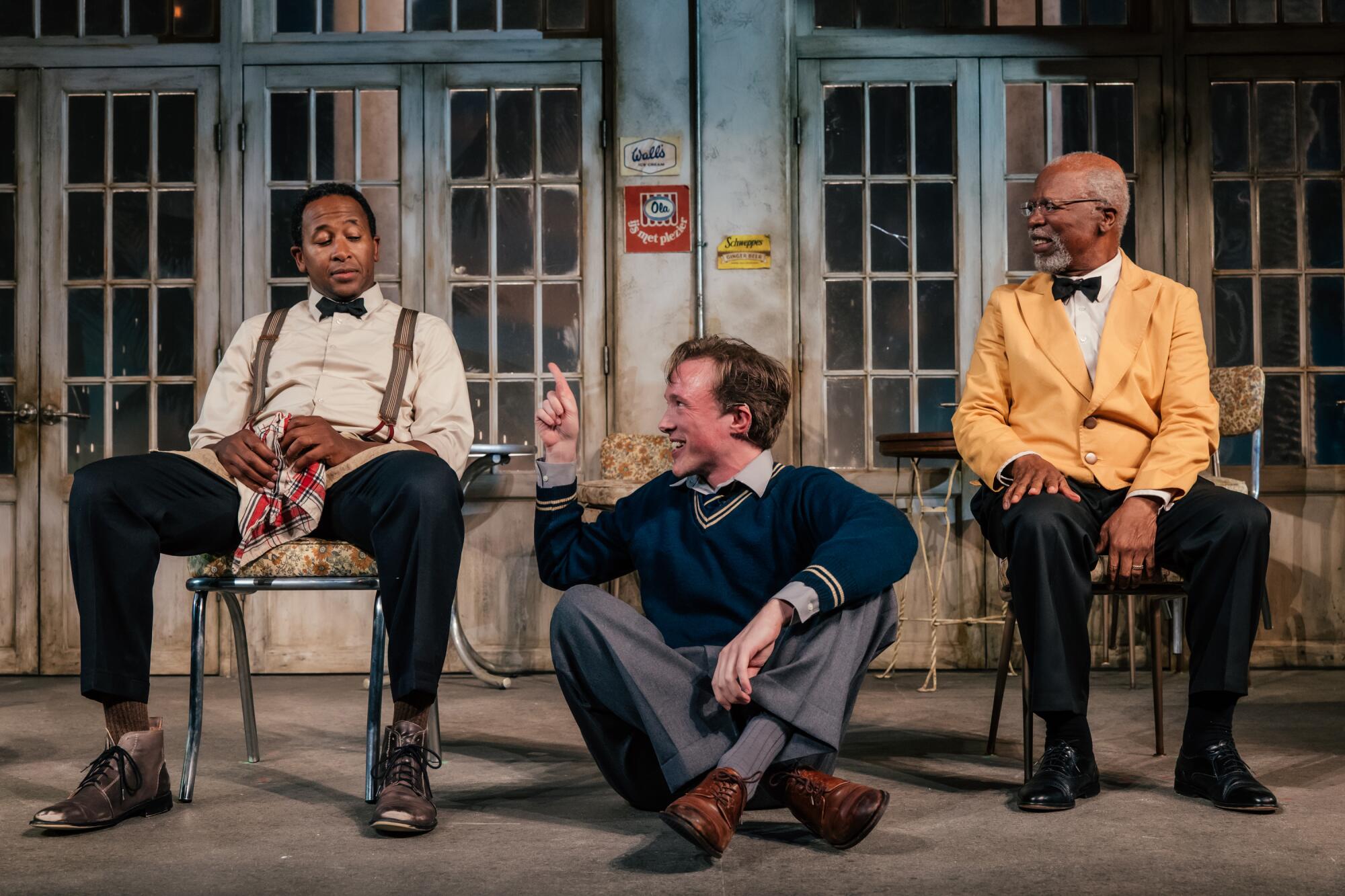
Nyasha Hatendi, from left, Ben Beatty and John Kani in “‘Master Harold’… and the Boys” at Geffen Playhouse.
(Jeff Lorch)
Hally is quick to take a superior tone with Sam and Willie, but the truth is that Sam has been a surrogate father to him. Sam has encouraged the boy to be more conscientious with his studies and has been learning alongside him for years, picking up his schoolbooks and offering ideas on how to make the assignments more meaningful.
Sam doesn’t have Hally’s vocabulary, but he has something more valuable: wisdom and maturity. Hally has badly needed a father figure. His own father, a crippled, cantankerous drunk, has been a source of shame to him.
Hally’s mood darkens as soon as he learns from Sam that his mother is bringing his dad home from the hospital. He laments the end of his domestic peace, but Sam urges him to be more respectful — advice that infuriates Hally, who spends the rest of the play asserting his dominance over the Black men who have been more caring toward him than his own parents.
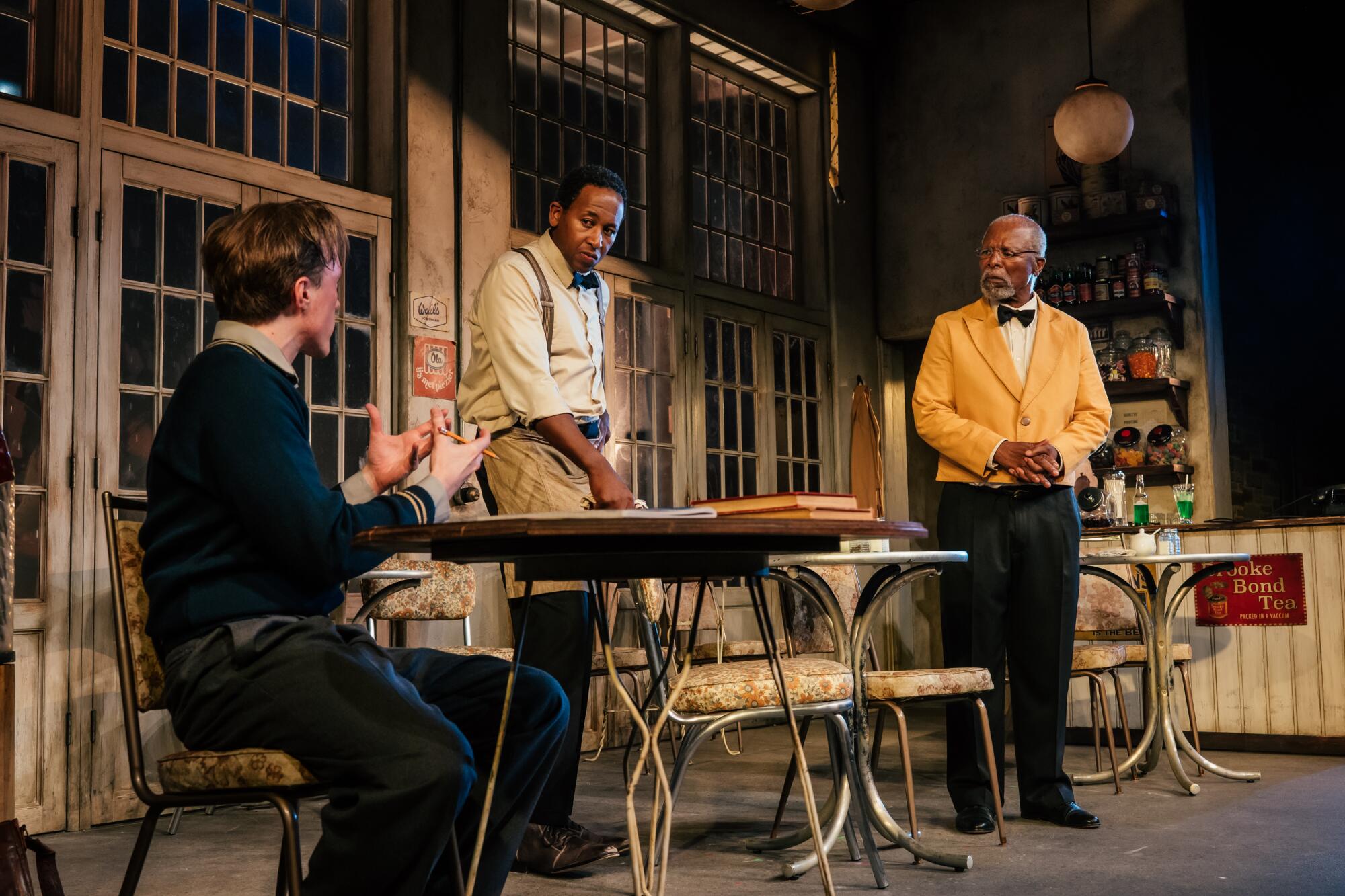
Ben Beatty, from left, Nyasha Hatendi and John Kani in “‘Master Harold’ … and the Boys” at Geffen Playhouse.
(Jeff Lorch)
The play has the old-fashioned carpentry of a solid one-act or mid-century short story. The characters are carefully introduced, the plot is hastened along by a telephone on the counter that rings with updates from the mother on her plans to retrieve the father, and the past is revisited through recollections that give rise to theatrical games that never quite break the frame of the story.
There’s a lot of talk. Fugard lets his scholastic streak drive a good deal of the conversation. (Learning as a vehicle for transformation was always a source of excitement for him.) Some of the prattle can feel like treading water, a delaying tactic until the inevitable confrontation scene. But the characters unfold before us in their exchanges, and the play makes room for the actors to inhabit the complexities and contradictions of lives caught in the vise of history.
Beatty, who happens to be the son of Warren Beatty and Annette Bening brings a fresh-faced vulnerability to the role of Hally. He has both the flush of youth and the imperious temper of a privileged young man who hasn’t grown up and probably never will. The hurt and humiliation behind Hally’s eyes allow us to adopt Sam’s sympathetic attitude toward the boy, even as Beatty refuses to soften the character’s wrathful entitlement.
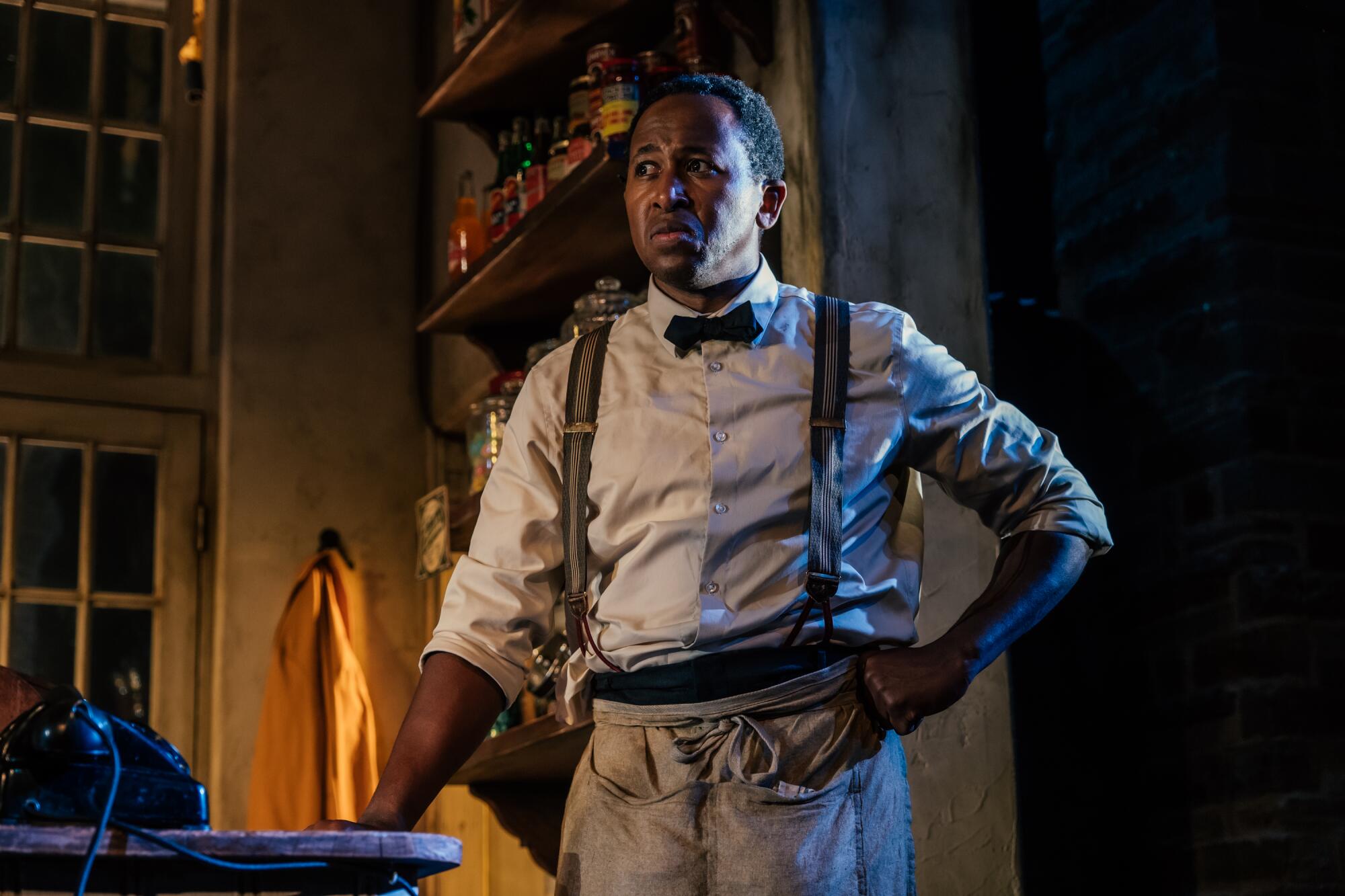
Nyasha Hatendi in “‘Master Harold’ … and the Boys” at Geffen Playhouse.
(Jeff Lorch)
Sam knows the shame Hally has suffered from his father’s drunken sprees. And having had no choice but to weather the indignities of his own life as a Black man in South Africa, he has tried to impart some of his strength while generously filling the paternal vacuum.
One particularly mortifying episode from the past haunts Hally. After he and Sam fetched his father in a drunken heap at a bar, Sam made the boy a kite, a flimsy, handcrafted patchwork that miraculously took flight and left Hally with a memory that fills him with both wonder and sadness. He’s bemused in retrospect by the strange spectacle of a “little white boy in short trousers” frolicking with a Black man old enough to be his father. But the conflict between his attachment to Sam and the reality of South African society is beyond his capacity to reconcile.
Sam is supposed to be in his mid-40s, but the character now says he’s 70 to accommodate Kani, who has returned to a role he first played in the 1983 South Africa premiere. There’s a grandfather quality to Kani’s Sam, but the increase in years has only deepened the play’s poignancy. When Sam looks at Hally, he hopes to catch a glimpse of the future he has tried in his loving way to shape. Hally’s vindictive turn is a betrayal, not just of their bond, but of the dream of a more equitable South Africa that could tolerate a Black man being a mentor to a spoiled, brokenhearted white kid.
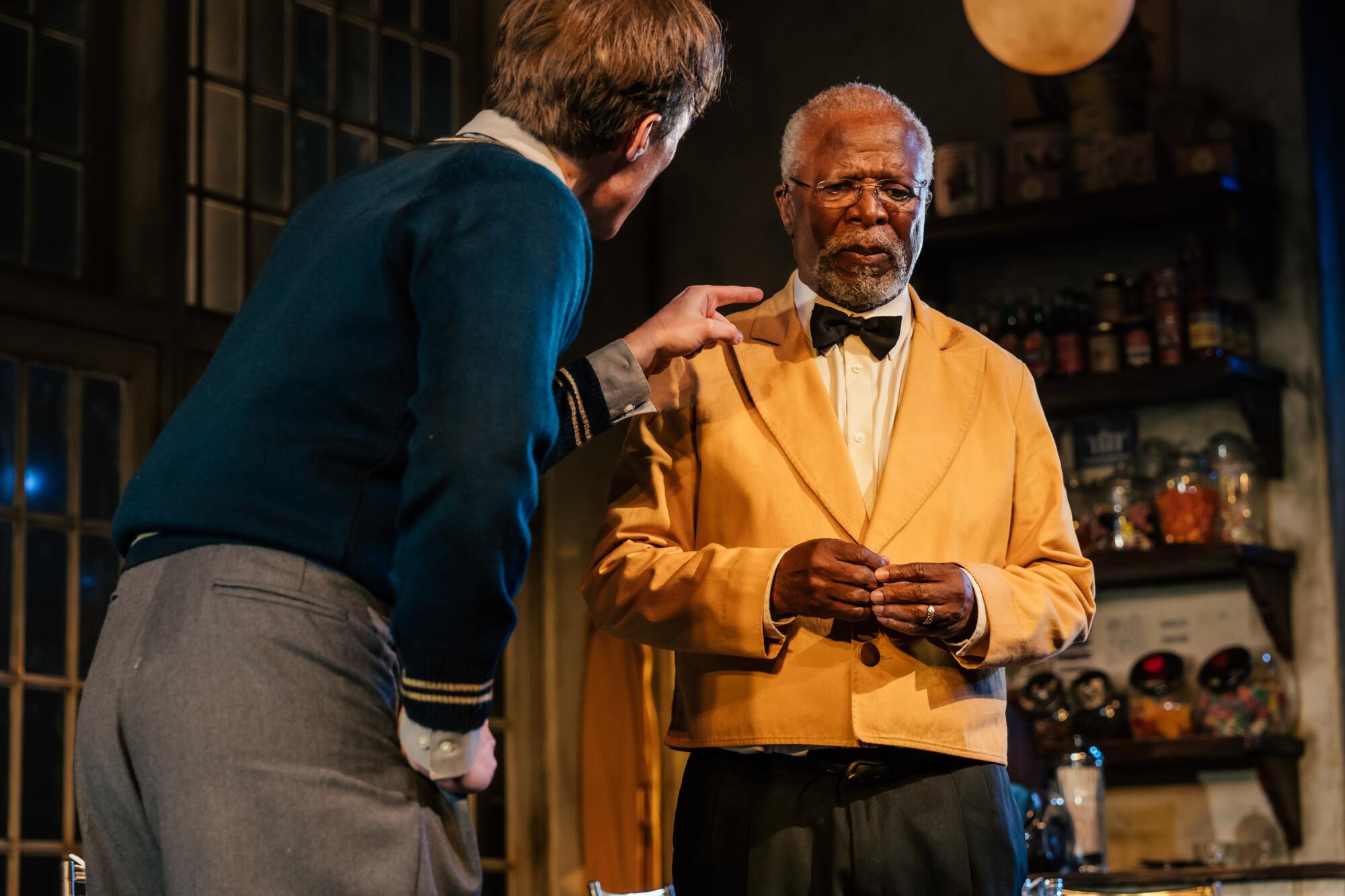
Ben Beatty, left, and John Kani in “‘Master Harold’ … and the Boys” at Geffen Playhouse.
(Jeff Lorch)
The production, subduedly aglow in Adam Honoré and Spencer Doughtie’s lighting, has the lyrical beauty of a vintage photograph magically summoned to life. Scenic designer Beowulf Boritt’s quaint tearoom seems both real and hallucinatory, with a melancholy rain pouring down in the background. Susan Hilferty’s costumes usher us back to a time when hierarchies were not only visible but rigorously enforced.
There’s one climactic moment involving spitting when the staging undermines the action. A simple adjustment of the blocking would alleviate the fakery. What needs no modification, however, is the battered dignity of Sam’s presence.
With a far-seeing stillness, Kani’s Sam does more than endure. He holds fast to what he knows to be true: the majesty of his own goodness.
As Hally reverts to the racial code of South African men like his father, Hatendi’s Willie, in an impressively calibrated performance, tries to stanch Sam’s emotional bleeding. Could standing by one another be the most radical act of all?
In “The Tempest,” Prospero comes to understand that “the rarer action is/ In virtue than in vengeance.” Sam has a similar if quieter epiphany, recognizing that his own humanity is one battle the future South Africa cannot afford him to lose.
‘”Master Harold” … and the Boys’
Where: Gil Cates Theater at Geffen Playhouse, 10886 Le Conte Ave., L.A.
When: 7:30 p.m. Wednesdays to Thursdays, 8 p.m. Fridays, 3 and 8 p.m. Saturdays, 2 and 7 p.m. Sundays. Ends May 10
Tickets: $45 to $139 (subject to change)
Contact: (310) 208-2028 or www.geffenplayhouse.org
Running time: 1 hours, 35 minutes (no intermission)