
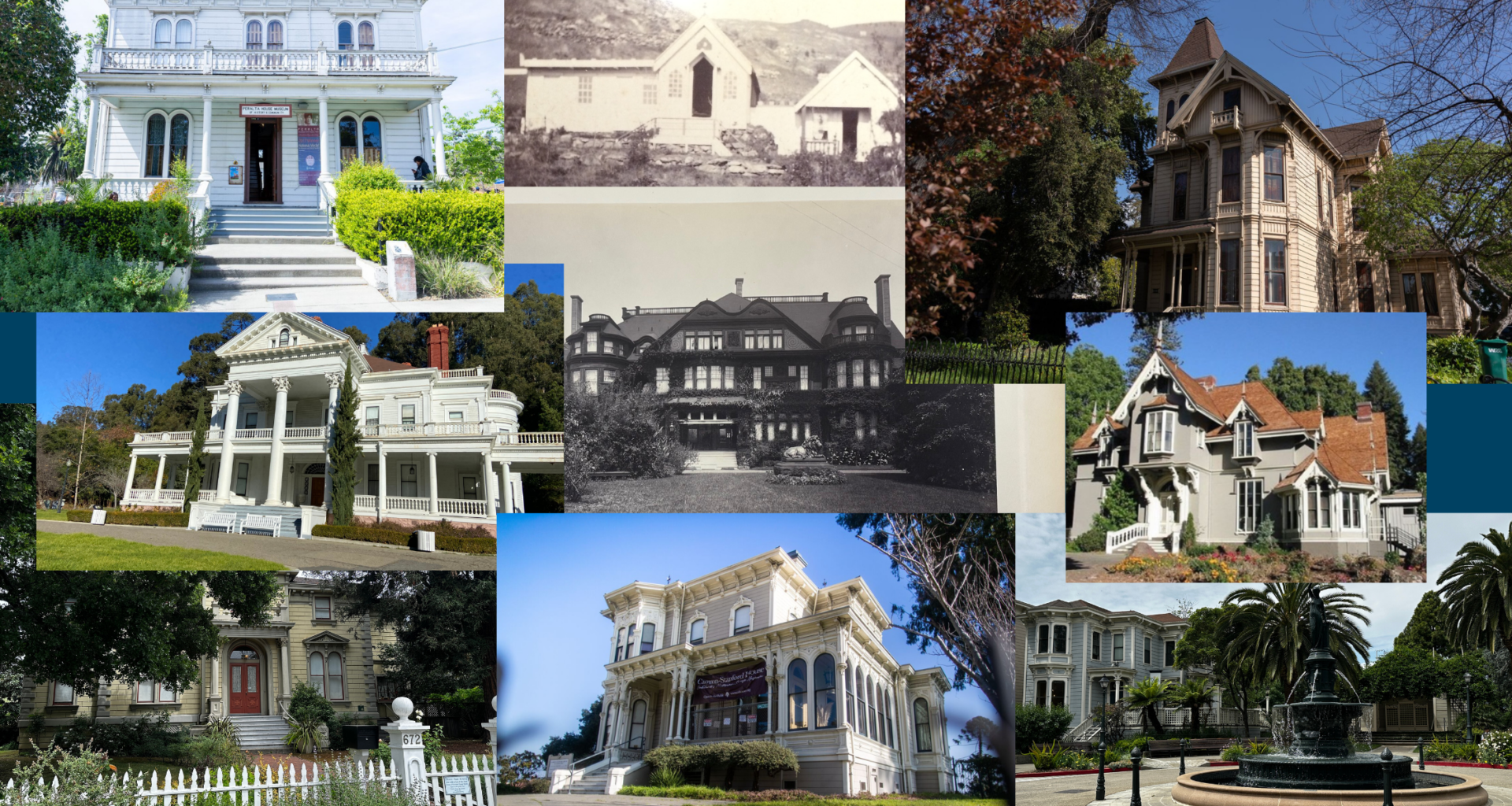
There’s little left of the grand Victorian homes and estates that once lined the streets of Oakland. The Camron-Stanford House on Lake Merritt, the Cohen Bray House in Fruitvale, the Dunsmuir Hellman Historic Estate near the zoo, and the Pardee Home Museum in downtown are among those that still offer a glimpse of an Oakland that once was.
Spanish settlers moved to the East Bay starting in 1776 to take land that had been home to indigenous people for thousands of years, and made it into fiefdoms of various dons like the Peraltas. Then, as the Gold Rush took off in 1848, American families like the Pardees, Cohens, Brays, Smiths and others began settling here as well. Many were able to acquire land following the end of the Mexican American War in 1848 and the Treaty of Guadalupe Hidalgo, when Mexico ceded more than half of its territory, including what is now the state of California. Just a few years later, the California Land Act of 1851 required Californios — descendants of California’s early Spanish settlers — to prove their land titles in United States courts, and many, unable to do so, lost their land as a result. Some of the largest losses hit the Peralta family, who owned most of the East Bay, including almost all of the land within Oakland’s current borders.
The Americans brought about a system of privatizing land, subdividing it, and making it sellable and transferrable. In 1850, Horace Carpentier, Edson Adams, and Andrew Moon laid claim to the Peralta land. In 1852, the three of them incorporated the city of Oakland.
The new residents built opulent Victorian homes in Queen Anne, Italianate, and Gothic Revival styles. Many of these elaborate constructions were paid for with money amassed from extractive industries such as lumber, mining and agriculture.
The city’s remaining grand estates were built over almost eight decades of aggressive land development in Oakland starting in 1850 until the turn of the century. Waves of migration left their mark on the land in the form of historic and heritage properties.
The city now owns some of these landmarks, such as the Camron-Stanford House, the Dunsmuir Hellman Estate, the Joaquin Miller Abbey, the J. Moss House and the Peralta Hacienda Historical Park.
According to a Capital Improvement Program unfunded project list from 2023 and 2024 provided by a city spokesperson, the Dunsmuir Hellman Estate mansion alone needs over $10 million in repairs including electrical, paint, replacement of windows and more. However, the city doesn’t have dedicated funding to maintain these historic sites, leaving many suffering from decades of deferred maintenance.
The homes on this list are places where visitors can learn more about the Spaniards who colonized the land, and the industrial and real estate barons who settled and prospered here during the Gold Rush in 1849 and after the arrival of the first transcontinental railroad in 1869.
The wealthy families who commissioned them contributed to the Oakland of today, playing a role in the founding of what is now EBMUD, the Key System of trains, street cars and buses, and the development of many of Oakland’s neighborhoods. Many also engaged in fights against labor unions, polluted the environment, or pitted citizens against immigrant workers.
But despite — or because of — their complex history, historians and preservation groups believe that these homes deserve to be maintained for use by future generations hoping to learn about the origins of the city.
“The problem is that some people like new and shiny buildings. Maintenance or repair projects don’t sound that exciting,” said Naomi Schiff, a longtime volunteer and board member of the Oakland Heritage Alliance, and currently the chair of the organization’s preservation action committee.
“It’s easier to get somebody to fund and give you capital for a new rec center than to repair a valuable 1864 building. The challenge is one of changing people’s perceptions. There are examples of good uses of historic buildings. We should do that. Why not? We used to.”
The Oaklandside compiled a list of the places you can either visit for a tour, attend for an event, rent for a private ceremony, or view from public land. All are designated landmarks, and each give a sense of how Oakland came to be, helping to inform the future of The Town.
Peralta Hacienda Historical Park, built 1820
 The Peralta Hacienda house is part of a six-acre park in Fruitvale. Credit: Estefany Gonzalez for The Oaklandside
In 1820, the last Spanish governor of Alta California, Don Pablo Vicente de Solá, granted over 44,000 acres to the Peralta family. The tract, called Rancho San Antonio, encompassed much of the East Bay. Land grants like this were issued statewide following the colonization of the Ohlone people, which began in the 1700s under the Spanish mission system. The original home, built in 1820, was made of adobe and its foundation still exists today at the park. The Italianate Victorian farmhouse that is now a museum was built in 1840.
The Peraltas began losing their estate after Mexico lost the war with the United States. The Treaty of Guadalupe Hidalgo in 1848 forced Mexico to cede more than half of its territory, including Alta California and much of the Southwest. The subsequent California Land Act of 1851 required the family to prove ownership of the land. Although the U.S. Supreme Court confirmed the Peraltas’ title in 1856, by then squatters had already taken much of the land. What was left after the subdivision of the land is six acres that include historic adobe structures built in 1820 and 1840, the Peralta House, and Peralta Creek, which is still surrounded by native flora.
According to records from the Peralta Hacienda’s website and the Oakland History Center, the property had 14 owners over a period of eight decades. After Antonio María Peralta (the last son of the patriarch, Luís María Peralta), died in 1879, Antonio’s sixteen heirs fought over what was left of Rancho San Antonio. At the end, it was his daughter Ynez Galindo and her husband Francisco Galindo who were deeded the property. In 1897, She sold the property to real estate developer Henry Z. Jones.
The land sat neglected for many years until 1975, when the Fruitvale District Community Development Board stepped in and convinced city officials to purchase the six acres. The city bought the property in 1980 and turned it into a park in 1981. After two decades of renovation of the house and grounds, Peralta Hacienda Historical Park opened to the public in March 1997. Since then, the historical park has served as an important public space for the immigrant communities of Fruitvale, including Mexican, Maya Mam, Cambodian, and Laotian families and elders. The park holds yearly festivals celebrating events like Khmer New Year, puts on theatrical productions by groups such as Teatro Jornalero, hosts programming for youth, and helps elders remain connected to their roots.
Address: 2465 34th Ave., see website for hours and programming
Pardee Home Museum, built 1868
 The house located in Downtown Oakland was built in 1868 and 1869 by Enoch Pardee, a Gold Rush migrant to California from the Midwest, who became an eye doctor in San Francisco. Credit: Azucena Rasilla/The Oaklandside
This Italianate villa was built in 1868 for Enoch Pardee and his wife Mary Elizabeth. Pardee came West during the Gold Rush and set up shop as an optometrist in San Francisco. He later got into politics, serving as mayor of Oakland, state assemblyman, and state senator.
The Pardees had one son, George Pardee, who, following in his father’s footsteps, becoming a doctor and then entering politics. He served as Oakland mayor and then was elected governor in 1903. George married his Oakland High School sweetheart, Helen Newhall Penniman, and they had four daughters: Florence, Madeline, Helen and Carol. Pardee played a role in the founding of the East Bay Municipal Utility District and, as California governor, was influential in leading the disaster recovery after the San Francisco earthquake in 1906.
The home still contains furniture and other collectors’ items that originally belonged to his wife Helen. She set up a private house museum to show off her extensive collection of items from around the world, when she moved back into the home in 1896, shortly after the death of her father-in-law.
The carriage house that is part of the property was threatened with demolition in the 1960s to make room for an I-980 on-ramp, but it was rescued and designated an Oakland Landmark. In 1976, it was listed in the National Register of Historic Places, and in 1997 it was named a California State Landmark.
Two of the daughters, Madeline and Helen, lived at the family home their entire lives. Today, the Pardee home is owned by the Pardee Home Foundation, which was established following Helen’s death in 1981. To preserve a tradition established by Helen’s mother, the foundation organizes tea parties; it also offers tours of the property, hosts special events, and can be rented for private events.
Address: 672 11th St., see website for hours and events
Camron-Stanford House, built 1876
 The Camron-Stanford House on Lake Merritt was built in 1876 and was home to five influential families during its time as a residence before becoming Oakland’s first museum. Credit: Amir Aziz/The Oaklandside
This Italianate Victorian was built in 1876 by Dr. Samuel Merritt when he was developing the area. It was home to several influential Bay Area families including Captain John Tennent Wright Jr. and his wife Susan, who were the last family to live at the lakeside house before it was sold to the city in 1907. The home served as the first site of the Oakland Public Museum until 1967, when construction of the Oakland Museum of California was completed a few blocks away.
The house sat empty, deteriorating, for years until the Camron-Stanford House Preservation Association raised more than $800,000 in donations to fully restore it. Descendants from the families who once called it home donated personal items. The house reopened as a museum and an event space in 1978. The association, which still runs the house, has been hosting tours and art exhibits as well as renting it out for private events such as weddings.
Recently, the museum, event venue and community space had been closed for over a year due to a lease dispute with the city, and the preservation association board had been raising funds to reopen the house to the public.
Then, on April 4, a fire caused significant damage to the north side of the property. The house will remain closed until an assessment of the damage is completed. The board launched a $50,000 GoFundMe campaign to raise funds for the restoration effort. The board is also recruiting volunteers to help with fire recovery. People interested in becoming volunteers can sign up for a virtual training on April 25.
Address: 1418 Lakeside Dr., see website to donate
Palm trees at Arbor Villa, built 1882
 A row of palms in Funktown once bordered the Arbor Villa estate. Credit: Azucena Rasilla/The Oaklandside
The majestic Washingtonia Robusta palm trees that line 9th Avenue from E. 24th to E. 28th streets are the last remnants of what once was Arbor Villa, the 35-acre estate of Francis Marion “Borax” Smith, built in 1882. Smith discovered a large deposit of borates, a mineral used in manufacturing and agriculture, in Death Valley, Nevada, and was soon dubbed the “Borax King.” He moved to Oakland in 1881, and, in 1895, he cofounded The Realty Syndicate, Oakland’s leading real estate development group at the time. Smith was also influential in developing the Key System, a privately-owned transit system that served Alameda and Contra Costa counties for decades between 1903 and 1960.
According to records at the Oakland History Center and the Bancroft Library, Smith’s Gilded Age estate included a 42-room, three-story mansion with a ballroom, an observatory, a grotto, rabbit hutches, an archery range, and carefully-manicured grounds with exotic trees and flowers and guesthouses.
 The mansion on the Arbor Villa estate was called Oak Hall. It was surrounded by 35-acre grounds that featured an observatory, greenhouses, gardens, and other amenities. Credit: courtesy of the Oakland History Center
By 1930, Smith’s health was failing and he had lost all of his fortune; he ended up auctioning off furnishings, artwork and other expensive artifacts inside the mansion. The acreage was sold separately, and the buildings were torn down. According to the contributors of the Oakland Wiki, a gap halfway through the row of palms marks the spot where a drive once led onto the property.
While the palms are all that’s left of this estate, the Oakland Heritage Alliance often hosts walking tours that take a path around where the estate once was. The next one takes place on Saturday, July 11, at 10 a.m. Tickets will be on sale soon.
Address: 9th Avenue from E. 24th to E. 28th streets
Cohen Bray House, built 1882
 The Cohen Bray House is nestled on 29th Avenue in Fruitvale. Credit: Amir Aziz/The Oaklandside
This Stick-Eastlake Victorian house tucked away on 29th Avenue was built in 1882. It was the home of two prominent Gold Rush era families: the Cohens and the Brays. The home was originally built for Julia Moses and Watson Bray, a grain merchant, as a gift for their daughter Emma, when she married attorney Alfred H. Cohen, the son of Alfred A. Cohen, who established the San Francisco and Oakland Railroad. The home was furnished with custom-made carved wooden furniture, all of which remains there.
Emma and Alfred lived at the home for the rest of their lives, and all four of their children were born there. Their youngest daughter, Edith Emelita, continued living at the home until her death in 1990.
Unlike some other historic homes in Oakland, the Cohen Bray House isn’t owned by the city. Its primary caregivers through the years were family members — until the last family member who lived at the house died in 2021. Sisters Patty and Nancy Donald, two great-granddaughters of Emma and Alfred, are the ones who now handle administrative and restoration efforts there. The Cohen Bray House offers special events such as a Mother’s Day tea event, a holiday decorations tour, a paranormal exploration, home tours, and fundraisers to help with the upkeep expenses.
Address: 1440 29th Ave., see website for hours and events
Dunsmuir Hellman Historic Estate, built 1899
 Dunsmuir House, near the Oakland Zoo, was built by Alexander Dunsmuir, who came to the Bay Area in 1878. The son of Robert Dunsmuir, a wealthy coal baron from Victoria, British Columbia, Alexander oversaw the family business in San Francisco. Credit: Azucena Rasilla/The Oaklandside
This Colonial Revival estate built in 1899, originally called Souther Farm, was built for Alexander Dunsmuir, the heir to a British Columbia coal mining fortune. The 50-acre estate bordering San Leandro includes the mansion, a pavilion, the Dinkelspiel House, a grotto, a swimming pool, a carriage house, and extensive grounds.
Dunsmuir had planned to move into the home with his wife Josephine Wallace, but he died in 1900 while on a trip to New York. Josephine, who returned to Oakland, died a year later. Dunsmuir’s stepdaughter, actress Edna Wallace Hopper, inherited the house but didn’t live there, instead renting the estate in 1905 to the San Francisco banker I.W. Hellman, Jr., and later selling it to him. The estate became the Hellman family’s summer home until it was purchased by the city in 1961.
The property sat empty until 1971, when a nonprofit, Hellman Park-Dunsmuir House, Inc., took on restoration efforts. Since then, the estate has served as the backdrop for various Hollywood films, including “Burnt Offerings,” a 1976 horror movie starring Karen Black. The nonprofit ran the estate, organizing community events such as Easter egg hunts, Mother’s Day celebrations, Gatsby picnics, and private events until 2010, when the city took over the lease.
The mansion has been closed since 2020, and has fallen into disrepair. On April 29, the Oakland History Center will host an event called “Dunsmuir House: “Past, Present, and Future,” where Oakland historian Liam O’Donoghue will be in conversation with Frances Dinkelspiel, a great-granddaughter of I.W. Hellman and a co-founder of Cityside, The Oaklandside’s parent organization; Edmund Clausen, a former president of the board of the Dunsmuir Historic Estate; and Mandolin Kadera-Redmond, executive director of the Oakland Parks and Recreation Foundation to discuss the history of the estate and paths forward for its restoration. While the mansion is closed to the public for now, other areas of the estate can be rented for private events.
Address: 2960 Peralta Oaks Ct., see City of Oakland website for rental information
J. Mora Moss House, built 1864
 The house, located between Telegraph and Piedmont Avenues, was part of the Mosswood estate now a city park. Credit: Binksternet/English Wikipedia
The J. Mora Moss House is a Carpenter Gothic–style Victorian that was part of the Mosswood Estate, built in 1864 for banker and business owner Joseph Moravia Moss. Moss’s heirs sold the property and the plot to the city and it became a public park in 1911. The house served as a community center for decades, but has been closed since the late 1990s. The Oakland Heritage Alliance has long advocated for protecting the landmark Moss House and is currently working on ways to collaborate with the city to help restore it.
Address: 3612 Webster St.
The Joaquin Miller Abbey, built 1886
 The Abbey is still standing today and can seen from Joaquin Miller Road. Credit: courtesy of Dale Risden, Friends of Joaquin Miller Park
The Joaquin Miller Abbey, built in 1886, is a Gothic Revival structure made up of three conjoined rooms. Two have gabled roots, and the third has a flat roof with overhanging eaves. The Abbey, located just off Joaquin Miller Road, is part of what once was The Hights estate, and is now Joaquin Miller Park. It was the private retreat of poet Joaquin Miller until his death in 1913. The estate had another larger home where his wife, hotel heiress Abbie Leland Miller, and their daughter Juanita Miller lived.
 The Hights was the estate that once belonged to poet Joaquin Miller. It is now Joaquin Miller’s Park. The Abbey, the structure on the lower left is still standing today and can seen from Joaquin Miller Road. Credit: Juanita Miller; courtesy of Dale Risden, Friends of Joaquin Miller Park
The City of Oakland purchased The Hights in 1919. Juanita, an artist and a staunch supporter of her father’s work, helped to promote arts and culture in Oakland. According to Dale Risden, the chair of the Friends of Joaquin Park organization, Juanita’s house was located were the playground tot lot is now. She continued living at the property until her death in 1970. In 2009, there were plans to restore The Abbey, but they didn’t pan out and the site has been boarded up for decades. It is visible from the outside as you walk up toward the park from Joaquin Miller Road.
In 2022, the city returned five acres of Joaquin Miller Park to permanent Indigenous control. While the city retained ownership under the “cultural conservation easement,” the Sogorea Te’ Land Trust will have nearly full control over the use of the parcel of the land in perpetuity.
Address: 3020 Joaquin Miller Rd.
Preservation Park
 The Latham-Ducel Fountain at the center of Preservation Park in Downtown Oakland. The fountain once graced the Latham-Glenn Mansion. Credit: Azucena Rasilla/The Oaklandside
This park, situated right across from I-980 on 12th and Castro streets, is a cluster of sixteen 19th century historic buildings. Five are original to the once upscale neighborhood and 11 were moved from other parts of Oakland to avoid demolition during the urban renewal campaigns of the 1970s, including the construction of the I-980. The homes that were saved once belonged to prominent families of the Oakland Gilded Age. The homes are now commercial spaces and mostly not open to the public, however, the park grounds are public and can be rented for private events. The park features a courtyard with a Parisian fountain that once graced the Latham-Glenn Mansion. That estate, which was located on 17th and Jackson streets, belonged to James Latham, a stockbroker, and his wife Henrietta, a cookbook author and watercolor painter.
One way to see inside is to stop by a Brazilian restaurant called Rio California Café, open for lunch Monday through Friday, which has occupied one of the Victorian homes since 1998.
Address: 1233 Preservation Park Way, see website for rental information
“*” indicates required fields