
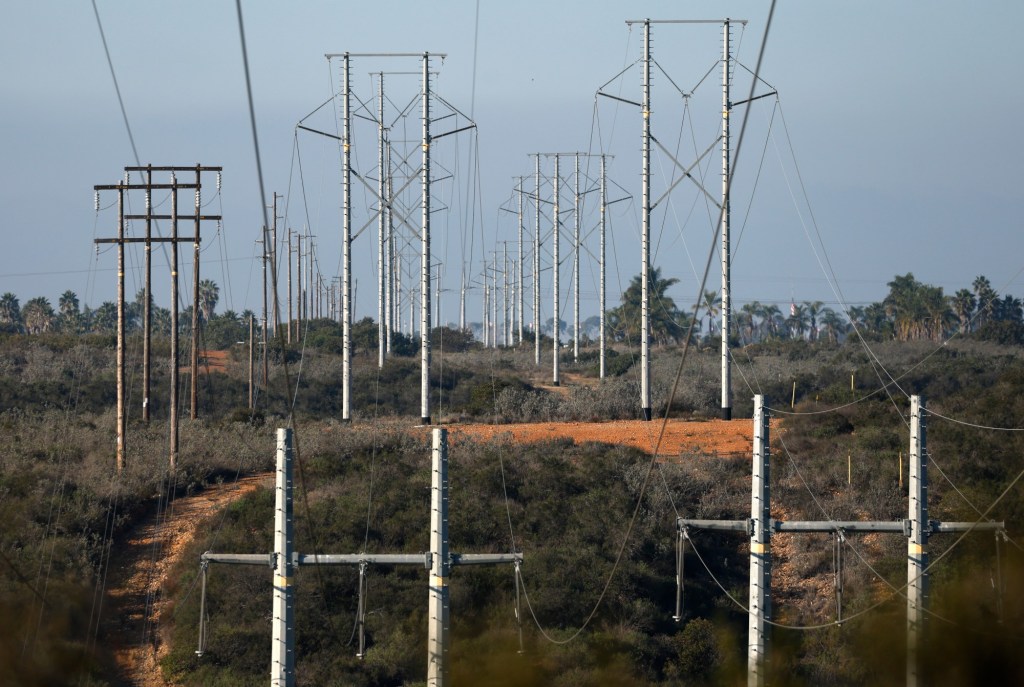
A study by a consulting firm says the potential for the city of San Diego to oust San Diego Gas & Electric and replace it with a municipal electric utility is an “operationally, technically and financial feasible alternative worth considering.”
The 202-page analysis presented Thursday afternoon to the City Council’s Environment Committee acknowledged the study’s projections “remain highly theoretical and dependent on several assumptions,” but said the ultimate potential financial benefits could result in annual savings of more than $600 million in the latter stages of a 30-year period, which would translate to $500 per customer.
“There’s an opportunity to save billions of dollars over time for the ratepayers,” said Scott Burnham, partner at NewGen Strategies & Solutions, which teamed with Siemens and another consultant to author the study. Burnham went on to say “significant unknowns and variables remain.”
SDG&E officials disputed the projections, saying the study vastly undercounts total costs the city would incur to acquire its assets, and the union representing many of SDG&E’s workers remains dead-set against a municipal utility.
“Why are we talking about something this big, this risky right now? If this goes sideways, you know who pays for this? It’s the public and it’s our workers,” Nate Fairman, business manager at IBEW Local 465, told the committee.
Environmental groups and longtime supporters of the city creating its own municipal utility said it’s time to make a change, citing high SDG&E rates.
“This (study) is an in-depth analysis of whether public power works financially for San Diego and the results are a green light to move forward,” said Parke Troutman, utilities campaign manager for SanDiego350.
The NewGen analysis now goes before the full San Diego City Council for further discussion. Council President Joe La Cava told the Union-Tribune he estimates it will be put on the agenda in late August.
The study is the second phase of a two-part analysis the city contracted NewGen Strategies — at cost of about $3 million — to analyze the practicality of a municipal utility within the city limits.
Phase I of the study came out in July 2023, with Phase II offering more robust financial details and analysis.
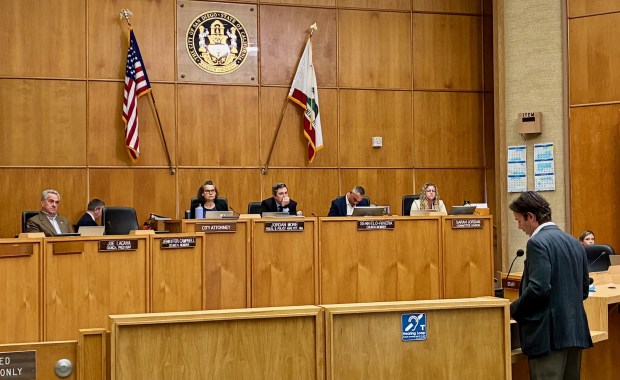 Members of the San Diego City Council’s Environment Committee listen to Mark Kersey of the San Diego County Taxpayers Association during a hearing on the feasibility of the city creating an electric municipal utility. (Rob Nikolewski/The San Diego Union-Tribune)
A major question revolves around how much it would cost the city to purchase SDG&E’s infrastructure assets.
The Phase II study came up with a wide variance: A book value, called “original cost less depreciation,” that valued the system at roughly $2.4 billion, and another approach, called “replacement cost new less depreciation,” of about $7.6 billion. That’s a difference of $5.2 billion.
The study says “an extensive and highly integrated distribution network” would include 4,300 miles of underground and overhead circuits, more than 45,000 transformers, plus associated switches and service lines.
Beyond the acquisition costs, the report estimates spending another $21 billion in capital investment over the space of three decades to maintain the assets for transmission and distribution of the utility system.
That’s a big chunk of money, but the analysis says a potential municipal utility could access the bond market at assumed interest rates of 5%, which is considerably lower than SDG&E’s cost of capital for equity at 10%.
Over a 30-year period, the city “might be able to generate a potential financial cumulative benefit” of $7 billion at the high-asset price and $19 billion at the lower asset estimation.
Furthermore, the study said the financial benefits “would potentially accelerate over time,” resulting in the estimated annual savings of $500 per customer.
The analysis worked on an assumption of SDG&E rates increasing 4% each year, although NewGen says historically rates have risen 6% annually, and if SDG&E retail rates go up more than 4%, “then the potential savings will be greater.”
Using the higher replacement cost estimate, the study predicts the city would break even — that is, meet a “net positive position” — after 11 or 12 years.
During public comment at Thursday’s hearing, SDG&E’s vice president of external affairs and communications, Brittany Applestein Syz, said the report “significantly underestimates costs and risks” of the city establishing its own municipal utility.
“Taking over the electric grid would be one of the most consequential decisions that you make as council members, and it requires complete and reliable facts,” she said. “This study does not meet that standard. It fails to answer the most basic question, what would customers actually pay?”
That drew a response from Councilmember Sean Elo-Rivera, chair of the Environment Committee.
“I will take that question seriously when you (SDG&E) can guarantee to customers what they will pay,” he said. “It’s questions like that that make people super angry … when it is a month-by-month, year-by-year guessing game what their utility bills will be.”
SDG&E also said the report does not take into account other costs — such as spending to reduce the risk of wildfires and related expenses to purchase wildfire insurance, plus what the financial implications of a San Diego-only municipal utility would mean to other cities across the county.
“We’re talking billions more,” Applestein Syz said after the meeting.
Mayor Todd Gloria is taking a cautious approach.
In a letter to the City Council about the Phase II report, Gloria referred to “potential benefits of a public energy utility” but also mentioned “significant and unavoidable risks and the substantial costs” of establishing it.
Gloria also pointed to San Francisco’s pursuit of breaking away from Pacific Gas & Electric and creating its own public power company — and how the city and county of San Francisco are in the midst of proceedings with the California Public Utilities Commission to establish fair valuation of and compensation for PG&E’s infrastructure.
“I intend to monitor those proceedings closely before drawing any further conclusions about the city’s path forward,” Gloria said.
Gloria and SDG&E hammered out a new 20-year franchise agreement that the San Diego City Council approved in June 2021. However, the city can opt out after 10 years if it creates a municipal utility.
Supporters of municipal utilities point to the Sacramento Municipal Utility District and the Los Angeles Department of Water and Power, which offer customers lower rates than investor-owned utilities.
However, SMUD and LADWP were established decades ago (SMUD in 1946 and LADWP started electricity service in 1917) when energy infrastructure was much less extensive.
But the topic of municipalization has picked up steam as utility customers across California shoulder a heavier financial burden.
Average residential electricity rates in the Golden State have grown faster than inflation, with the Public Advocates Office reporting that SDG&E rates have soared 98% in a 10-year period. Southern California Edison’s average residential rate has climbed 101% and PG&E’s has risen 76% during that same time frame.
“We need a utility grid governed by San Diegans, for San Diegans,” said Isaiah Glasoe, program coordinator for Public Power San Diego.
The San Diego County Taxpayers Association was circumspect.
“Today with San Diego’s current budget woes, it’s more important than ever to do a deep dive on ideas that carry hidden financial consequences,” the group’s CEO, Mark Kersey, said during public comment, adding that “taxpayers deserve proof, not assurances … Feasibility is not enough. You need responsibility as well.”
The NewGen analysis looks at an electricity-only municipal utility that would not include natural gas services. The consultant offered a number of reasons, including that determining the value and acquisition costs of gas infrastructure could add significant costs “without proportional revenue benefits” to the city.