
Welcome to Sliders, a weekly in-season MLB column that focuses on both the timely and timeless elements of the game.
The new pitching coach for the Los Angeles Angels was the first role model for the winningest pitcher alive. Mike Maddux’s kid brother, Greg, earned 355 victories in a Hall of Fame career built largely on intellect and precision.
The sinker, Greg Maddux once said, is “the furthest strike from the hitter’s eyes — a little bit harder to see, a little bit harder to hit.” But you can’t throw too many, he would caution, because the last pitch a hitter sees is the one he remembers best.
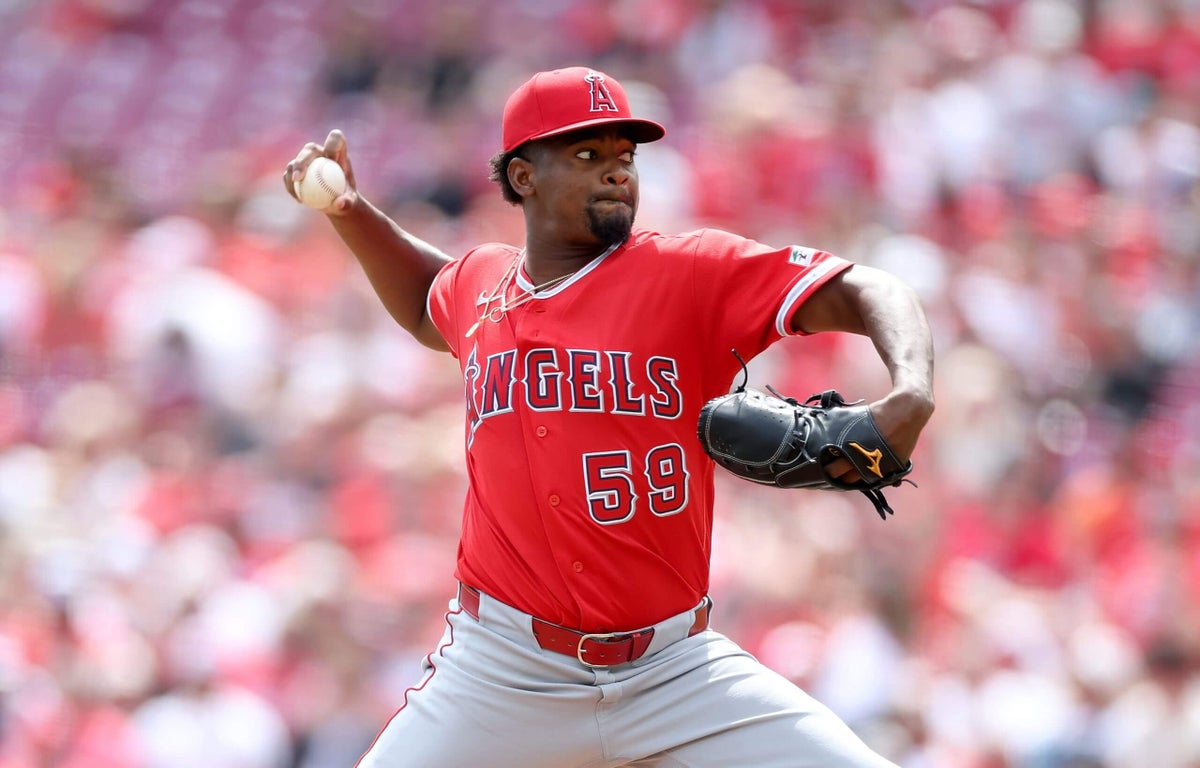
José Soriano, the Angels’ ace, has an outstanding sinker. Last year, when he threw it more than any other qualified pitcher in the majors, he had a good season. This year, he is throwing it 20 percent less — and having the best season of any pitcher in the sport.
“It was an easy sell,” Maddux said. “Just explain why: ‘Move their eyes. (You’ve done) East and West, now we go North and South.’ Holy cow — big strike zone.”
And Soriano, who will take the mound Friday against the San Diego Padres, is filling it up. In four starts, he is 4-0 with a 0.33 ERA, allowing just one run and nine hits in 27 innings, with 31 strikeouts. Soriano has fanned 10 in each of his past two starts, while allowing no more than one run and three hits. The last Angel to do that in consecutive starts was Nolan Ryan in 1978.
Now Soriano wants to do something Ryan never did: Win the Cy Young Award. Only two Angels — Dean Chance in 1964 and Bartolo Colón in 2005 — ever have.
“That’s one of my goals, to win the Cy Young, and I think I started the right way,” Soriano said this week at Yankee Stadium. “I believe in myself. I believe I can do it.”
Last season, when Soriano was 10-11 with a 4.26 ERA, almost everything he threw was down. He used his sinker about 50 percent of the time, mixing it mainly with curves, splitters and the occasional slider. Hitters looked down and stayed down.
The four-seamer forces them to respect the high pitch, and now Soriano throws sinkers, four-seamers and curveballs in nearly equal ratios — all between 23 and 30 percent. He is reminding Kurt Suzuki, the new Angels manager, of two righties he caught for the Washington Nationals.
José Soriano leads Major League pitchers this season in:
🔥 ERA (0.33)
🔥 Wins (4)
🔥 Strikeouts (31)#RepTheHalo pic.twitter.com/gpvgVzLp7y
— Los Angeles Angels (@Angels) April 13, 2026
“(Stephen) Strasburg and (Max) Scherzer, those two guys were pretty darn good when I caught them,” Suzuki said. “Just the way they attack hitters, the way they executed stuff, the calmness they had on the mound, I feel like Sori’s up there with those guys, which is saying a lot.”
As a boy, Soriano seemed destined to be a hitter. He was born in Santo Domingo in October 1998, just after the Dominican Republic’s favorite son, Sammy Sosa, had slugged 66 homers for the Chicago Cubs. But Soriano gravitated to the mound, inspired by different Dominican stars: Pedro Martínez at first, and then Luis Severino.
He signed with the Angels for $70,000 in 2016 and pitched well for four seasons until undergoing Tommy John surgery in January 2020. As he recovered, the Pittsburgh Pirates took him first overall in the Rule 5 draft that December.
After two games for Class-A Bradenton in 2021, Soriano hurt his elbow again. He flew to Pittsburgh for a second Tommy John surgery, and briefly considered quitting, leaning on family to help him through.
“When those things happen, you try to be strong and confident you can come back, but it’s hard to do,” Soriano said. “Especially because, when you come in for the first one, you start recovering and you start feeling better — and then that happens. At the moment you feel very bad, frustrated. You feel like you don’t want to play anymore.”
Had Soriano avoided the second surgery and pitched for Pittsburgh through the end of that 2021 season, he would probably still be a Pirate. But when the second operation made that impossible, the Pirates — in the spirit of the Rule 5 draft — returned him to the Angels after the season.
“When the Rule 5 happened, at the moment I felt weird because my whole (career) I was an Angel,” Soriano said. “A couple months later I felt fine because they treated me very well, but when I had to come back, I felt weird again. Just one year and I had to come back. But when I got here, I felt like I was at home.”
In the three-season span from 2020 through 2022, Soriano pitched only 16 2/3 innings. The Angels built him up as a reliever in 2023, and though he was wild, it was tempting to keep him on that path.
“Eventually, we thought he could be at the back end (as) the ninth-inning type guy,” general manager Perry Minasian said. “But what made us convinced, what made us believe and take the risk of starting him, was the brain. He’s a good guy, and his brain works.”
These days, Minasian said, Soriano stands at the sweet spot of his career. He understands himself better as a pitcher, works diligently to stay healthy and even decided he was ready to do interviews without an interpreter. When he became a father last summer, Soriano wore a T-shirt featuring a cartoon baby and the words “Little Sinker Boy.”
“Last year when I realized my wife was pregnant, I had the idea to do something funny for the guys,” Soriano said. “I was thinking a lot, and at some point I thought, ‘Let me do this and see if they like it.’ They said, ‘Oh yeah, this is gonna be funny.’”
All those sinkers gave Soriano the best ground-ball rate in the American League from the time he reached the majors through the end of last season. Throwing fewer of them — while exploring the upper reaches of the strike zone, too — is making him a star.
“Everybody knows he’s got a good sinker,” Maddux said. “That’s not all he’s got good. He’s got a good curveball, a good splitty, his four-seam is an offset to the two-seam — and he enjoys himself when he’s out there. And that’s probably the greatest thing about him.”
Is well-traveled Craig Kimbrel on a path to Cooperstown?
When the New York Mets added Craig Kimbrel to their bullpen last weekend, manager Carlos Mendoza casually referred to him with the ultimate baseball superlative.
“He’s still got weapons and he’s here to help us,” Mendoza said. “This guy is well on his way to being a Hall of Famer.”
As a nine-time All-Star with 440 saves, ranking fifth on the career list, Kimbrel can certainly make a case. Then again, his production has been fairly ordinary for a while now. In his first eight seasons (2010 through 2017), Kimbrel had a 1.80 ERA and a 222 ERA+. In the next eight seasons, before joining the Mets, he had a 3.83 ERA and a 110 ERA+.
If Kimbrel does get to Cooperstown, though, he will set a modern record: most teams in a Hall of Fame career. The right-hander, who turns 38 next month, has pitched for the Atlanta Braves, San Diego Padres, Boston Red Sox, Chicago Cubs, Chicago White Sox, Los Angeles Dodgers, Philadelphia Phillies, Baltimore Orioles, Houston Astros and the Mets.
That’s 10 teams, one more than modern record-holders Rickey Henderson and Goose Gossage. Only one Hall of Famer played for more teams than that duo, but you’ve got to go way back to find him.
Dan Brouthers suited up for 10 franchises from 1879 to 1896 — then added an 11th, in 1904, when John McGraw gave him a ceremonial cameo for the New York Giants at age 46. Brouthers, a first baseman, hit .342 in a career spent mostly with defunct franchises, including the Troy Trojans, Buffalo Bisons, Detroit Wolverines, Boston Reds, Louisville Colonels and the 1800s version of the Baltimore Orioles.
5 questions (and Off the Grid) with …A’s coach Marcus Jensen
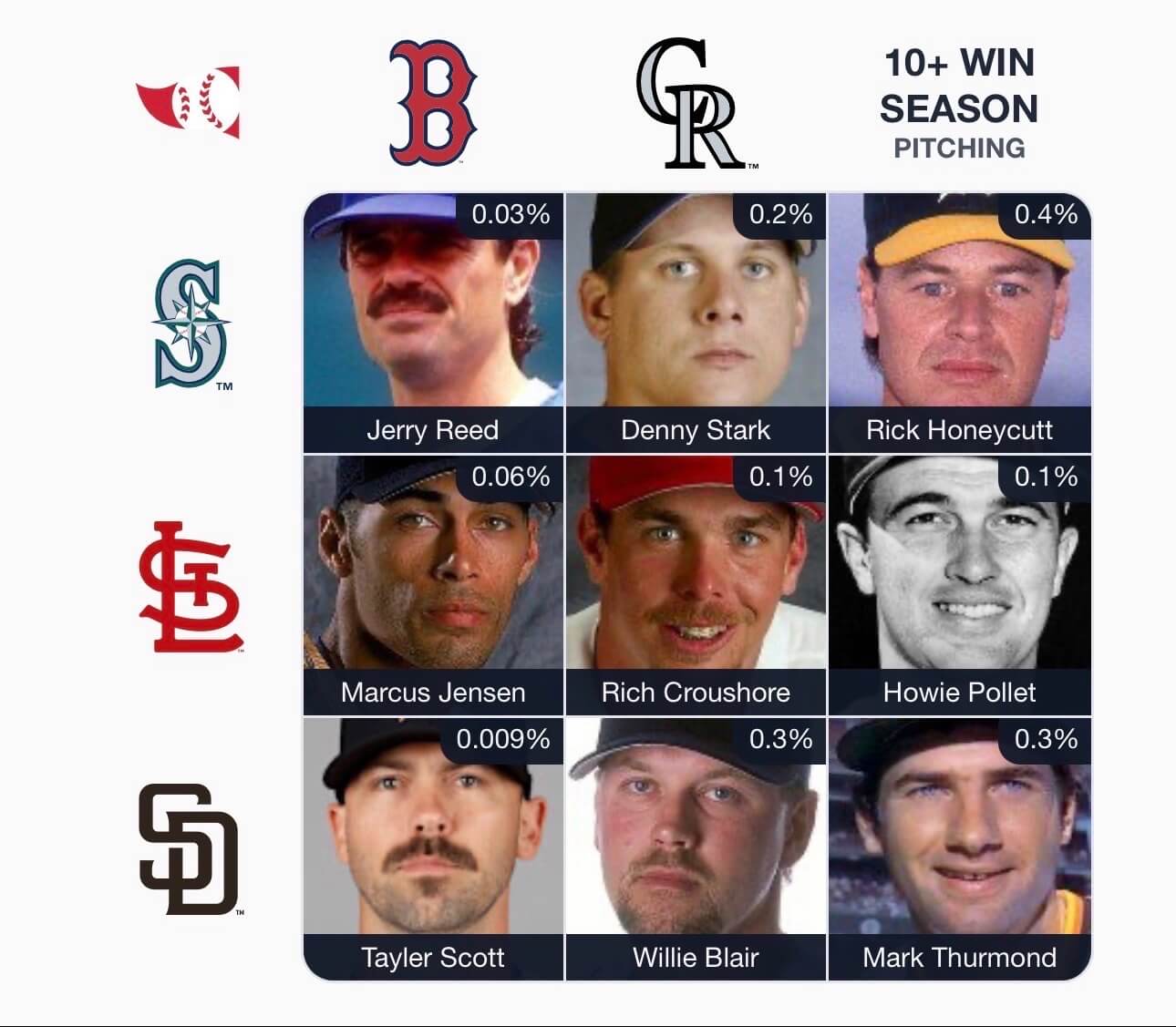
For devoted Immaculate Grid players, Marcus Jensen is a legend. Jensen played only 145 major-league games, but spread them across seven teams in seven seasons from 1996 to 2002. He’ll work for any team-crossover square involving the San Francisco Giants, Detroit Tigers, Milwaukee Brewers, St. Louis Cardinals, Minnesota Twins, Boston Red Sox and Texas Rangers. (The Grid below is from last month.)
“It has been brought to my attention a few times,” Jensen said recently. “Like, ‘I used your name and it was point zero-zero-zero-something.’”
Now in his 12th season as a coach for the Athletics, Jensen has found the stability that eluded him as a player. But while he had about 10 times more plate appearances in the minors than he did in the majors (roughly 4,000 to 400), at least Jensen had the chance.
One grandfather, Arthur “Mickey” Kemper, caught for a barnstorming Negro League team called the Toledo Bearcats, and also served as an umpire. Another grandfather, Lauritz “Babe” Jensen, played five seasons in the affiliated minors, including three for the New York Yankees from 1946-48, when he hit .295 but never got the call.
“They had a monster team up in the big leagues,” Jensen said.
Before a recent A’s game at Citi Field, the 53-year-old Jensen shared a few thoughts on his eventful baseball life.
A powerful heritage: “The barnstorming teams would play the major (Negro League) teams because they’d come through as they were traveling to the next city. (Kemper) also umpired at the same time. He played against Josh Gibson, so he’d tell stories about playing against him, and umpiring when he was there. It’s a fascinating generation of baseball, a fundamental stage for African-Americans. He made due under the circumstances, but he was also happy to see the progression of baseball, especially in my (hometown) of Oakland, Calif., a number of great baseball players he used to tell me about that weren’t far removed from the Negro Leagues who were getting opportunities that guys he played with weren’t. So he’d plant seeds with me all the time and give me the history.”
An MLB career of pride and frustration: “Probably a little bit of both, not being able to maximize opportunities that I had. I was still learning the craft, kind of labeled as a defensive guy who was still trying to figure things out at the plate. And once you get removed from the game and get on this side of it, it’s the old adage: Had I known then when I knew now, the process may have been easier. But that was my journey — kind of a journeyman catcher, trying to find a home.”
A golden moment at the 2000 Olympics: “That’s a highlight of my career. That year was interesting, because I was up with Minnesota for a lot of the year and then I got sent down, and it was kind of like when one door closes, another one opens. I had played in the Pan-American Games the year before and did pretty well, so that created an opportunity for the Olympics. We had a pretty dominant pitching staff. I would split time with Pat Borders. We rotated each game, and it just kind of worked out where Pat got the gold medal game. He had actually gotten hurt, and I think the rotation brought him back in line to catch that game. I wouldn’t have missed that opportunity either, if I was him.”
Knuckling under in a one-game Red Sox career: “I caught Tim Wakefield. I was happy to say that I did not (have any passed balls), but I was exhausted after the game because you had to bear down on every pitch. We didn’t win that game, but it was fun. He’s my one and only knuckleballer.”
What does a quality control coach do?: “It varies among every organization. Kotsay had the position prior to me, before he was managing, and it was a different role for him. It’s primarily just a title — for me, it’s handling the catching and the base-running game. (A’s catcher Shea Langeliers) can swing it, obviously. He’s got power and he’s growing in both facets of it, coming into his own but still understanding there’s room to improve on both sides.”
Classic clipMike Scott’s “split-finger trash ball”
Split-finger fastball usage is up again this season, continuing a recent trend. Modern pitchers no longer fear the pitch of the 1980s, which fell out of favor for a generation in MLB (though not in Japan) over injury concerns.
Forty years ago, Mike Scott won a Cy Young Award for the Astros with a devastating splitter, part of a suspiciously lively repertoire that nearly carried Houston to the World Series. It’s been a rough start for today’s injury-ravaged Astros staff, which had an MLB-high 6.17 earned run average entering Thursday. Maybe they need more splitters.
Here’s a splitter-inspired public-service ad for the Texas Department of Transportation from 1986, the year Scott led the majors in ERA (2.22), innings (275 1/3) and strikeouts (306).
At first I was thrown off by the “M. SCOTT” on his jersey, since the Astros had only one player named Scott at the time. (They did have Tony Scott in 1984, so maybe Mike wore an old jersey for the shoot.) But I was really not prepared for Mike’s pitch to explode upon impact with the trash can.
Raging roadside fires would seem to be a more serious problem than littering. In the ’80s, though, it all made sense. You had to be there.