
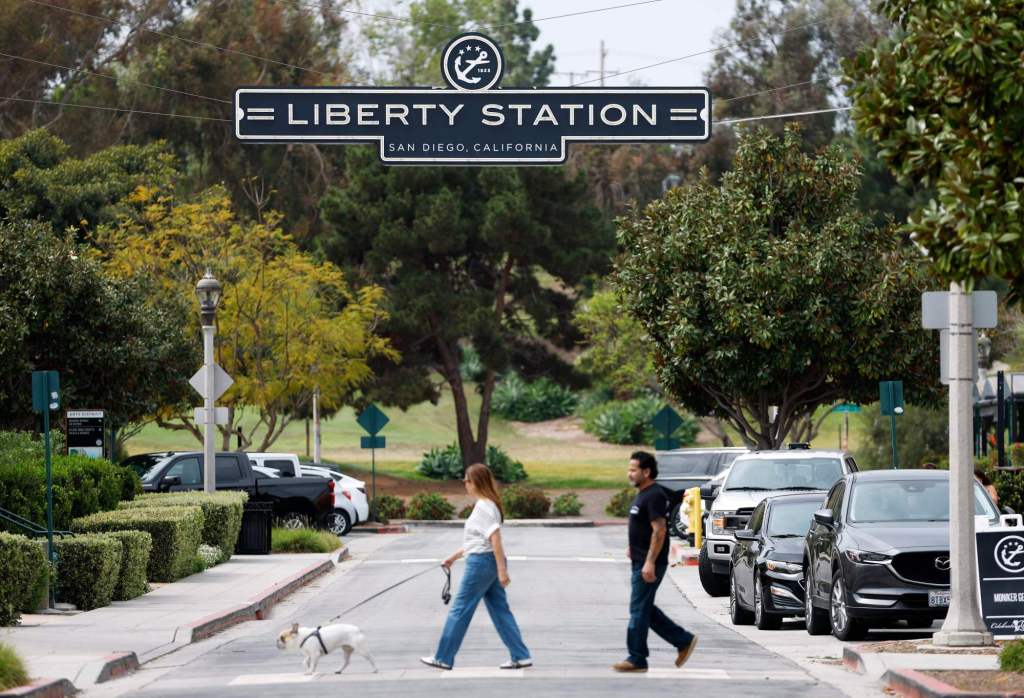
San Diego’s roller coaster effort to cement long-term public control of Liberty Station is becoming steadily more bitter as city officials and the complex’s largest leaseholder trade barbs and accusations.
City officials have managed in recent weeks to convince 10 of 12 other government agencies to agree to payouts needed for the city to retain control of Liberty Station, but the effort has prompted a war of words.
That’s because the leaseholder — Seligman Properties — has been simultaneously trying to convince those agencies to reject the city’s efforts so Seligman can buy and control much of the sprawling district of parks, artist studios, shops and restaurants.
City officials say Seligman is trying to scuttle the payout deals so the city will be forced to sell Liberty Station to Seligman at a substantially deflated purchase price.
The conflict has led lawyers and consultants for Seligman to accuse city officials of being “coercive” and “delinquent,” not engaging in fair play and attempting to selfishly “siphon” money away from local public schools.
In turn, city officials have called Seligman’s representatives “active obstructionists” making “calculated attempts to sow confusion.” They also contend Seligman officials sometimes strategically contradict themselves.
Seligman’s efforts have had some success, albeit temporarily. Concerns raised by Seligman last month prompted board members for the San Diego Unified School District to delay a vote on the district’s payout offer from the city.
“It’s not that I don’t trust the city, but I don’t trust the city,” trustee Sharon Whitehurst-Payne said last month after Seligman raised questions about the city’s offer and accused city officials of trying to dupe the school district.
But the board revisited the issue Tuesday and voted unanimously to approve the city’s payout offer.
That decision came despite Seligman representatives arguing the school district would get much more money than — perhaps seven times — the city’s $1.4 million payout offer if it rejected the offer and forced the city to sell.
Grace Cho, an attorney for Seligman, told trustees they would gain financially by rejecting the city’s offer.
“The district cannot be forced or coerced into entering a contract,” she said.
Mitch Mullinix, a consultant for Seligman, said trustees shouldn’t fall for the city’s “lack of fair play,” noting that the city only began pursuing agreements with government agencies after Seligman filed suit in 2022.
Joe Haeussler, who works for Seligman’s Liberty Station partner Pendulum Property Partners, said the city has delayed paying the agencies for more than a decade and now wants to “siphon money away” from needy schools.
“Don’t reward their delinquency,” he said.
Andra Greene, the school district’s general counsel, told trustees that Liberty Station is a “very valuable property to the community.”
She also told them that however much the district is paid for its share of Liberty Station won’t impact district finances. That’s because it’s state policy to cancel out such payouts by reducing the state’s contributions to districts that get them by an equal amount.
The dispute over Liberty Station is mostly about a complicated set of rules the state created when it dissolved redevelopment agencies in 2012 and had to determine what to do with the properties those redevelopment agencies owned.
Most were given to the cities where the property was located, and those cities were required to categorize the properties they received as a “future development” site or a “liquidation” site.
San Diego declared Liberty Station a future development site so that it wouldn’t have to sell. But using that designation requires a city to reach compensation deals with many other government agencies.
The city must compensate those agencies because redevelopment law forced them to give up tax revenues they would have otherwise collected.
After Seligman sued in 2022 with the goal of forcing the city to sell, Sacramento Superior Court Judge Shelleyanne Chang ruled that the city must show progress on redeveloping the area by agreeing to the payouts.
The city has now agreed to payout deals with San Diego County, the county Office of Education, Lemon Grove School District, Grossmont-Cuyamaca Community College District, San Diego Community College District, Grossmont Healthcare District, the San Diego County Water Authority, Grossmont Union High School District, San Ysidro School District and San Diego Unified.
Deals still must be reached with Southwestern Community College District, which is scheduled to vote on the city’s proposed payout April 20, and the Sweetwater Union High School District, which hasn’t yet scheduled a vote.
What makes the situation with San Diego and Seligman unusual is that Seligman controls 330 acres of Liberty Station’s commercial areas under no-rent leases that run through 2070.
City officials contend those leases mean it wouldn’t make sense for any other company to bid against Seligman — limiting how much the city could get in any sale and giving Seligman a great deal.
In a 52-page update to Judge Chang filed April 10, City Attorney Heather Ferbert hailed the recent progress San Diego has made and harshly criticized Seligman.
The update says Seligman and its partners have transitioned from “concerned stakeholders” to “active obstructionists” and calls Seligman’s pleas to school officials “a calculated attempt to sow confusion.”
The court filing also contends that Seligman often lobbies the judge to make the city speed up, but then lobbies the school districts to slow down.
“Petitioners continue to send conflicting messages depending on the audience,” the filing says. “They demand the city’s ‘expeditious’ compliance before this court while simultaneously lobbying the affected taxing entities to prevent or delay the city’s compliance.”
Michael Wong, an official with the city’s Economic Development Department, said San Diego has already set aside all the money needed to complete the compensation agreements and hopes to have them all finalized by June 30.