
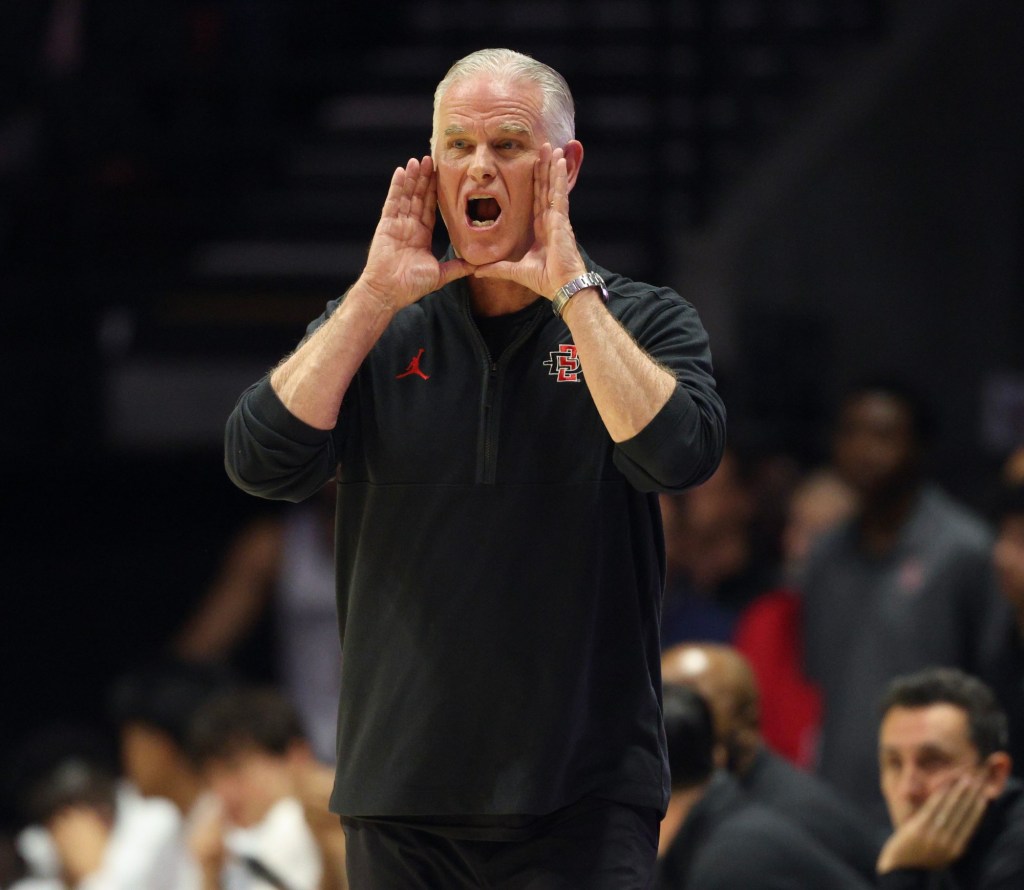
Brian Dutcher and his coaching staff have spent the past few weeks figuring out who’ll play on the team next season.
They’ve also been figuring out who they’ll play against.
The move from the Mountain West to the Pac-12 Conference brings an expanded nonconference schedule, dropping from 20 league games to 16 with only nine basketball-playing members. That, and the NCAA’s decision to increase the regular season to a maximum of 32 games, means 16 available in the nonconference.
Last season, they played 10 nonconference games. In 2024-25, nine.
The next question is how to fill them: with a steady dose of high-profile opponents to build an NCAA Tournament resume and sharpen the roster ahead of conference play, or a stream of cupcakes to collect wins and pump up their metrics?
There are new arguments for the latter approach, particularly after Miami (Ohio) received an at-large berth with statistically the third-easiest nonconference schedule in Division I. But Dutcher has made clear, both through talk and action, that he’ll forge ahead with his traditional approach, at least for next season.
In other words, they won’t duck anybody.
“I still believe in scheduling as many really good teams as we can,” Dutcher said recently. “A lot of teams are playing Quad 4 games and trying to win by 30 and 40 points. Everybody knows how to game the metrics. I’m trying to play a competitive schedule.”
That became evident with news that SDSU is finalizing a neutral-court game against the Big 12’s BYU on Dec. 19 at Acrisure Arena in the Palm Springs area, part of the same event with Gonzaga against Michigan State that same day.
There is also talk of another single-game event in Southern California involving the Aztecs against a high-profile opponent in the season’s opening week. An announcement is expected soon.
Add to that three (and possibly four) games in the loaded Players Era Festival in Las Vegas over Thanksgiving week, the start of a home-and-home series against Mountain West left-behind UNLV, plus plans to find a couple more marquee games at road or neutral venues.
In all, the Aztecs likely will have 15 nonconference dates, leaving room for a fourth at the Players Era Festival (the current plans are for the top four teams to play an extra “championship round” game). Of those, about half will be against power conference programs or top mid-majors.
The nonconference schedule so far:
Nov. 3 or 4: Cal State Fullerton at Viejas Arena
Nov. 23-27: Players Era Festival, Las Vegas
Dec. 5: UNLV at Viejas Arena
Dec. 11: Montana State at Viejas Arena
Dec. 19: BYU in Palm Springs
“Our other choice is to load up Quad 4 home games and buy ourselves some 20- and 30-point wins and see if that changes the metrics,” Dutcher said. “It’s a fine line deciding what way to go. I’m always on the side of scheduling stronger, but I’m not afraid to go in a meeting with my staff and say, ‘We’re changing our philosophy because these other teams are getting in (the NCAA Tournament) and doing it the other way.’”
That includes all four mid-major teams that got at-large berths last season: Santa Clara and Saint Mary’s from the WCC, St. Louis from the Atlantic 10 and Miami from the MAC.
They followed a similar formula of largely avoiding power conference teams – especially traditional juggernauts — and instead filling November and December with good mid-majors mixed with metric-juicing blowouts against low-majors.
Their nonconference strength of schedules ranked, in order, 106th, 123rd, 317th and 363rd in Division I. SDSU ranked 44th.
Utah State, with a nonconference SOS of 185th, didn’t need an at-large invitation after winning the Mountain West tournament, but it positioned itself for one despite facing no power conference opponents. The Aztecs played four.
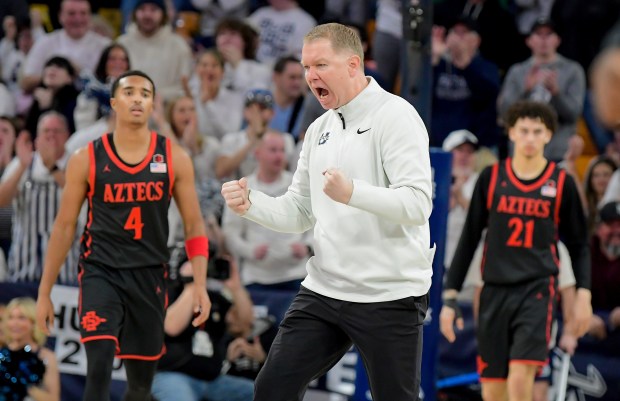 Utah State head coach Jerrod Calhoun celebrates in the home win against SDSU on Jan. 31.
“Everybody thinks you have to go out and play (a bunch) of Power Four games,” coach Jerrod Calhoun, who was hired by Cincinnati last month, told the Union-Tribune during the season. “The chances of you winning those games are probably not really that high. Really, what are you accomplishing other than saying, hey, we played a Quad 1 game? You lost the game.
“You have to be really intelligent. We’re very analytically driven. We study the numbers and figured out, OK, who are the best mid-major teams in the country on paper that you may be able to play. I think we’ve done a masterful job two years in a row with our non-league schedule to put us in a position to build a resume.”
Saint Mary’s didn’t have a Quad 1 win — the most competitive level of opponents — until the regular-season finale against Gonzaga, and still finished at 24 in the NCAA’s NET metric. Utah State was 25. St. Louis was 29 despite playing only one power conference team (and that was Stanford, which finished ninth in the ACC). Santa Clara was 42.
Miami opened the season with eight straight games against Quad 4 or non-Division I foes and went 31-0 — all but three were Quad 3 or below — before losing in the first round of the MAC Tournament. The Redhawks got in as well.
SDSU, meanwhile, played Michigan, Oregon and Baylor at the Players Era Festival plus Arizona in a neutral-court game in Phoenix. Michigan and Arizona both reached the Final Four. Baylor made it three opponents in NET top 50.
Problem was, the Aztecs lost all three by a combined 73 points.
Conventional wisdom has been that it’s a can’t-lose proposition. If you snatch a win or two, as the Aztecs did the previous season against Creighton and Houston, your chances of an at-large berth increase exponentially. If you lose, no harm, no foul.
The flip side is that the talent gap between power conferences and mid-majors has never been greater with the widening disparity of financial resources, and you run the risk of getting blown out — which can have an adverse effect.
Bart Torvik’s college basketball metric has a feature allowing games to be dropped and recalibrates your numbers. Drop the Michigan and Arizona games last season, replace them with home wins against teams in the NET 200s, and the computer moves the Aztecs from one of the first teams out of the NCAA field to the last team in.
Of course, beating Baylor would have had the same statistical outcome.
“I’m going to try to schedule aggressively again,” Dutcher said. “But all these teams that are scheduling Quad 4 games and just trying to beat people by 35 points, if they’ve cracked the system, then I think metrically the NCAA or the Selection Committee has got to look at that and say — they always used to say this — we want teams that challenge themselves with their (nonconference) schedules.
“We have to find a way, whether it’s continue to schedule hard or for me to say a year from now, ‘If they continue to let these teams in that play Quad 4 games, then I might have to play more Quad 4 games and try to run the score up on people.’ That’s the nature of it. I have to find a way to get us in the NCAA Tournament.”