
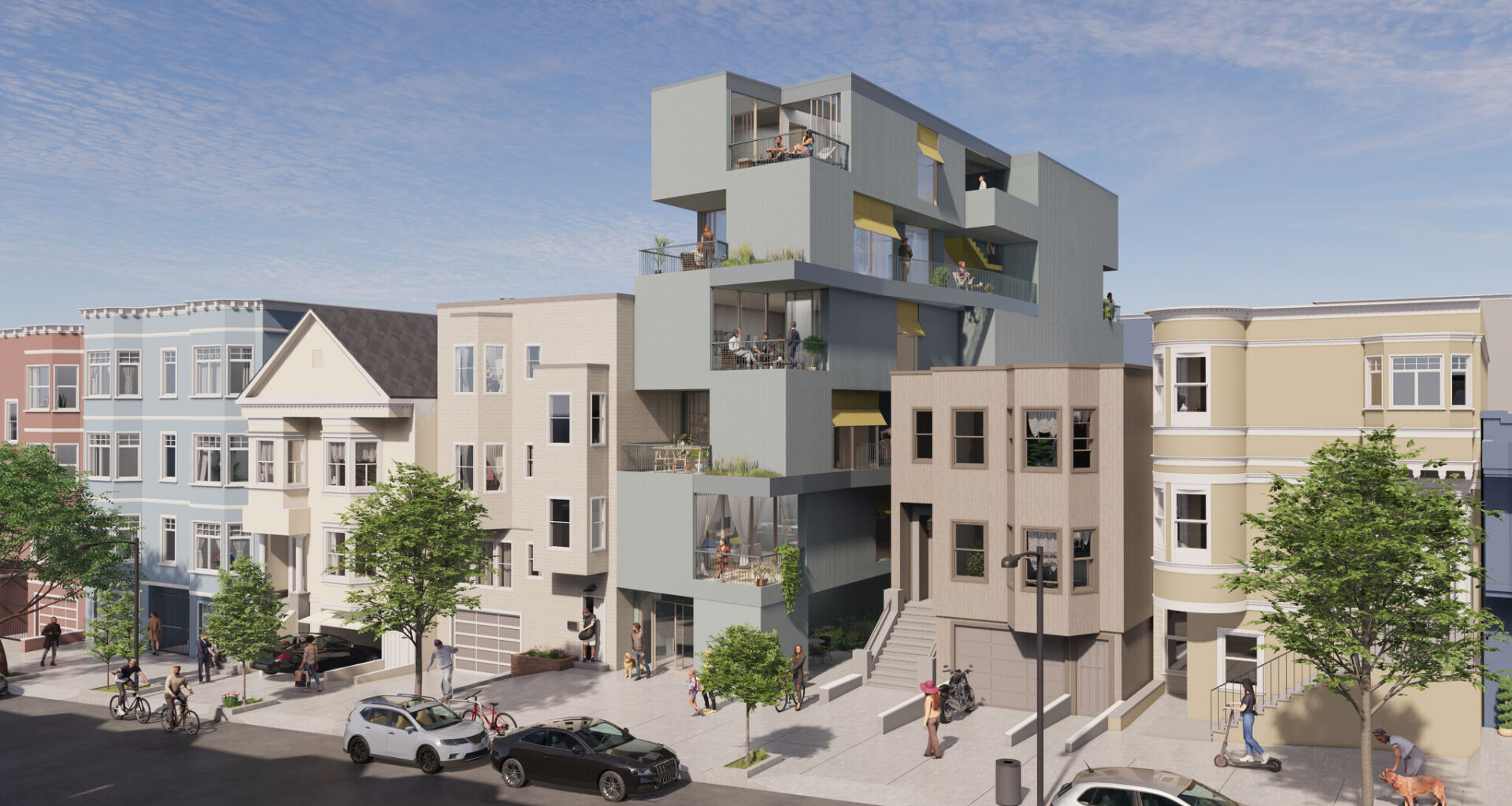
Sidell Pakravan Architects’ light-filled proposal for a six-story single-stair building in San Francisco won second place in the National Single Stair Architectural Design Competition.
Rendering by Sidell Pakravan Architects
It used to be quite common to build lovely mid-rise, medium-sized apartment buildings throughout San Francisco.
The San Francisco Planning Department’s 2024 Housing Inventory Report showed that of the 1,735 homes added that year, only 163 were in medium-sized buildings (5 to 19 units).
Article continues below this ad
That’s a shame for a variety of reasons.
I recently wrote about what San Francisco could learn from Parisian-style density in the form of six-story buildings. Paris’ Haussmann buildings make uniformity elegant. Great attention is paid to materials and design details and bringing in an abundance of light and air. At ground level, the buildings activate the street with cafes, restaurants and shops. It’s what many refer to as gentle density, bridging the gap between high-rises and single-family homes.
San Francisco Chronicle Logo
Make us a Preferred Source to get more of our news when you search.
Add Preferred Source
So, why aren’t we building more of those here?
Typically, modern apartment buildings require two exit stairwells, connected by a hallway. These rules were implemented for fire safety. But they make it particularly difficult to fit multifamily developments on San Francisco’s small neighborhood lots. That second set of stairs takes up way more space and costs way more money than you might think and dictates to a large degree what a building ends up looking like — typically not for the better. Long double-loaded corridors result in smaller units with fewer windows and less light. More money and attention need to be paid to the exits and the hallways. The look of the facade and the building interior suffers.
Article continues below this ad
Eliminating the two-stairwell requirement allows for design flexibility — from the ability to fit a greater diversity of unit types (a four-bedroom unit on one floor, for example, with two studios and two one bedrooms on another) to including more windows and open space, which brings in more natural light and ventilation. Losing a staircase also helps reduce construction costs by an estimated 6% to 13%.
Despite advances in fire mitigation technology, the U.S. is among only a handful of nations where cities still widely mandate two stairwells in new multifamily construction. California requires two stairway exit routes in all multiunit apartments above three stories.
Architects, planners and housing advocates have become increasingly interested in legalizing so-called “single stair” developments.
The recent National Single Stair Architectural Design Competition showed us what could be possible if this reform were to be implemented in San Francisco.
The competition’s design criteria were straightforward. Buildings could have a maximum height of only 75 feet and a maximum of six stories and no more than four units per floor. No parking was required.
Article continues below this ad
Entries were judged in three regions across the country. The Bay Area winners were particularly compelling.
David Baker Architects’ Steplight project won first place in the National Single Stair Architectural Design Competition.
Rendering by David Baker Architects
In first place was Steplight by David Baker Architects, a firm that has done the lion’s share of well-designed affordable housing in the Bay Area. Inspired by San Francisco’s pre-war apartments, the light-filled six-story building shows what kind of architecture single-stair rules can unlock on a narrow lot in a dense urban neighborhood.
Steplight has 10 units, but it feels of a piece with its low-slung neighbors. Its tiered massing, cascading open space and large light wells provide spaciousness and outdoor connection. The openness keeps the building from taking light from its neighbors — perhaps the most common salvo thrown in opposition to multistory apartments. There’s a mix of units from studios to four-bedrooms on five levels with a modest ground-floor cafe and accompanying parklet to activate the street.
The project, its architects explain in their statement, “realizes the potential of San Francisco’s recent upzoning throughout its western and northern neighborhoods.” They credit single stair reform as “an opportunity to leverage modern building technology while reinvesting in the tried and true qualities of old, midrise, dense apartment living.”
Article continues below this ad
Siddell Pakrvan’s design allows for lots of open space and natural light, something allowable only by eliminating the second stair.
Rendering by Sidell Pakravan Architects
Meanwhile, Siddell Pakravan Architects’ second-place entry, called appropriately enough, Let Me Live in Your City, uses elemental architectural strategies — light, air and street connection — to create an open and architecturally dynamic nine-unit, six-story building on a narrow lot on a mixed-use street near the city’s Mission District. There are one-bedroom and three-bedroom units that appeal to different family sizes. Every unit has access to natural light, ventilation and a direct relationship with the street and with the city.
“Single-stair,” architect Rudabeh Pakravan explained to me, “fosters a strong sense of community. Rather than sharing a hallway with 60 other units, you’re sharing a stair with just a few neighbors you can see and interact with more personally.”
Pakravan and Siddell see single stair as a timely and radical way to completely rethink housing in the U.S.
“We’re optimistic, but there’s not the platform in the real world to do it yet,” Pakravan said.
Article continues below this ad
That could change. And soon.
Assembly Bill 2252 from Assembly Member Alex Lee, D-San Jose, co-authored by Assembly Member Buffy Wicks, D-Oakland, and state Sen. Scott Wiener, D-San Francisco, could soon pave the way for single-stair reform in California. On Wednesday, the Assembly Housing and Community Development Committee is holding a hearing on the bill, which directs the Department of Housing and Community Development to propose building standards for single-stairway multiunit residential apartments of up to six stories.
The Cal Fire Office of the State Fire Marshall is not a fan of single-stair reform, citing potential fire danger. But its report, issued earlier this year, acknowledged the spiraling costs associated with current regulations.
There’s a separate column to be written about the many ways fire safety impacts architectural design. But for our purposes here, I will simply opine that global best practices show a second stair requirement for six-story buildings persists out of an abundance of caution rather than necessity.
What excites so many architects and advocates — and me — is that single-stair enables more efficient and attractive buildings on small lots. As Bryan Alcorn of David Baker Architects told me, “It opens up a path where we could build at a modest scale, adding housing and density more incrementally.”
Guest opinions in Open Forum and Insight are produced by writers with expertise, personal experience or original insights on a subject of interest to our readers. Their views do not necessarily reflect the opinion of The Chronicle editorial board, which is committed to providing a diversity of ideas to our readership.
Read more about our transparency and ethics policies
Instead of fighting over giant towers or massive transit-oriented development projects (though I believe we need those, too), we can expand opportunities for housing in high-demand neighborhoods without changing those neighborhoods too dramatically.
The American Dream should be achievable without a single-family home. But we’ve got to find ways to provide a compelling multifamily alternative. Single stair could help get us there.
Allison Arieff is a columnist and editorial writer for the Opinion section.